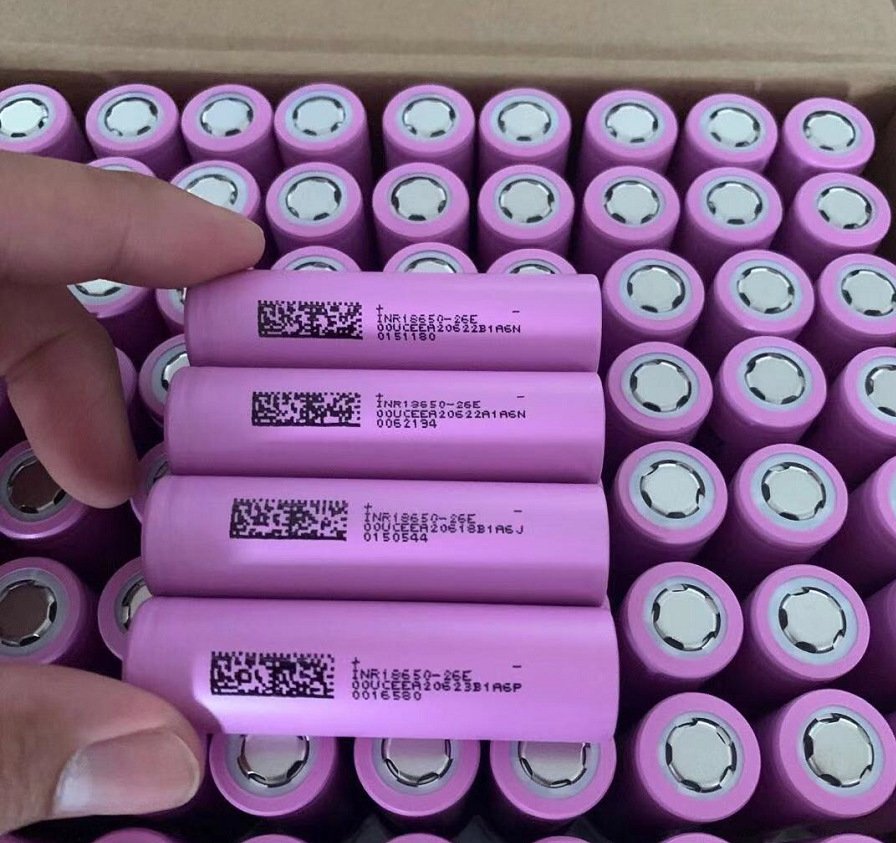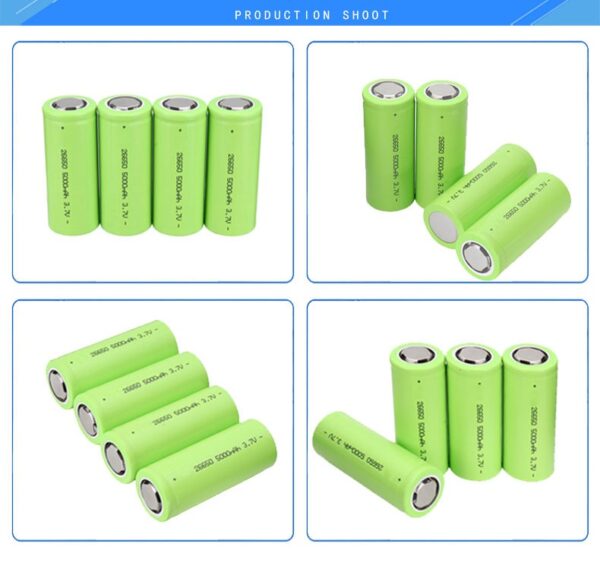
Complete Short Lead Time Solution for Power Tools Using High-Quality 18650 LFP Cells Ideal for Manufacturers
In the highly competitive global market for power tools, manufacturers are constantly seeking a balance between performance, safety, and supply chain resilience. While cylindrical cells have long been the standard, the recent shift towards Lithium Iron Phosphate (LFP) chemistry within the 18650 format presents a unique opportunity. For engineers and procurement managers in North America and Europe, finding a “Complete Short Lead Time Solution” is no longer a luxury—it is a necessity to stay ahead of production schedules and meet strict regional safety mandates.
This article serves as a technical deep dive into why high-quality 18650 LFP cells are becoming the preferred choice for professional power tool design, focusing on the critical intersection of rapid delivery cycles and robust technical specifications.
Why 18650 LFP is the Optimal Choice for Modern Power Tools
The transition from traditional NMC (Nickel Manganese Cobalt) chemistry to LFP (Lithium Iron Phosphate) in power tools is driven by fundamental material science. While NMC offers higher energy density, LFP excels in thermal stability and cycle life—two factors that are non-negotiable for heavy-duty tools.
For manufacturers, the primary advantage lies in the safety profile. LFP cells have a much higher thermal runaway threshold compared to cobalt-based chemistries. This means that during the high-current discharge cycles typical of impact drivers or saws, the risk of thermal events is significantly reduced. Furthermore, the 18650 format provides mechanical robustness that pouch cells often lack, making it ideal for the rugged environments power tools operate in.
From a supply chain perspective, iron and phosphate are far more abundant and geopolitically stable than nickel and cobalt. This abundance translates directly into price stability, a critical factor for manufacturers looking to lock in costs for long-term production runs.
Decoding the “Short Lead Time” Advantage
In 2026, the global logistics landscape remains volatile. Standard lead times for battery cells from Asia can often stretch beyond 16-20 weeks, creating bottlenecks in manufacturing pipelines. A “Short Lead Time Solution” specifically addresses this pain point.
At CNS Battery, our strategy revolves around maintaining strategic buffer stocks of our most popular 18650 LFP formulations specifically for the power tool sector. Unlike custom cell manufacturers who operate on a strictly build-to-order model, we keep key raw materials and semi-finished goods in a state of readiness.
This operational efficiency allows us to compress the delivery window significantly. For urgent OEM projects, this can mean the difference between hitting a crucial Q4 retail window or missing it entirely. It is not just about speed; it is about predictability. Our clients in the power tool industry rely on us because we offer a “Complete Solution”—from the cell specification to the final pack integration support—delivered on a timeline that aligns with agile manufacturing practices.
Technical Deep Dive: Key Parameters for Power Tool Design
When evaluating 18650 LFP cells for your next power tool design, there are specific electrical characteristics that must be scrutinized to ensure the tool meets performance benchmarks.
1. High Discharge Rate Capability
Power tools are not flashlights; they require bursts of high current. A standard 18650 LFP cell might be rated for 1C continuous discharge, but a tool-grade cell must handle 10C, 15C, or even 20C. At CNS, our tool-specific cells are engineered with low internal resistance (DCIR). For instance, our high-power variants maintain a DCIR of less than 25mΩ, ensuring minimal voltage sag under load. This translates to consistent torque output even as the battery depletes.
2. Cycle Life and Durability
Professional-grade tools are expected to last. Therefore, the battery cells must match this durability. While consumer LFP cells might achieve 2000 cycles, our industrial-grade 18650 LFP cells are cycled to 3000+ cycles at 1C rate while retaining over 80% of their initial capacity. This longevity is achieved through a proprietary electrolyte additive package that stabilizes the SEI (Solid Electrolyte Interphase) layer on the anode.
3. Thermal Management
Heat is the enemy of both performance and safety. During the design phase, engineers must consider the thermal coefficient of the cell. LFP chemistry naturally operates at lower temperatures, but the cylindrical format aids in heat dissipation. In our testing protocols, we subject cells to -20°C to 60°C environments to simulate global usage conditions. A robust 18650 LFP cell should demonstrate less than a 5% efficiency drop in sub-zero temperatures compared to room temperature.
Testing Methodologies: Ensuring Reliability Before Deployment
As a technical expert, I cannot stress enough the importance of rigorous testing. Relying solely on the manufacturer’s datasheet is a risk. Here are the three critical tests every batch of 18650 LFP cells should undergo before being integrated into a power tool pack:
- The Nail Penetration Test: This is the gold standard for safety. A steel nail is driven through the cell to simulate an internal short circuit. A high-quality LFP cell will not catch fire or explode; at worst, it may vent smoke. This test is mandatory for UL certification in the United States.
- Crush Test: Simulating accidental drops or impacts, the cell is compressed from two sides with a force of 13kN. The cell must not ignite or rupture.
- Overcharge and Short Circuit Test: Cells are charged to 1.5 times their nominal voltage or subjected to a direct external short circuit. The cell should remain within a safe temperature envelope (typically below 150°C) and not vent violently.
Geographical Compliance and Market Adaptation
For manufacturers targeting specific regions, understanding local compliance standards is not optional—it is the law. This is where partnering with a technically savvy manufacturer like CNS Battery becomes a strategic advantage.
- European Union (EU) Market: The EU has some of the strictest environmental regulations in the world. The upcoming Battery Passport requirements under the EU Battery Regulation mandate detailed tracking of carbon footprint and raw material sourcing. Our 18650 LFP cells are designed with full material disclosure (SDS) and are compliant with REACH and RoHS directives. Furthermore, the iron-phosphate chemistry inherently avoids the “conflict minerals” scrutiny often associated with cobalt.
- North American (US/Canada) Market: Safety certification is king here. Our cells are engineered to pass UL 1642 (Standard for Safety Lithium Batteries) and UL 2054 (Standard for Safety Household and Commercial Batteries). For power tool manufacturers, having cells with pre-approved UL listings can shave months off the product certification timeline with bodies like CSA or ETL.
Conclusion: The Complete Solution for Manufacturers
For power tool manufacturers, the decision to adopt 18650 LFP technology is a strategic move toward safety, longevity, and supply chain security. However, the “Complete Short Lead Time Solution” offered by specialized manufacturers bridges the gap between technical requirements and production reality.
By choosing a partner that understands the nuances of high-rate discharge applications and maintains the inventory agility to ship rapidly, OEMs can de-risk their production schedules. We invite engineers and procurement managers to explore our full range of cylindrical battery solutions.
To consult with our technical team on a specific power tool application or to request a sample for testing, please visit our Cylindrical Battery Cell product page or contact us directly to discuss how we can support your next high-performance tool design.