
Here is the professional article tailored for your requirements, designed to address the specific needs of overseas B2B engineers and technical procurement professionals.
How to Choose the Right Li-SOCl₂ Battery for Your IoT Sensor
In the rapidly expanding Internet of Things (IoT) landscape, the choice of power source is not merely a utility but a critical design constraint. For engineers and procurement specialists working on remote or maintenance-free sensors, Lithium Thionyl Chloride (Li-SOCl₂) batteries represent the gold standard. Unlike consumer-grade alkaline cells, these primary lithium batteries are engineered for extreme longevity and stability in harsh environments. However, selecting the wrong specification can lead to catastrophic voltage delay issues or premature failure. This guide provides a technical deep-dive into the selection criteria necessary to ensure your IoT deployment operates reliably for a decade or more without intervention.
Understanding the Chemistry: Why Li-SOCl₂?
Before diving into selection, it is crucial to understand the fundamental physics of the chemistry. Li-SOCl₂ batteries utilize Lithium metal as the anode and Thionyl Chloride as both the cathode and electrolyte. This configuration offers the highest specific energy (energy density) of any commercially available battery chemistry.
However, a unique characteristic of this chemistry is passivation. When the battery sits idle, a lithium chloride film forms on the anode surface. While this prevents self-discharge (enabling a shelf life of over 10 years), it also creates a high internal resistance. Consequently, when a load is first applied, the voltage drops significantly before recovering. This phenomenon, known as the “voltage delay,” is the primary factor differentiating standard capacity (low-rate) cells from bobbin-type (high-rate) cells.
1. Assessing Pulse Power Requirements
The most common mistake in IoT sensor design is underestimating the pulse power demands of wireless transmission. While your sensor might draw only 10µA in sleep mode, the radio module (LoRa, NB-IoT, or Zigbee) can demand pulses of 1A to 2A.
- The Voltage Delay Challenge: Standard Li-SOCl₂ cells have high internal impedance due to the passivation layer. If your sensor requires a 1.5A pulse, a standard cell will collapse below the minimum operating voltage (typically 2.0V for most microcontrollers).
- The Solution: You must select a Bobbin-Type Li-SOCl₂ cell. These cells are constructed with a different electrode structure that reduces internal impedance, allowing for higher pulse currents.
- Hybrid Approach: For extremely high pulses, a hybrid solution combining a primary Li-SOCl₂ cell with a supercapacitor is often necessary. The supercapacitor handles the instantaneous high-current pulse, while the battery slowly recharges the capacitor during idle periods.
2. Evaluating Temperature Extremes
IoT sensors are deployed everywhere—from underground utility meters to Arctic monitoring stations. Standard lithium batteries often fail below -20°C. Li-SOCl₂ chemistry, however, remains functional at temperatures as low as -55°C.
When choosing a battery for extreme cold:
- Internal Resistance: Resistance increases exponentially as temperature drops. You must derate the battery’s capacity and pulse capability based on the manufacturer’s temperature curves.
- Heating Mechanisms: For applications below -40°C, consider batteries with built-in thermal management or select a cell specifically designed for low-temperature electrolytes. Ensure the battery’s operating range matches the geographic deployment location, not just the datasheet specifications.
3. Calculating Lifespan vs. Size
IoT design is a constant battle between battery size and operational lifetime. Li-SOCl₂ batteries offer capacities ranging from 1.9Ah to over 19Ah in standard cylindrical formats (C, D, and F sizes).
To calculate the required capacity:
- Duty Cycle: Calculate the average current draw:
(Sleep Current × Sleep Time) + (Active Current × Active Time) / Total Cycle Time. - Voltage Cutoff: Determine the minimum voltage your circuit requires. Li-SOCl₂ cells start at 3.67V but discharge down to 3.0V or lower. Most IoT circuits require at least 2.0V–2.2V.
- Passivation Build-up: Over a 10-year life, the internal resistance increases. You must add a safety margin (typically 20–30%) to your capacity calculations to account for this voltage drop at end-of-life.
4. Physical Form Factor and Safety
The physical integration of the battery is as important as the electrical specs. Li-SOCl₂ batteries are primary (non-rechargeable) cells. Attempting to recharge them will result in explosion.
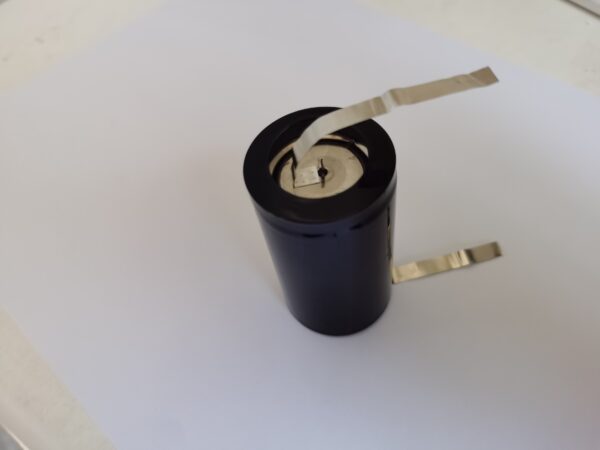
- Welding vs. Soldering: Never solder directly to a Li-SOCl₂ cell. Always specify batteries with spot-welded tabs to ensure a safe mechanical connection to your PCB.
- Pressure Vents: Ensure the battery housing has a pressure relief vent. If the sensor is potted or enclosed, thermal runaway (though rare) must have an escape path.
- Custom Shapes: For space-constrained IoT devices, standard cylindrical cells may not fit. In such cases, custom prismatic or pouch configurations may be required to maximize energy density within the enclosure.
5. Regulatory Compliance and Sourcing
For global deployment, your battery must pass stringent transportation and safety regulations.
- UN38.3: This is mandatory for the transport of lithium batteries by air, sea, or road. Ensure your supplier provides the latest test summary report.
- RoHS/REACH: Compliance is non-negotiable for entry into European and North American markets.
- Supply Chain Stability: IoT deployments often require components for 10–15 years. Choose a manufacturer with a proven track record and in-house cell production to avoid obsolescence issues.
Partnering with the Right Manufacturer
Selecting the right Li-SOCl₂ battery is not a one-size-fits-all process. It requires analyzing the specific pulse profiles, environmental conditions, and physical constraints of your IoT application. Standard off-the-shelf batteries may not suffice for high-pulse or extreme-temperature applications, necessitating a customized solution.
If you are facing challenges with voltage delay in your current design or need to optimize for a 15-year lifespan, CNS Battery offers a comprehensive range of primary lithium solutions engineered for industrial IoT reliability.
For technical inquiries regarding your specific sensor requirements, contact our engineering team directly at amy@cnsbattery.com or via WhatsApp at +86 166 6811 2039.
Ready to find the optimal power solution for your IoT project?
Explore our full range of industrial battery products designed for longevity and extreme environments: Primary Battery Product Range.
Need immediate technical support?
Contact our sales engineers for a customized solution: Contact Us.
