
Here is the SEO-optimized article tailored for a B2B audience, written from the perspective of a professional primary lithium battery engineer.
How to Fix Li-SOCl₂ Battery Passivation in Water Treatment Flow Meters
In the realm of Automatic Meter Reading (AMR) and smart utility management, the reliability of water treatment flow meters is non-negotiable. As a primary lithium battery engineer, I have spent years analyzing field data and dissecting failed units. One of the most persistent and misunderstood issues plaguing these systems is battery passivation.
Specifically, in Lithium Thionyl Chloride (Li-SOCl₂) cells—the gold standard for long-life applications—the formation of a passivation layer (LiCl) on the lithium anode is a double-edged sword. While it drastically reduces self-discharge, allowing these batteries to last 10-20 years in storage, it becomes a critical liability during high-current pulses required for data transmission.
This article delves into the technical nuances of fixing passivation issues and ensuring your flow meters operate flawlessly in the harsh environments of water treatment.
Understanding the Passivation Mechanism
To fix the problem, we must first understand the enemy. Passivation occurs when the lithium anode reacts with the thionyl chloride electrolyte, forming a lithium chloride (LiCl) film.
The Technical Dilemma:
In a dormant state (which constitutes 99% of a flow meter’s life), this film is beneficial. However, when the meter initiates a “wake-up” cycle to transmit data via LoRaWAN, NB-IoT, or other RF modules, the circuit demands a sudden surge of current (often 1A-3A).
The passivation layer acts as an insulator. If the battery cannot “depolarize” quickly enough—that is, if the internal resistance caused by the LiCl layer does not break down rapidly—the voltage sags. This voltage delay often drops the output below the minimum operating voltage (Vmin) of the transmitter circuit, resulting in a communication failure.
Solution 1: Pulse Design Optimization
The first line of defense is not changing the hardware but optimizing the software and electronic architecture.
- Staggered Wake-Up: Instead of commanding the RF module to transmit at full power immediately, implement a “soft start” protocol. Allow a micro-second delay or a lower-power handshake before the full transmission burst. This gives the chemical reaction within the Li-SOCl₂ cell time to heat up and dissolve the passivation layer.
- Pulse Width Modulation (PWM): Redesign the load profile. Short, sharp pulses are more likely to cause voltage delay than slightly elongated, lower-current pulses. By tweaking the firmware to draw current more gradually, you reduce the stress on the battery.
Solution 2: Selecting the Right Cell Architecture
Not all Li-SOCl₂ cells are created equal. If firmware fixes are insufficient, the issue often lies in the physical construction of the battery.
When sourcing batteries for water treatment applications, you must look beyond the chemistry and examine the electrode design.
- Bobbin vs. Flat Cell Design: Standard bobbin-type Li-SOCl₂ cells have a higher internal resistance and are more prone to severe voltage delay after long storage. For critical flow meters, “Pulse” or “Hybrid” C Cell” variants are engineered with specialized cathodes and electrolyte additives.
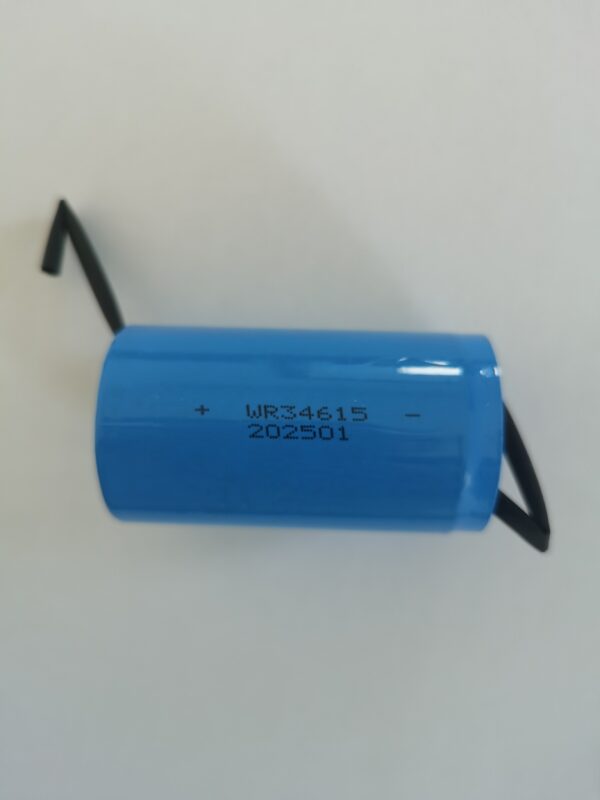
- High Rate vs. Low Rate: Ensure you are not using an “Energy” type cell (designed for low continuous drain) for an “Application” that requires high pulses. The C Size Primary Battery is often the sweet spot for flow meters, balancing capacity with pulse capability.
Expert Tip: Always request the Pulse Voltage Curve from your battery supplier, not just the nominal voltage. Test the cell under a 1.5A – 2A pulse load to simulate the RF transmission scenario.
Solution 3: The Role of Hybrid Layer Capacitors (HLC)
In the most challenging environments—such as deep underground water wells or high-interference zones—relying solely on the battery is risky. The best engineering practice is to pair the Li-SOCl₂ cell with a Hybrid Layer Capacitor (HLC) or a Pulse Assist Module.
How it Works:
The HLC acts as a reservoir. During the brief moment when the battery voltage sags due to passivation breakdown, the HLC discharges instantly to cover the RF module’s peak current requirement. Once the passivation layer is cleared and the battery voltage recovers, it recharges the capacitor.
This hybrid solution effectively decouples the sensitive electronics from the chemical limitations of the primary cell.
Solution 4: Environmental & Manufacturing Preconditioning
Sometimes, the “fix” happens before the meter is even installed.
- Pre-Delivery Cycling: If your flow meters sit in a warehouse for months, the passivation layer will be thick. Some manufacturers perform a “pre-conditioning” cycle before shipment, applying a small dummy load to thin the initial passivation layer.
- Temperature Compensation: Lithium Thionyl Chloride batteries are notoriously temperature sensitive. At low temperatures (below -20°C), the passivation effect is exacerbated. If your application is in a cold climate, ensure the battery compartment is insulated, or consider a Tadiran-style TLM (Temperature Limited Module) design.
Partnering with the Right Manufacturer
Fixing passivation issues is not a one-size-fits-all solution. It requires a deep understanding of electrochemistry and the specific load profiles of your telemetry system.
At CNS Battery, we specialize in custom primary lithium solutions for the utility sector. We don’t just sell cells; we analyze your load profile and provide technical data sheets specific to your pulse requirements.
If you are experiencing unexplained communication dropouts in your water treatment network, it might be time to re-evaluate your power source.
Ready to optimize your flow meter’s power solution? Contact our engineering team for a technical consultation or explore our range of high-pulse primary batteries.
