BMW i3 Battery Range: Load Impact – How Much Weight Is Killing Your Miles?
You are planning a weekend getaway in your BMW i3. You’ve packed the trunk with camping gear, loaded up the back seat with friends, and strapped a bike rack to the rear. You glance at the dashboard: “100% Charged, 80 Miles Range.” You feel confident.
But thirty miles into the trip, climbing a gentle hill with the car fully loaded, the range estimator plummets. Suddenly, you’re looking at 15 miles remaining. Panic sets in. Did my battery fail? Is the charger broken? How did I lose 65 miles of range so fast?
The culprit isn’t a dead cell or a software glitch. It’s physics. Specifically, the impact of load (passengers and cargo) on your BMW i3’s energy consumption.
The i3 is a marvel of lightweight engineering, but that also means every extra pound has a magnified effect on its efficiency. When you add 800 lbs of people and gear, you aren’t just making the car heavier; you are fundamentally changing how your battery delivers power, especially on inclines and during acceleration.
Exactly how many miles does a full load cost you?
Why does weight hurt EVs more than gas cars on hills?
And if your range is already tight, is there a solution that gives you a massive buffer against weight penalties?
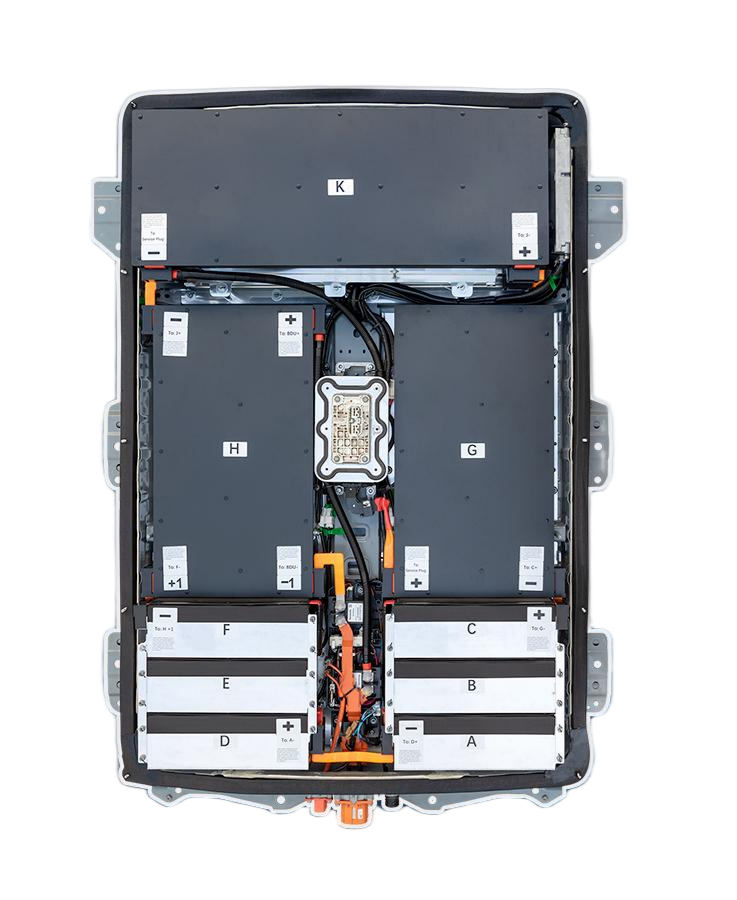
At CNS BATTERY, we understand the delicate balance between weight, energy, and range. We know that for owners of older 60 Ah or degraded 94 Ah models, a heavy load can turn a manageable trip into a towing nightmare. This guide breaks down the real math of load impact, offers tips to maximize efficiency when hauling, and reveals why upgrading to a high-capacity battery is the only way to make weight irrelevant.
The Physics of Weight: Why Every Pound Counts
In an internal combustion engine car, adding weight increases fuel consumption, but the engine can simply burn more gas without much change in driving dynamics. In an EV like the BMW i3, weight impacts two critical areas: Acceleration and Gravity.
1. The Acceleration Tax
According to Newton’s Second Law ($F=ma$), moving a heavier mass requires more force (energy). Every time you stop at a light and accelerate back to speed, your motor must draw significantly more current from the battery to move the extra weight.
- The Impact: In stop-and-go city traffic, a fully loaded i3 can see energy consumption rise by 15-20% compared to a solo driver.
2. The Gravity Penalty (The Hill Killer)
This is where the pain is most acute. When climbing a hill, your motor fights gravity. The energy required to lift a mass is directly proportional to that mass.
- The Math: Adding 800 lbs (4 passengers + gear) to a 3,000 lb i3 increases the total weight by ~27%. On a steep grade, this can increase energy consumption by 30% or more.
- The Result: That 80-mile range estimate? With a full load on hilly terrain, it can realistically drop to 50-55 miles.
3. Regenerative Braking Limits
While regen recovers some energy when going downhill, it’s not 100% efficient. You might recover 60-70% of the energy used to climb, but the net loss due to the extra weight is permanent. Plus, if the battery is full or cold, regen is limited, forcing you to use mechanical brakes and wasting all that potential energy.
The Real-World Math: How Many Miles Does Load Cost?
Let’s look at realistic scenarios for a BMW i3 (94 Ah model) with a healthy battery (~80 miles real-world range):
| Scenario | Estimated Load | Range Impact | Real-World Range |
|---|---|---|---|
| Solo Driver | ~150 lbs | Baseline | ~80 Miles |
| Driver + 1 Passenger | ~300 lbs | -5% | ~76 Miles |
| Family of 4 | ~600 lbs | -12% | ~70 Miles |
| Full Car + Cargo | ~900 lbs | -20% to -25% | ~60-64 Miles |
| Full Car + Hills | ~900 lbs + Grade | -30% to -35% | ~52-56 Miles |
The Danger Zone: If you are driving an older 60 Ah model (original range ~50 miles) or a degraded 94 Ah pack, a full load on hills can slash your range to 30-35 miles. This turns a simple day trip into a high-stakes gamble where one wrong turn leads to a tow truck.
Tips to Maximize Range When Loaded
If you must travel with a full car, use these strategies to minimize the penalty:
- Smooth Acceleration is Key: Aggressive throttling with a heavy load spikes energy draw. Pretend there is an egg between your foot and the pedal. Slow, steady acceleration saves massive amounts of energy.
- Moderate Highway Speeds: Aerodynamic drag increases with speed, and weight exacerbates the energy needed to maintain that speed. Dropping from 70 mph to 60 mph can regain 10-15% of your range, offsetting the weight penalty.
- Pre-Condition While Plugged In: Use the AC or heater while still connected to the charger. This ensures you aren’t draining the battery to comfort the extra passengers before you even start moving.
- Plan Charging Stops Conservatively: Don’t aim for 10% remaining. With a heavy load, plan to charge when you hit 40%. The extra weight makes the “Guess-O-Meter” less reliable near the bottom of the tank.
The Hard Truth: Efficiency Tricks Have Limits
You can drive smoothly, reduce speed, and pre-condition all you want. But you cannot cheat physics. If your battery capacity is small (e.g., 60 Ah) or degraded, a heavy load will always consume a disproportionate percentage of your total energy.
No amount of hyper-miling will turn a 35-mile range into 80 miles. When your buffer is this thin, every passenger feels like an anchor. The only way to truly neutralize the impact of load is to have a battery so large that the weight penalty becomes negligible.
The CNS BATTERY Solution: Make Weight Irrelevant
Why stress about every pound of luggage or hesitate to invite friends along? At CNS BATTERY, we solve the load problem by giving you a battery so capacious that weight barely registers on your range anxiety meter.
Our 120 Ah upgrades transform the i3 from a fragile city commuter into a robust hauler.
Why Upgrading Neutralizes Load Impact
- Massive Capacity Buffer: With 130+ miles of real-world range, a 25% penalty from a full load only costs you ~30 miles. You still have 100+ miles left! Compare that to a stock 60 Ah pack where the same penalty leaves you stranded.
- Consistent Performance: Our modern Grade-A cells deliver power more efficiently under load. The voltage sag under heavy acceleration is minimal, ensuring consistent performance even when fully packed.
- Freedom to Explore: You can take the mountain roads, carry the gear, and bring the family without doing complex math before every trip. The “Load Impact” becomes a footnote, not a crisis.
- Cost Efficiency:
- Dealership OEM Replacement: $18,000–$22,000 USD (restores original, weight-sensitive range).
- CNS BATTERY Upgrade: $8,000 – $12,000 USD. You get double the capacity, making weight penalties manageable, for half the dealer price.
Real Story: From “One-Person Car” to “Family Hauler”
Meet Mark, a 2015 i3 owner. He loved his car for commuting but refused to take it on family trips. “With my wife and two kids, the range dropped to 35 miles,” Mark says. “I was constantly watching the meter, sweating every hill. It was too stressful.”
Mark installed a CNS BATTERY 120 Ah upgrade. “Last weekend, we loaded the car with four people, bikes, and a cooler,” Mark reports. “We drove 90 miles through hilly terrain. I still had 35% battery left when we got home. The weight didn’t matter anymore because I had so much extra capacity. The car finally feels like it can handle real life.”
Stop Letting Weight Dictate Your Life
The BMW i3 battery range load impact is real and significant. For owners of standard or degraded packs, every passenger and pound of cargo eats into your already limited freedom.
Don’t let physics ground your car. Upgrade to a system where you have the power to spare, no matter how full the trunk is.
Tired of calculating range based on who’s in the car?
Stop leaving people behind. Contact CNS BATTERY today for a consultation. Discover how our BMW i3 Series Battery upgrades can give you 130+ miles of range, making passenger and cargo weight a non-issue for your next adventure.
👉 Get Your High-Capacity Upgrade Quote
Frequently Asked Questions (FAQ)
1. How much does a full load of passengers affect BMW i3 range?
A full load (4 passengers + cargo, approx. 800-900 lbs) can reduce real-world range by 20-25% in mixed driving. On hilly terrain, this penalty can increase to 30-35%, drastically cutting usable distance.
2. Why does weight affect EVs more than gas cars?
EVs rely entirely on stored battery energy, which is finite and cannot be “refilled” instantly like a gas tank. Additionally, EVs often use regenerative braking, which recovers only a portion of the energy spent lifting the extra weight up hills, leading to a net loss.
3. Can driving slower offset the weight penalty?
Partially. Driving at moderate speeds (55-60 mph) reduces aerodynamic drag and acceleration demands, which helps. However, it cannot fully negate the energy required to lift heavy mass up inclines. A larger battery capacity is the only complete solution.
4. Does the i3’s lightweight design help with load?
Yes, the carbon-fiber reinforced plastic (CFRP) chassis keeps the base weight low, which helps. However, because the starting battery capacity (especially in 60 Ah models) is also small, the percentage impact of added weight is still very high.
5. Will a CNS BATTERY upgrade help with heavy loads?
Absolutely. By doubling your capacity to 130+ miles, a 25% range loss from weight only consumes ~30 miles of range, leaving you with plenty of buffer. It transforms the car from “weight-sensitive” to “weight-tolerant.”
6. How much does it cost to upgrade for better load capacity?
A dealership OEM replacement costs $18,000–$22,000 USD. A CNS BATTERY 120 Ah upgrade typically ranges from $8,000 to $12,000 USD, providing double the range and the ability to carry full loads without anxiety.
7. Should I avoid highway driving with a full i3?
With a stock or degraded battery, yes, it is risky. With a CNS BATTERY upgrade, highway driving with a full load becomes viable, as the increased capacity absorbs the higher energy consumption of speed and weight.