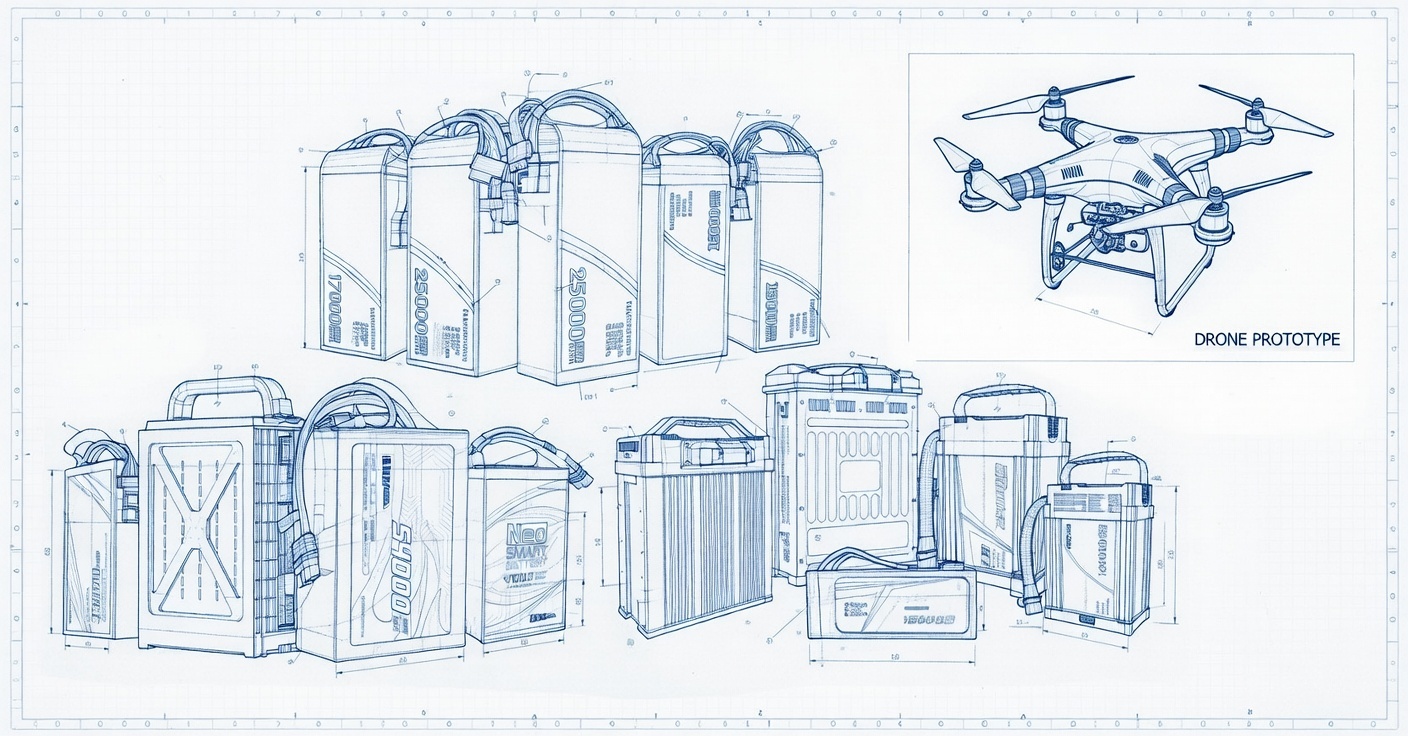
How Solid State Heavy-Lift Drone Battery Transparent Supply Chain Will Solve Certification Delays by 2027
The drone industry is facing a silent bottleneck. You are likely familiar with the scenario: your engineering team has finalized a revolutionary heavy-lift drone design, capable of carrying unprecedented payloads for logistics or construction. The prototype is ready. Yet, you are stuck in a holding pattern, waiting months for the necessary safety certifications to go live. Why? Because the black box of traditional battery supply chains creates compliance nightmares.
By 2027, this bottleneck will be shattered. The convergence of Solid State Heavy-Lift Drone Battery technology and Transparent Supply Chain protocols is not just an upgrade; it is the solution to the certification delays that have plagued B2B drone operations.
Imagine a world where your battery supplier doesn’t just ship cells, but ships verified data. At CNS Battery, we are already architecting this future. We understand that for industries relying on heavy-lift capabilities, time is not just money—it is operational viability. Let’s explore how this technological and logistical shift will streamline your path to market.
The Certification Bottleneck: Why Traditional Batteries Cause Delays
Before we dive into the future, we must diagnose the present pain point. If you are sourcing standard Lithium Polymer (LiPo) batteries for heavy-lift applications, you are likely facing a “trust deficit” with regulatory bodies.
Traditional supply chains are opaque. You often receive a battery pack without granular data on the specific chemical composition, the origin of raw materials, or the exact thermal testing parameters of the individual cells. When you submit your drone for certification (be it FAA, EASA, or local safety standards), you are forced to conduct extensive third-party testing because the manufacturer cannot—or will not—provide auditable data trails.
This lack of transparency results in:
- Extended Testing Cycles: Regulators cannot fast-track approvals without verified data.
- Compliance Rejections: Missing documentation on material sourcing leads to application denials.
- Total Cost of Ownership (TCO) Spikes: Every month of delay costs thousands in development overhead.
By 2027, this reactive model will be obsolete, replaced by a proactive system where the battery itself carries its “birth certificate.”
The Rise of Solid State: Inherent Safety Meets Data Integrity
The shift to Solid State technology is the cornerstone of this revolution. Unlike traditional liquid electrolyte batteries, which are prone to thermal runaway and physical swelling, solid-state batteries offer a fundamentally safer architecture.
The Heavy-Lift Advantage
For heavy-lift drones, energy density is king. Solid-state batteries promise energy densities exceeding 380Wh/kg (as seen in next-gen prototypes), allowing your drones to carry heavier payloads without exponentially increasing the battery weight. However, the true game-changer for certification isn’t just the energy; it is the stability.
Because solid-state batteries do not rely on flammable liquids, they pass the most stringent safety tests (like nail penetration and crush tests) with flying colors. In the eyes of a certification body, a battery with inherent physical safety features requires less rigorous external safety validation, significantly shortening the approval timeline.
Transparency as a Feature: The 2027 Supply Chain Standard
Transparency will no longer be a buzzword; it will be a protocol. By 2027, leading manufacturers like CNS Battery are implementing blockchain-verified or digitally immutable logs for every battery cell.
How the Transparent Supply Chain Works
- Raw Material Traceability: From the mine to the factory, every gram of lithium, nickel, and cobalt is logged. This satisfies environmental and ethical sourcing regulations instantly.
- Real-Time BMS Data: The Battery Management System (BMS) in a transparent supply chain doesn’t just manage charge; it broadcasts health data. Regulators can access anonymized performance data to verify cycle life and thermal stability claims without physical intervention.
- Digital Twin Certification: Each battery pack will have a digital twin registered with the manufacturer. When you apply for drone certification, you simply share the digital twin ID, granting the regulator access to the full lifecycle data of the power source.
This level of openness eliminates the guesswork. Instead of waiting for a lab to test a sample, the certifier reviews the aggregated data history of that specific battery model, slashing approval times from months to weeks.
A Step-by-Step Guide to Future-Proofing Your 2027 Drone Fleet
You do not have to wait until 2027 to start adapting. Here is a practical guide to aligning your procurement strategy with the upcoming standards.
Step 1: Audit Your Current Data Flow
Look at your current battery supplier. Can they provide a full traceability report on the cobalt or lithium in their cells? If not, you are already behind the 2027 curve.
Step 2: Demand “Open BMS” Protocols
Insist on batteries where the BMS data is accessible, not locked down. For heavy-lift operations, being able to monitor cell voltage and temperature in real-time is not just operational efficiency; it is pre-certification compliance.
Step 3: Partner with Innovators, Not Just Suppliers
Seek out manufacturers actively developing semi-solid or solid-state solutions. At CNS Battery, our roadmap includes high-energy-density solutions specifically designed for industrial inspection and logistics, built with transparency in mind.
Case Study: From 6 Months to 6 Weeks
Let’s look at a hypothetical (yet realistic) scenario based on current industry shifts.
The Challenge:
A logistics company in 2025 is trying to certify a new delivery drone with a 10kg payload. They are using standard high-voltage LiPo batteries from a traditional supplier.
- The Result: The certification body requests thermal runaway test data. The drone manufacturer does not have it, so they must commission a third-party lab. This process takes 4 months. The batteries then fail a vibration test due to inadequate internal bracing (a manufacturing secret the supplier wouldn’t disclose). The company must redesign the battery compartment. Total delay: 9 months.
The 2027 Solution:
The same company uses a Solid State Heavy-Lift Drone Battery from a transparent supply chain partner.
- The Result: The company downloads the full compliance dossier and thermal test video from the manufacturer’s portal during the design phase. The BMS data shows zero thermal incidents across 10,000 recorded flight hours. The certification body reviews the digital logs and approves the design based on the manufacturer’s proven track record. Total delay: 3 weeks (mostly paperwork).
The CNS Battery Difference: Powering Your Compliance
At CNS Battery, we are not waiting for 2027 to solve these problems. We are solving them today. Our commitment to B2B excellence means we treat battery manufacturing as a data-driven service, not just a hardware transaction.
We understand that your drone is only as reliable as its power source. That is why we offer:
- Customization with Documentation: When you request a custom voltage or capacity, we provide the testing data alongside the product.
- Global Supply Chain Networks: With headquarters in Shenzhen and operations in Zhengzhou, we ensure that the “transparency” in our supply chain translates to reliability on your balance sheet.
- Innovation in Energy Density: From our high-performance soft-pack series to our cutting-edge semi-solid state research, we are focused on giving you the power to lift more and fly longer.
We invite you to explore our current industrial solutions to see how we are building the transparent future of drone power.
Explore our Industrial Drone Battery Specifications
Conclusion: The Future is Transparent and Solid
The prediction is clear: by 2027, the drone industry will bifurcate into those who rely on legacy, opaque battery technology and those who embrace the Solid State and Transparent Supply Chain revolution.
Certification delays will no longer be a barrier to entry. Instead, they will become a speed bump easily navigated by those with verifiable data and inherently safe hardware. If you are developing heavy-lift solutions today, the time to act is now. Do not let your innovation be grounded by an outdated power supply.
Ready to solve your certification delays before they happen?
Contact our experts today to discuss how our transparent supply chain and advanced battery solutions can accelerate your path to market.
Contact Us