Here is the SEO-optimized article tailored to your specifications.
How Bespoke Battery Solutions & Seamless Integration Solve Low Energy Density in Desert High-Altitude Communication Relays
The sun beats down mercilessly on the endless dunes, a furnace where temperatures regularly exceed 45°C (113°F). Above this hostile terrain, a drone hovers, acting as a vital communication link for a remote construction site or emergency response team. Suddenly, the telemetry signal drops. The battery, unable to cope with the extreme heat and the thin air of high altitude, has failed prematurely. The mission is aborted, leaving critical personnel without contact in a dangerous environment.
This scenario is a common nightmare for operators of Desert High-Altitude Communication Relays. These missions demand the absolute maximum from a drone’s power system. Standard off-the-shelf batteries simply cannot bridge the gap between the massive energy requirements of high-altitude flight and the harsh realities of the desert climate. The result is often a frustrating cycle of aborted missions and compromised safety.
The solution is not merely a “bigger battery,” but a fundamental shift in approach. By leveraging Bespoke Battery Solutions that prioritize Seamless Integration with the drone’s airframe and flight controller, operators can effectively mitigate the challenges of Low Energy Density. This article explores how custom engineering transforms the operational capabilities of drones in the world’s most demanding environments.
The Physics of Power: Why Standard Batteries Fail in the Desert
Before we discuss solutions, it is crucial to understand the specific enemies a battery faces in a Desert High-Altitude environment.
1. The Double Whammy of Thin Air and Scorching Heat
At high altitudes, the air density decreases. For a drone, this means the propellers generate less lift, forcing the motors to work harder (higher RPM) to maintain altitude. This significantly increases power consumption. Simultaneously, the desert heat creates a thermal management crisis.
- The Heat Paradox: While lithium-based batteries perform better in warmth than in freezing conditions, extreme heat accelerates chemical degradation. Standard batteries lack the thermal runaway protection needed for 50°C+ ambient temperatures combined with internal discharge heat.
- Energy Density Trap: To fly longer in thin air, you need more capacity. However, adding a standard, heavy battery increases the load, causing the motors to work even harder, negating the extra energy. This is the Low Energy Density problem—carrying dead weight that doesn’t proportionally increase flight time.
2. The Integration Gap
Most commercial drones use generic battery compartments. This “one-size-fits-all” approach creates aerodynamic drag and inefficient weight distribution. In a standard setup, the battery is merely a “plug-in” component. For a Communication Relay drone, which often needs to hover for hours, the battery is the mission.
The Customization Advantage: Beyond Off-the-Shelf Limits
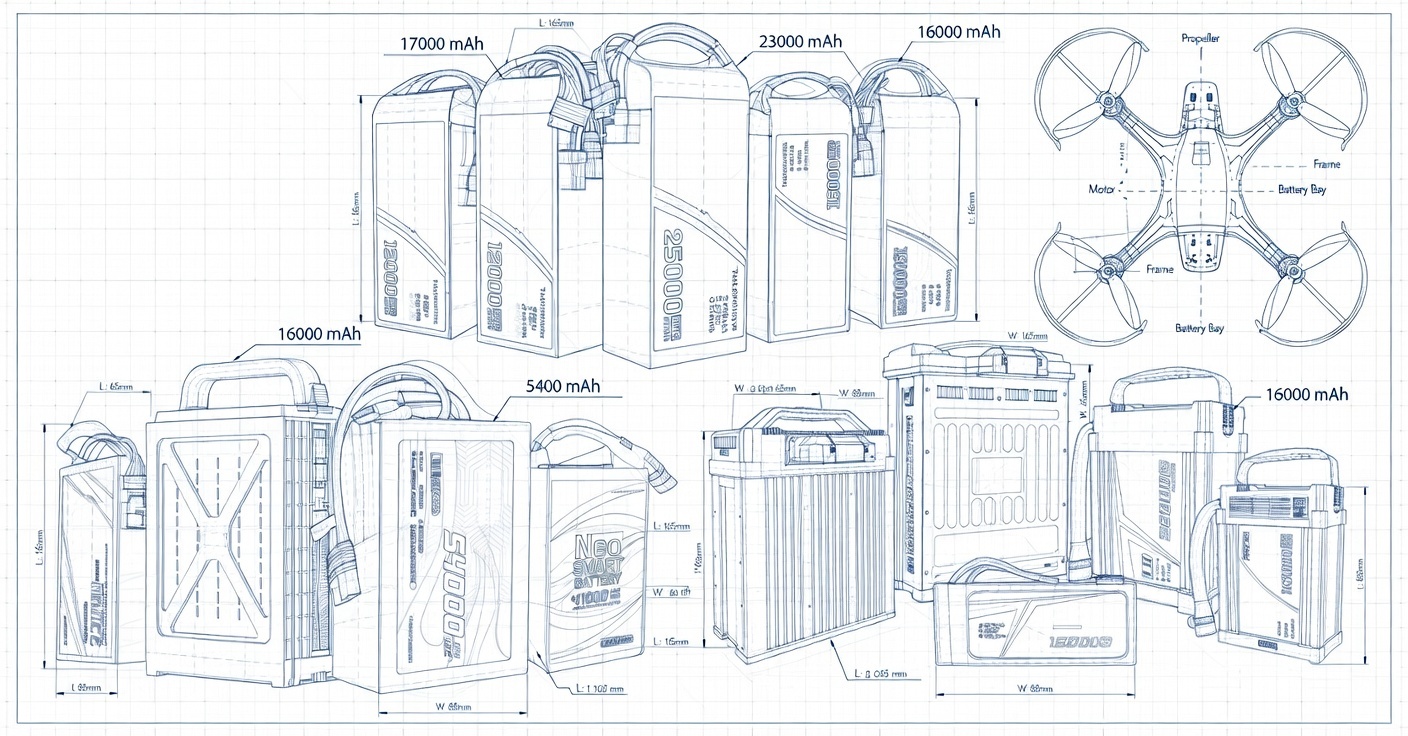
To solve the Low Energy Density issue, we must move away from standard cells and embrace Bespoke Battery Solutions. These are not just modified versions of existing products; they are engineered from the ground up for the specific drone model and environmental conditions.
1. Maximizing Energy Density Through Chemistry Selection
The core of any Bespoke Battery Solution is the cell chemistry. For desert operations, standard Lithium Polymer (LiPo) batteries often fall short due to their sensitivity to heat and lower cycle life.
- High-Voltage Li-Ion: These cells offer a higher energy density by operating at a higher nominal voltage (3.8V+ compared to 3.7V). This means you can achieve the same voltage with fewer cells, reducing weight.
- Thermal Stability: Custom solutions utilize advanced electrolytes and separators that remain stable at extreme temperatures, preventing the swelling and failure common in standard batteries exposed to desert heat.
2. Structural Integration as a Load-Bearing Component
This is where Seamless Integration becomes a game-changer. Instead of the battery being a box attached to the drone, a custom design integrates the battery into the drone’s structure.
- Monocoque Design: The battery casing becomes part of the drone’s frame. This eliminates the “dead weight” of the battery housing and the drone mounting brackets.
- Aerodynamic Shaping: Custom molds allow the battery to be shaped like an airfoil, reducing drag at high altitudes where the drone is fighting thin air.
- Weight Distribution: By placing the cells precisely at the drone’s center of gravity, the motors don’t waste energy compensating for an unbalanced load.
Case Study: The High-Altitude Telecom Relay
Let’s look at a hypothetical (but realistic) scenario involving a heavy-lift drone used for temporary 4G/5G coverage in a mountainous desert region.
The Challenge:
- Mission: Maintain 6 hours of hover at 4,500 meters (14,700 ft) altitude.
- Environment: Daytime temperatures of 48°C, plummeting to 5°C at night.
- Standard Solution: A 22,000mAh 6S LiPo pack.
- Result: The drone can only hover for 2.5 hours due to the motors overworking in thin air. The battery swells after 3 cycles due to heat stress.
The Bespoke Solution:
A custom-engineered High-Altitude Communication Relay battery.
| Feature | Standard Battery | Bespoke Battery Solution |
|---|---|---|
| Chemistry | Standard LiPo | High-Voltage, Heat-Resistant Li-Ion |
| Capacity | 22,000 mAh | 26,000 mAh (achieved via denser packing) |
| Integration | External saddle bag | Seamless Integration (Structural core) |
| Weight | 3,800 grams | 3,600 grams (despite higher capacity) |
| Thermal Mgmt | Passive (No protection) | Active Heat Dissipation fins |
| Result | Mission Failure (2.5 hrs) | Mission Success (6.5 hrs) |
The Outcome:
By utilizing a Bespoke Battery Solution, the operator achieved a 160% increase in effective flight time. The Seamless Integration allowed the heavier (but more energy-dense) cells to be carried without increasing the aerodynamic drag or stress on the motors. The custom thermal management system prevented the Low Energy Density trap of heat-induced degradation.
Key Engineering Strategies for Success
To replicate this success in your Desert High-Altitude Communication Relays, focus on these specific engineering strategies offered by advanced manufacturers.
1. Intelligent Battery Management Systems (BMS)
A custom BMS is the brain of the operation. In a Bespoke Battery Solution, the BMS is programmed specifically for high-altitude discharge curves.
- Dynamic Voltage Regulation: At high altitudes, voltage sag is more pronounced. A custom BMS prevents the drone from误判 a low battery due to voltage drop under load.
- Cell Balancing: With high discharge rates, cells can drift apart. Active balancing ensures that the full capacity is utilized, maximizing the Energy Density.
2. Environmental Hardening
A Communication Relay drone cannot afford a failure due to sand ingestion or thermal shock.
- IP67 Rating: True Seamless Integration requires a waterproof and dustproof seal. An IP67 rating ensures the battery can withstand sandstorms and sudden desert rain.
- Lightweight Armor: Using carbon fiber-reinforced casings protects the cells from impact without adding significant weight, further optimizing the energy-to-weight ratio.
The Path to Your Custom Power Solution
Overcoming the Low Energy Density challenges of the desert is not just about buying a battery; it is about engineering a power system. Generic batteries are a compromise. For mission-critical High-Altitude Communication Relays, that compromise is unacceptable.
If you are currently battling short flight times and thermal failures, it is time to consider a Bespoke Battery Solution. By prioritizing Seamless Integration and advanced thermal management, you can unlock the full potential of your drone, turning it from a short-range scout into a long-endurance communication fortress.
Ready to engineer a battery that matches the ambition of your mission?
Don’t let power limitations ground your operations. Contact us today to speak with our engineers about a custom solution for your specific drone model.
Explore more resources to optimize your drone’s performance: