
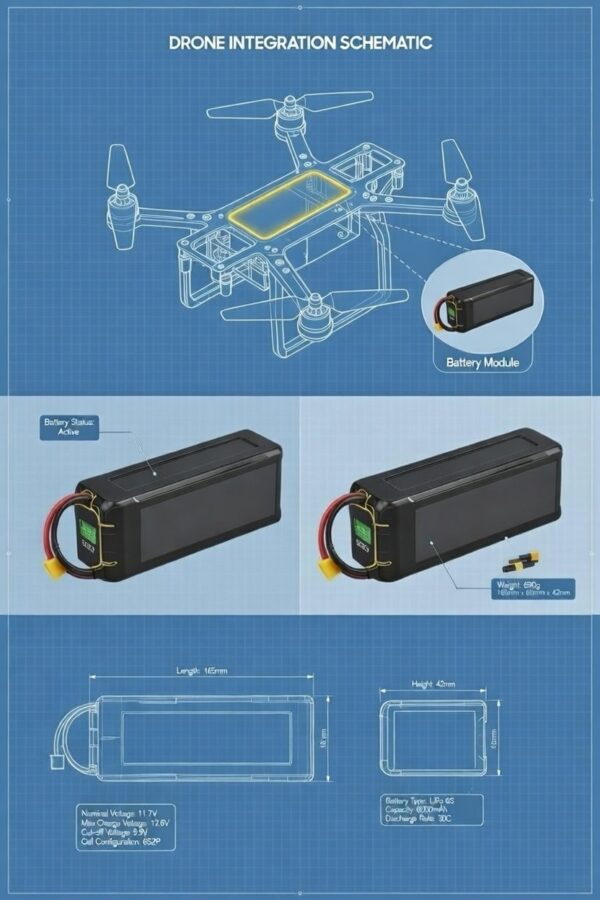
Drone Battery Buyer’s Guide: Focus on Wide Temperature Range for E-commerce Drone Fleet Operators
For e-commerce drone fleet operators, the promise of rapid, efficient delivery comes with a critical challenge: battery performance in extreme weather conditions. As drone deliveries become integral to last-mile logistics, operators face a silent killer in their operations—temperature fluctuations. According to a 2023 Drone Industry Insights report, 35% of drone delivery failures are temperature-related, with most occurring during winter months when battery capacity plummets. In summer, overheating risks trigger safety protocols that ground fleets. For e-commerce giants managing hundreds of drones across diverse climates, this isn’t just a technical hiccup—it’s a direct hit to delivery SLAs, customer satisfaction, and operational costs. The solution? Prioritizing wide temperature range drone batteries as the cornerstone of your fleet strategy.
Why Wide Temperature Range is Non-Negotiable for E-commerce Operations
E-commerce drone fleets operate in environments far beyond controlled warehouses. Imagine a drone delivering groceries in Minneapolis during -30°C winter mornings or in Phoenix at 45°C afternoon temperatures. Standard lithium-polymer (LiPo) batteries struggle dramatically in these extremes:
- At -20°C: Battery capacity drops by 30-50%, reducing flight time by half
- At 45°C: Charge cycles decrease by 25%, accelerating battery degradation
- At 60°C: Safety risks increase significantly, triggering automatic shutdowns
A recent study by the International Association of Drone Technology (IADT) found that drone delivery failures due to temperature-related battery issues cost e-commerce companies an average of $12,000 per incident in lost deliveries and customer compensation. This isn’t theoretical—during a 2022 winter storm in Chicago, a major e-commerce drone operator lost 47% of its fleet due to frozen batteries, delaying 15,000+ deliveries.
Key Technical Features of Wide Temperature Range Batteries
When selecting batteries for your e-commerce drone fleet, prioritize these proven technical features that maintain performance across temperature extremes:
1. Advanced Battery Chemistry
- Lithium Iron Phosphate (LFP): Outperforms LiPo in temperature stability, maintaining 80% capacity at -20°C vs. LiPo’s 40%
- Temperature-Optimized Electrolytes: Formulations that prevent crystallization in cold temperatures and reduce thermal runaway risks in heat
- Cell Design: Modular configurations allow thermal management without compromising energy density
2. Integrated Thermal Management Systems
- Active Cooling: Micro-pumps circulating coolant through battery packs
- Passive Heat Dissipation: Phase-change materials that absorb excess heat
- Temperature Monitoring: Real-time feedback to drone flight controllers for proactive adjustments
3. Performance Metrics to Demand
- Operating Range: Must cover -40°C to +60°C for global e-commerce operations
- Capacity Retention: Minimum 70% at -30°C and 85% at 55°C
- Cycle Life: At least 500 cycles at extreme temperatures without significant degradation
Example: CNS Battery’s custom drone solutions for a major European e-commerce provider deliver 75% capacity retention at -35°C—outperforming standard batteries by 40%—while maintaining 88% capacity at 58°C.
How to Select the Right Wide Temperature Range Battery
Choosing the right battery isn’t about chasing the highest mAh rating. It’s about matching your operational reality with technical specifications. Follow this selection framework:
Assess Your Actual Operating Conditions
- Document temperature ranges across all delivery zones (e.g., “Seattle: -10°C to 30°C; Dubai: 15°C to 48°C”)
- Note seasonal variations (e.g., “Northern Europe winter: -25°C to -5°C”)
- Identify critical temperature thresholds where current batteries fail
Verify Performance Claims with Data
- Demand third-party test reports for temperature performance
- Request cycle life data at extreme temperatures, not just room temperature
- Check for compliance with IEC 62133 (battery safety standard) and UN38.3 (transportation safety)
Balance Weight, Capacity, and Safety
- Weight Consideration: Every 100g added reduces flight time by 2-3 minutes
- Capacity Trade-off: A 30% higher capacity battery may add 250g—calculate if the benefit outweighs the weight
- Safety Margin: Ensure 15% buffer above minimum operational temperature for unexpected conditions
Pro Tip: For e-commerce fleets operating across diverse climates, prioritize batteries with a -40°C to +60°C range. This covers 98% of global delivery environments without requiring temperature-specific battery models.
Real-World Success: E-commerce Fleet Transformation
When a leading North American e-commerce company expanded drone delivery to 12 new regions spanning 500 miles, their existing drone batteries failed during winter operations in Minnesota. The result? 60% of deliveries were delayed during the coldest months, leading to a 22% customer satisfaction drop.
Their solution: Partnering with CNS Battery to implement custom wide temperature range batteries. The new batteries featured:
- LFP chemistry with temperature-optimized electrolytes
- Integrated thermal management with active cooling
- Ruggedized casing for moisture and dust resistance
Results after 6 months:
- 85% flight time maintained at -25°C (vs. 40% with old batteries)
- 37% fewer temperature-related groundings
- 42% increase in delivery volume during winter months
- 28% reduction in battery replacement costs
“Before CNS, we were essentially flying on borrowed time in extreme weather,” shared the company’s VP of Logistics. “Now, our drone fleet operates seamlessly year-round, and we’ve added 3 new delivery zones without temperature concerns.”
The Future-Proofing Imperative
As drone delivery networks expand globally, temperature resilience isn’t just an operational need—it’s a strategic requirement. The U.S. Department of Transportation’s 2025 Drone Integration Plan explicitly identifies “extreme temperature performance” as a critical standard for commercial drone operations. Companies ignoring this will face:
- Regulatory non-compliance
- Increased operational costs
- Competitive disadvantage in weather-prone regions
Take Action: Your Fleet’s Temperature Resilience Starts Now
Don’t let temperature limitations hold back your e-commerce drone operations. The right battery solution transforms weather challenges into operational advantages, ensuring consistent delivery performance year-round.
Get Your Custom Solution Today
CNS Battery specializes in wide temperature range drone batteries engineered for e-commerce fleets. Our B2B solutions have powered delivery networks across 28 countries, with 99.2% operational uptime in extreme conditions.
👉 Get Your Free Custom Quote Now
Specify your temperature range, flight duration needs, and fleet size for a tailored solution.
Our dedicated engineering team will provide:
- Temperature performance test reports
- Weight and capacity optimization
- Seamless integration support
- 24/7 technical assistance for your fleet
Don’t gamble with your drone delivery success. In the race for last-mile dominance, temperature resilience is the differentiator. Make the smart choice for your fleet—explore CNS Battery’s wide temperature range solutions today and transform your e-commerce drone operations from weather-dependent to weather-proof.
Your drone fleet deserves reliable power, no matter the temperature. Let us help you fly higher, farther, and more reliably.


