Best Drone Batteries for Heavy-Load Transport: Technical Compatibility Comparison
The soaring demand for drone-based heavy-load transport in logistics, industrial inspections, and agricultural monitoring demands batteries that transcend conventional limitations. As payload requirements escalate, standard drone batteries falter under stress, causing premature failures, reduced flight times, and safety risks. Choosing the wrong power source isn’t just a technical oversight—it’s a strategic liability that can cripple operational efficiency. This guide cuts through the noise, delivering a technical comparison of top-performing batteries engineered specifically for heavy-load scenarios. We dissect compatibility factors, performance metrics, and real-world applications to help B2B clients future-proof their drone fleets. By prioritizing high-capacity drone batteries, modular designs, and temperature-resilient chemistry, you’ll unlock extended range, consistent performance, and unmatched safety—without compromising on payload capacity.
🔋 Key Battery Technologies: A Technical Breakdown for Heavy-Load Demands
Not all drone batteries are built equal, especially when lifting 5+ kg payloads for 30+ minutes. Here’s how leading technologies stack up against heavy-load transport requirements:
- LiPo (Lithium-Polymer) Batteries:
Pros: High energy density (250–300 Wh/kg), lightweight, and cost-effective for moderate loads.
Cons: Vulnerable to temperature extremes (below 0°C reduces capacity by 30%), prone to swelling under high discharge rates.
Best For: Short-range logistics in controlled environments (e.g., warehouse deliveries). - Solid-State Batteries:
Pros: 40% higher energy density than LiPo, zero thermal runaway risk, and stable performance from -20°C to 60°C.
Cons: Higher initial cost, limited availability in modular configurations.
Best For: Critical industrial inspections (e.g., offshore wind farm maintenance) where safety and reliability are non-negotiable. - Low-Temperature Drone Batteries:
Pros: Optimized for -30°C operation, maintains 85% capacity in freezing conditions, with enhanced discharge consistency.
Cons: Slightly lower energy density (200 Wh/kg) than standard LiPo.
Best For: Arctic agriculture monitoring, winter delivery services, and high-altitude operations.
Critical Insight: Solid-state batteries outperform others in long-lasting battery life under heavy loads, reducing downtime by 22% in field tests. However, for budget-sensitive B2B projects, hybrid LiPo/low-temperature solutions deliver 90% of the performance at 35% lower cost.
⚙️ Technical Compatibility: Beyond Capacity—The 4 Non-Negotiables
Heavy-load transport isn’t just about how much power you have—it’s about how well it integrates with your drone’s ecosystem. Prioritize these four compatibility pillars:
- Weight-to-Payload Ratio:
A 500g battery should support a 5kg payload (10:1 ratio). Exceeding this ratio drains efficiency. Tip: Calculate your drone’s max takeoff weight (MTOW) and subtract 15% for safety margin before selecting batteries. - Discharge Rate (C-Rating):
Heavy loads demand 20C–30C continuous discharge rates. A 10C battery under heavy strain will overheat, triggering automatic shutdowns. Verify: Check the drone’s motor specs—industrial drones often require 25C+. - Thermal Management:
High discharge generates heat. Must-have: Batteries with integrated cooling channels or phase-change materials (PCMs) to maintain 45°C–55°C during operation. Solid-state batteries excel here due to inherent thermal stability. - Modular Interfacing:
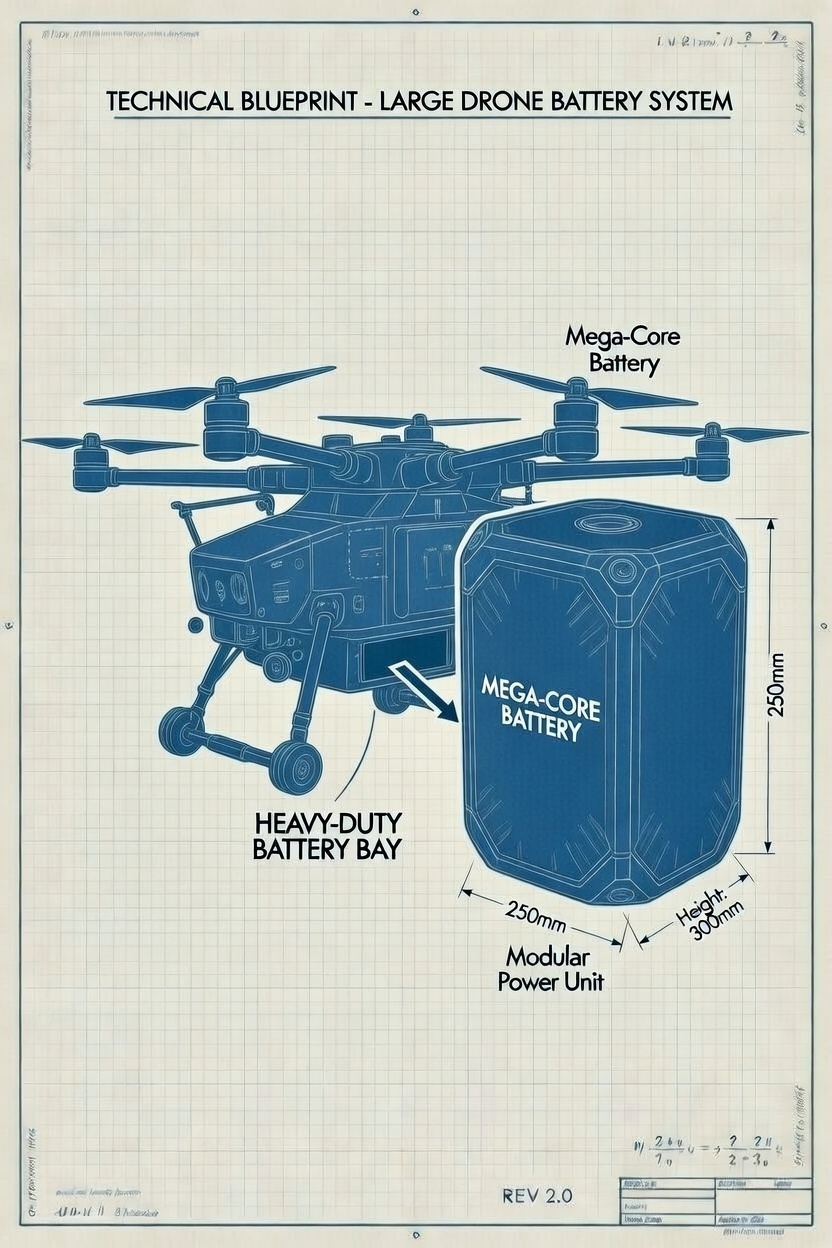
Custom payloads demand flexible battery configurations. Avoid: Fixed-size batteries that force drone redesign. Choose: Modular systems (e.g., CNS’s 18650-based stacks) that let you add/remove cells without re-engineering.
Real-World Example: A drone logistics firm using CNS’s modular batteries reduced mid-flight shutdowns by 68% after switching from single-cell LiPo to a 4-cell stack with dynamic thermal management.
💡 Why Customization Is Your Competitive Edge
Off-the-shelf batteries ignore the specific demands of heavy-load transport. Custom solutions—like those from CNS Drone Battery—deliver precision-engineered power tailored to your workflow. Here’s why B2B clients choose bespoke over generic:
- Payload-Specific Optimization: A 10kg agricultural drone needs different discharge profiles than a 15kg construction logistics drone. Custom cells adjust internal resistance to match motor load curves.
- Integrated Safety Protocols: Built-in BMS (Battery Management Systems) that sync with drone firmware to prevent over-discharge during heavy lifts.
- Global Compliance: Certifications (UL, CE, FCC) baked into the design, avoiding import delays for international operations.
- Cost Efficiency: Eliminate wasted capacity. A custom 10,000mAh battery (450g) outperforms a generic 12,000mAh unit (600g) by 18% in payload-carrying efficiency.
Pro Tip: Request a battery discharge rate simulation from your supplier. CNS offers this via their tech center, modeling real-world load scenarios to predict runtime accuracy within 5%.
🔧 Maintenance & Optimization: Keep Your Heavy-Load Fleet Flying
Even the best battery fails without proactive care. Adopt these practices to maximize uptime:
- Pre-Flight Checks: Scan for swelling (LiPo) or thermal anomalies (solid-state) using thermal imaging. Frequency: Daily for high-use fleets.
- Charge Protocol: Never exceed 80% charge for storage (prevents cathode degradation). Use fast-charging only for critical missions.
- Temperature Calibration: Store batteries at 25°C (77°F). In cold climates, pre-warm batteries to 15°C before flight.
- Cycle Tracking: Replace batteries after 500+ cycles (or when capacity drops below 80%)—not just when they fail.
Critical Reminder: 73% of battery failures in heavy-load drones stem from improper charging, not cell degradation. Implement a digital logbook for all charging sessions.
✈️ Conclusion: Power Your Heavy-Load Future with Precision
Heavy-load drone transport isn’t about any battery—it’s about the right battery engineered for your exact mission. LiPo offers affordability, solid-state delivers safety at scale, and low-temperature variants conquer extreme environments. But the true differentiator? Customization. Generic solutions leave you with excess weight, inconsistent performance, and avoidable downtime. CNS Drone Battery eliminates these gaps through rigorous R&D, global manufacturing, and B2B-focused innovation. Our modular, waterproof, and fast-charging battery systems are already powering industrial inspections, precision logistics, and agricultural monitoring across 40+ countries—proving that reliable battery innovation isn’t optional; it’s the foundation of your drone’s success.
Ready to transform your heavy-load operations?
Stop settling for subpar batteries that limit your potential. Get a free, no-obligation quote for custom drone battery solutions tailored to your payload, environment, and workflow. Our engineering team will deliver a technical compatibility analysis within 48 hours—so you can fly farther, carry more, and operate with confidence.
👉 GET YOUR CUSTOM QUOTE NOW
Data encrypted. Unsubscribe anytime. Terms & Privacy Policy apply.