⚡️ From Sparks to Downtime: The Hidden Cost of Ignoring Charging Protocols in High-Performance Drones
In the high-stakes world of industrial UAV operations, a single spark or an unexpected battery swell can turn a routine mission into a catastrophic failure. Whether you are hovering over a construction site in Dubai or mapping a dense rainforest in Brazil, the heart of your drone is not just its motors or sensors—it is the battery. However, many B2B operators fall into a critical trap: they optimize for flight time (capacity) or environmental resilience (waterproofing) while completely neglecting the physics of how these batteries recharge.
The “Instant Gratification” Fallacy
The market is flooded with “fast-charging” claims, but what manufacturers often omit is the trade-off. When you pair a high-capacity battery (designed for long endurance) with a waterproof casing (designed for ruggedness), the thermal dynamics change dramatically. Without proper engineering, attempting to charge these behemoths quickly generates heat—a drone operator’s worst enemy. This heat can lead to thermal runaway, cell degradation, or even fires.
To help you navigate this minefield, we have distilled the risks and solutions below.
⚠️ The Risk Matrix: Why Charging is a Silent Killer
Before diving into the technical specifications, it is crucial to understand the “why” behind the failure. Most drone battery fires or premature deaths occur not during flight, but during the charging cycle, especially when operators try to “top up” quickly between missions.
Root Causes of Charging Failures
- Thermal Buildup in Confined Spaces: Waterproof batteries often have sealed casings. While this protects against rain, it also traps heat generated during high-current charging.
- Voltage Mismatch: High-capacity batteries require precise voltage balancing. Cheap chargers or incorrect settings can cause over-voltage in individual cells, leading to swelling.
- Rushed C-Rates: Ignoring the “C-Rate” (charge speed) specific to your battery chemistry can degrade the anode, reducing the battery’s lifespan by up to 50% in just 10 cycles.
Preventative Measures & Best Practices
- The 1C Golden Rule: For longevity, charge at a 1C rate (fully charging in 1 hour). While some batteries support 3C or 5C, this should be reserved for emergencies.
- Active Cooling: Never charge high-capacity batteries on a carpet or bed. Use a fireproof charging bag or a metal rack with active airflow.
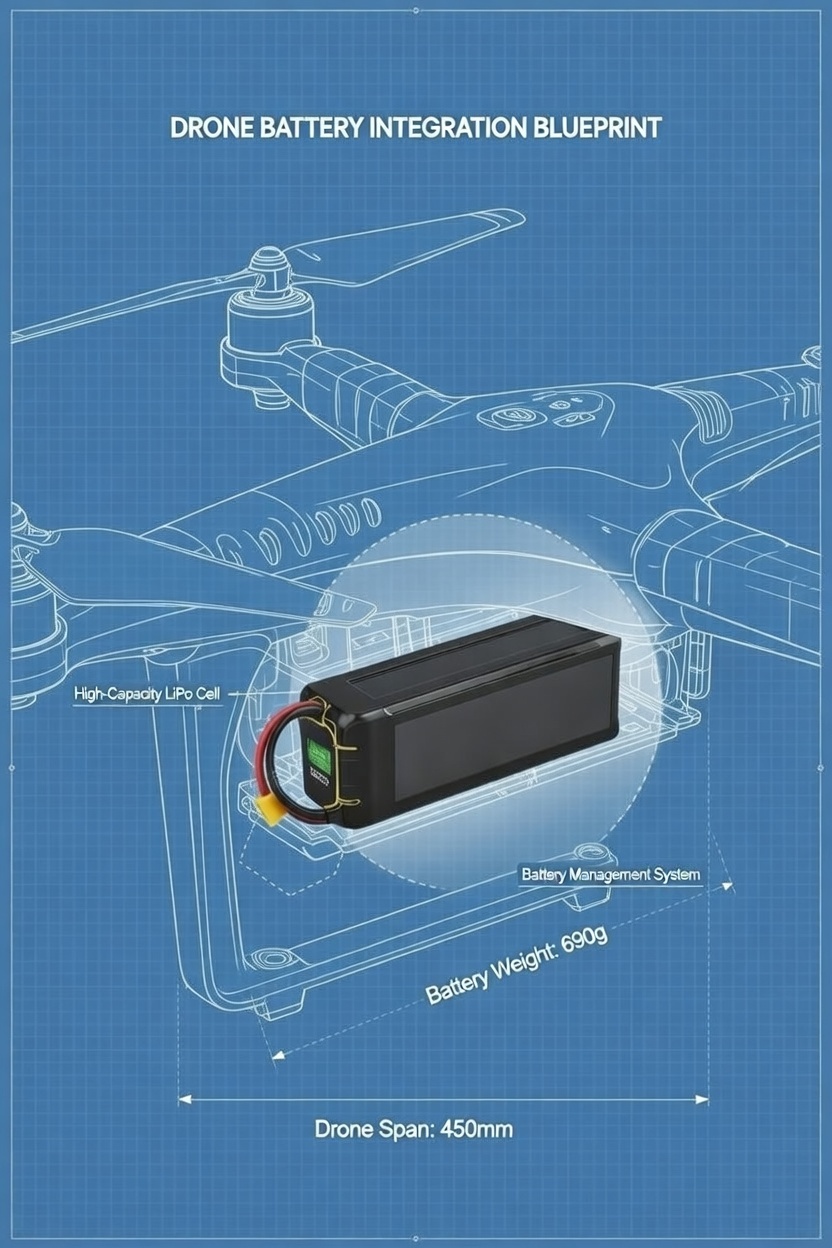
- Smart BMS Monitoring: Always use a Battery Management System (BMS) that communicates with your charger to regulate temperature and voltage in real-time.
🏗️ Engineering the Powerhouse: The Architecture of a High-Performance Drone Battery
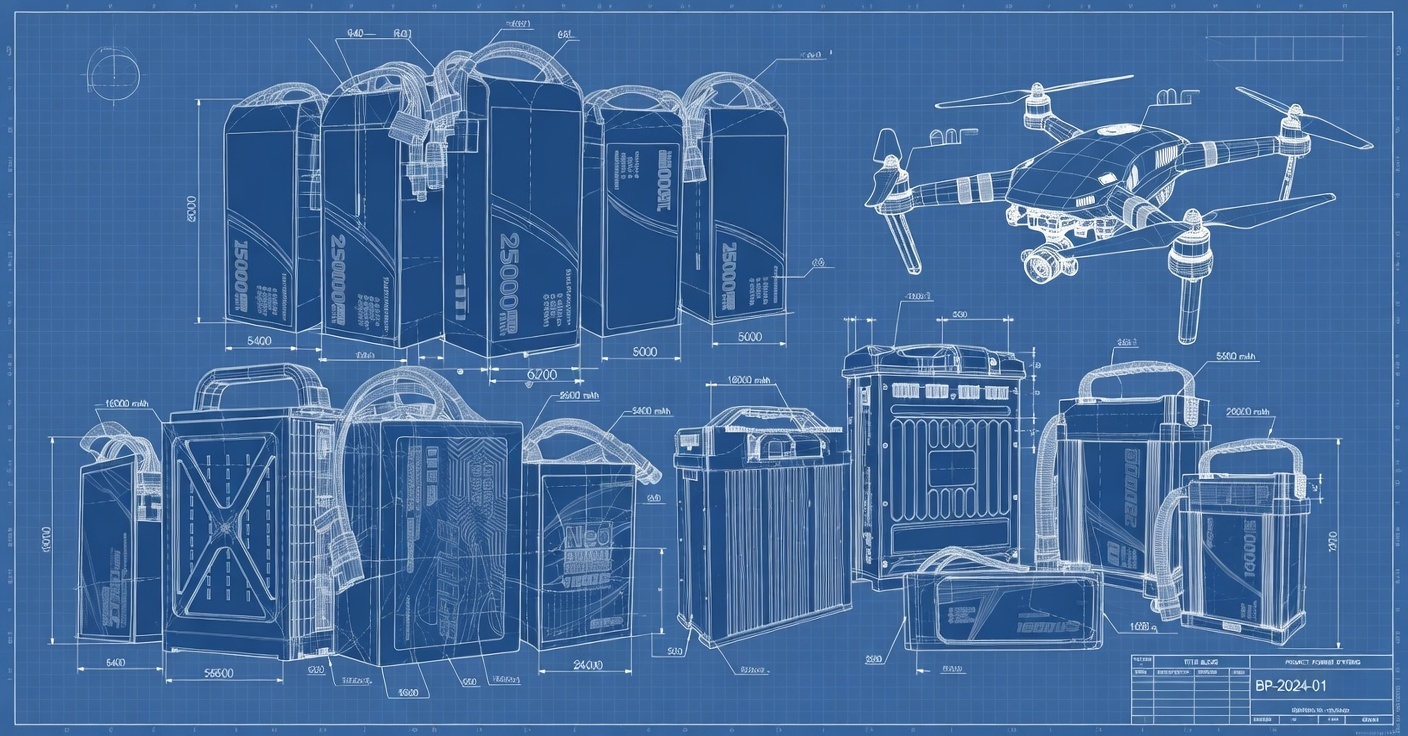
To understand charging times, we must first look at what is inside the box. At CNS Battery, our engineering philosophy revolves around the “Power-Density-Safety” trinity. We do not just manufacture cells; we engineer energy systems.
1. The Core: Cell Chemistry and Configuration
The foundation of any battery is the cell chemistry. For industrial applications, Lithium Polymer (LiPo) and Lithium Iron Phosphate (LiFePO4) are the most common, but our proprietary Semi-Solid State technology is redefining the landscape.
- High Energy Density: Our standard soft-pack batteries achieve up to 290Wh/kg. For context, this means we can pack more power into a lighter shell, directly translating to longer flight times.
- Semi-Solid State Innovation: By utilizing NMC 811 chemistry with a semi-solid electrolyte, we push this density to 380Wh/kg. This technology reduces internal resistance, which is a key factor in allowing faster, safer charging cycles without the risk of dendrite formation (metallic spikes that cause shorts).
2. The Brain: Intelligent BMS
A high-capacity battery is useless without a brain. Our Smart BMS is the guardian of the cell.
- Real-Time Analytics: It monitors voltage, current, and critically, temperature at the cell level.
- Communication Protocol: Unlike generic batteries, our BMS talks to the drone and the charger. If the temperature rises above a safe threshold during a rapid charge, the BMS signals the charger to reduce the current automatically.
3. The Shield: Structural Integrity
For waterproof applications, the casing is everything. We utilize a combination of explosion-proof casings and specialized sealing techniques.
- IP67 Rating: Our waterproof models are fully submersible. However, this requires advanced thermal interface materials (TIMs) to conduct heat away from the cells to the outer casing, ensuring that even when sealed, the battery does not overheat during charging.
⏱️ The Physics of Charging: Decoding the “C” Rate
Now, let us address the elephant in the room: How long does it really take to charge a high-capacity, waterproof drone battery?
The answer lies in the “C-Rate.” This is not just a number; it is a ratio of the charge current to the battery’s capacity.
The Mathematics of Replenishment
Imagine you have a high-capacity 22,000mAh (22Ah) battery, a common workhorse for heavy-lift drones.
- Standard Charging (1C): If you charge this at a 1C rate, you are feeding it 22 Amps. This is the “gold standard” for longevity and safety. It will take approximately 60 minutes to reach full capacity, plus a top-balance trickle phase.
- Fast Charging (3C): If you are in a rush and use a 3C rate, you are pushing 66 Amps into the battery. In theory, this can fill the battery in 20-25 minutes. However, this generates immense heat.
- Ultra-Fast Charging (5C+): Some of our Smart Drone Battery series support 5C charging. While this sounds like a 12-minute miracle, physics dictates that the charger must taper the current as the battery fills to prevent over-voltage. Realistically, you are looking at 15-18 minutes.
The Trade-Off Curve
| Charging Speed | Estimated Time (22,000mAh) | Heat Generated | Cycle Life Impact |
|---|---|---|---|
| 1C (Standard) | 60 – 70 Minutes | Low | Best (500+ cycles) |
| 3C (Fast) | 25 – 30 Minutes | High | Moderate (300 cycles) |
| 5C (Turbo) | 18 – 22 Minutes | Very High | Reduced (200 cycles) |
Expert Insight: While our Neo and Pro series batteries support 5C charging, we recommend reserving this for emergency response scenarios. For daily logistics or surveying operations, 1C or 2C charging provides the best Total Cost of Ownership (TCO) by preserving battery health.
⚖️ The Great Debate: Waterproof vs. High-Capacity
When comparing these two battery types, the charging time difference often comes down to heat dissipation.
The Waterproof Paradox
A waterproof drone battery is essentially a sealed thermos. While excellent for flying in rain or dust, this design traps the heat generated during charging.
- The Challenge: You cannot simply blast a high current into a sealed battery. The internal temperature can spike, triggering the BMS to cut off the charge or, worse, damaging the electrolyte.
- The Solution: Lower C-Rates. For waterproof models, we strictly recommend charging at 1C. This slower pace allows the thermal interface materials to conduct heat to the outer casing, preventing internal hotspots.
The High-Capacity Conundrum
High-capacity batteries (like our 30,000mAh or 40,000mAh monsters) store a massive amount of energy. The sheer volume of ions moving during a charge creates resistance.
- The Physics: Larger capacity usually means more parallel cells. Balancing these cells perfectly takes time.
- The Verdict: Even if a high-capacity battery supports 3C charging, the physical limitations of ion diffusion mean the “average” charge time remains closer to 30-40 minutes, not the theoretical 20 minutes.
🚀 The CNS Battery Advantage: Where Innovation Meets Reliability
In a market saturated with generic lithium packs, CNS Battery stands apart by focusing on the specific needs of B2B enterprises. We are not just a vendor; we are a partner in your aerial operations.
1. The “Plug-and-Play” Intelligence
Our Smart Drone Battery series (including the Plus, Pro, and Neo lines) feature Bluetooth APP monitoring. This is not just for show. Before you even plug in the charger, the APP can diagnose the battery’s health (SOH). During charging, it provides real-time feedback, ensuring that the process is optimized for safety.
2. Unmatched Energy Density
We have cracked the code on weight versus power. By utilizing Stable Automatic Stacking Technology, we minimize the internal “dead space” in our cells. This means our batteries are lighter, which reduces the drone’s energy consumption, but more importantly for charging, it means less internal resistance and therefore less heat generation.
3. Ruggedized for Reality
We understand that B2B environments are harsh. Whether it is the salt spray of a maritime inspection or the dust of a mining site, our batteries are built to last. Our IP67 waterproofing and -30℃ to 60℃ operating temperature range mean your battery performs in the field, and our rigorous quality control ensures it charges safely back at base.
🛑 Conclusion: Choosing the Right Power for Your Mission
In the race to maximize drone uptime, it is easy to be seduced by the promise of “5-minute charging.” However, the reality for industrial operators is far more nuanced.
If your priority is raw flight time, a high-capacity battery charged at a conservative 1C rate is your best bet for longevity.
If your priority is all-weather operation, a waterproof battery with a slightly slower charge time is a non-negotiable safety feature.
At CNS Battery, we do not believe in one-size-fits-all solutions. We engineer batteries that are tailored to your specific payload, flight duration, and environmental requirements.
Ready to optimize your drone’s power system?
Do not let generic batteries compromise your mission. Explore our full range of high-performance solutions, from standard LiPo to cutting-edge semi-solid state technology.
Contact us today for a personalized consultation and discover how we can power your next flight.