The Invisible Weight: How to Break Free from the LiPo vs. Smart Battery Dilemma
The drone industry operates on a fundamental law of physics: every gram matters. For professionals pushing the boundaries of aerial photography, precision agriculture, or industrial inspection, the choice between Lithium Polymer (LiPo) and Smart batteries isn’t just a technical spec sheet comparison—it’s a high-stakes gamble on flight time, payload capacity, and operational ROI.
You are likely facing the “Invisible Weight” problem. You need maximum endurance, but you are shackled by the limitations of traditional power sources. If you strip away the marketing jargon, the core challenge remains: How do you maximize energy density while minimizing physical weight and management overhead?
This article cuts through the noise. We will dissect the structural, chemical, and technological differences between standard LiPo and Intelligent Drone Batteries, revealing how modern engineering is rewriting the rules of weight-to-power ratios.
The Anatomy of Weight: Why Traditional LiPo is Heavy
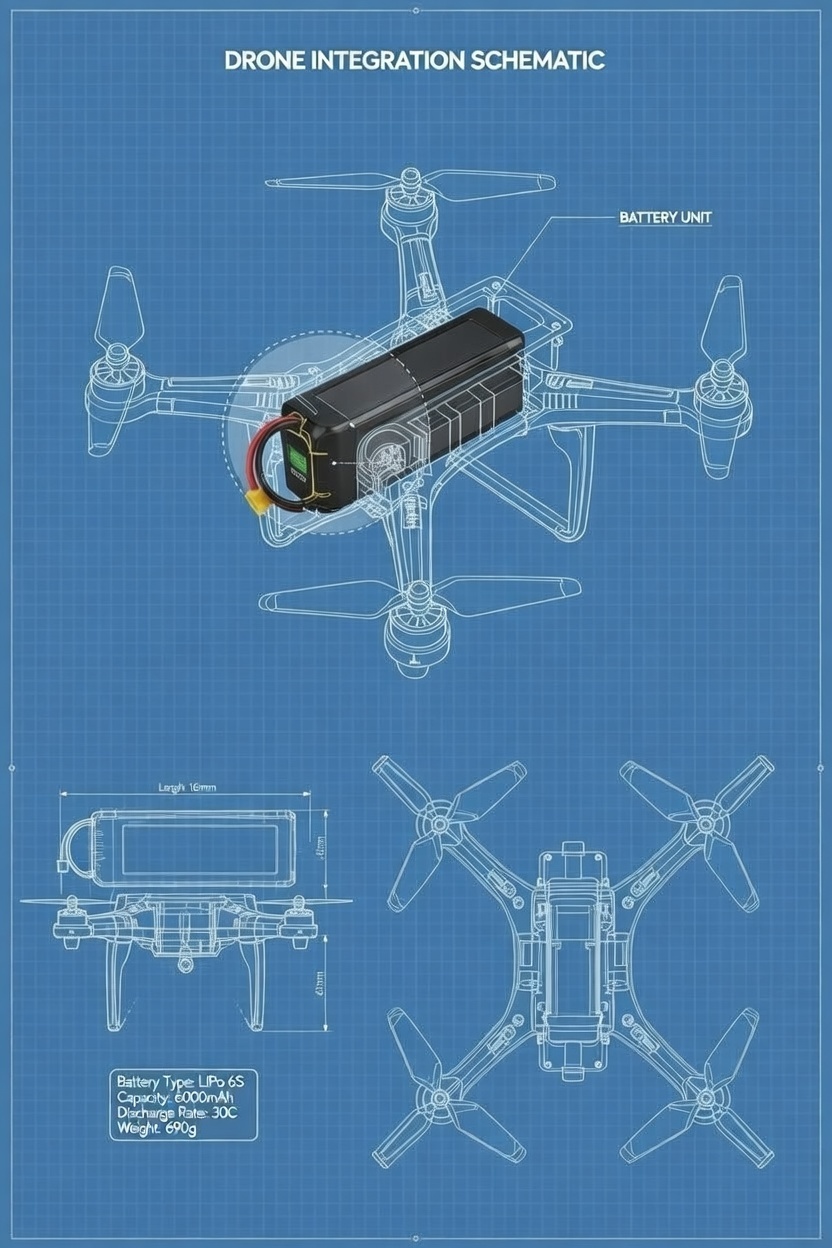
To beat the weight, you must first understand what creates it. Standard LiPo batteries are essentially “dumb” energy vessels. They are composed of raw cells, a simple protective casing, and basic connectors.
The Hidden Culprits of Dead Weight:
- Structural Packaging: Traditional laminated pouches require thick, rigid outer shells to maintain shape under stress.
- Lack of Integration: Because they lack internal intelligence, external monitoring systems (or manual checks) are required, adding system-level weight.
- Material Density: Standard cathode and anode materials have physical limits on how much energy they can store per gram.
While LiPo batteries offer a decent power-to-weight ratio compared to older chemistries, they often force a compromise. You are carrying extra structural weight to protect cells that, while powerful, are not utilizing the absolute cutting edge of energy density.
The Smart Battery Revolution: Intelligence vs. Mass
Intelligent batteries are not just cells in a box; they are micro-computers. They contain a Battery Management System (BMS) that monitors voltage, temperature, and health. The common misconception is that this electronics adds “dead weight.”
However, the reality is the opposite. The intelligence allows for radical weight reduction in other areas.
The Efficiency Paradox
Because a Smart Battery has a BMS, it can prevent over-discharge and thermal runaway. This safety margin allows manufacturers to use lighter, more advanced casings. Furthermore, the data provided by the BMS allows pilots to utilize 100% of the rated capacity safely, whereas with LiPo, pilots often leave “reserve” capacity unused to avoid damage, effectively carrying weight for energy they never use.
The Game Changer: Beyond LiPo and Standard Smart
The true frontier in the war against weight lies in the chemistry and design innovations that surpass both standard LiPo and early-generation Smart batteries. Based on the latest advancements in battery technology, the focus has shifted to High-Nickel Cathodes and Silicon-Carbon Anodes.
To visualize the evolution, consider the following comparison of modern battery solutions designed for maximum endurance:
| Feature | Standard LiPo / Smart | Semi-Solid State (Advanced) |
|---|---|---|
| Energy Density | 210 – 240 Wh/kg | 280 – 380 Wh/kg |
| Weight Impact | Moderate | Ultra-Light |
| Structure | Rigid Casing Required | Optimized for Lightweight Design |
| Best For | General Inspection, Short Missions | Mapping, Heavy Payload, Long Endurance |
1. The Physics of High Energy Density
The key metric is Watt-hours per Kilogram (Wh/kg). Standard LiPo batteries typically cap out around 240 Wh/kg. In contrast, advanced semi-solid state batteries, such as those utilizing NMC 811 chemistry (80% Nickel), can achieve densities of up to 380 Wh/kg.
What does this mean for you? It means a battery that is 15% lighter for the same capacity, or conversely, 30% longer flight time without adding any weight.
2. The “No Memory Effect” Advantage
Unlike older battery technologies, modern Lithium Polymer and Lithium-Ion smart batteries do not suffer from the “memory effect.” This allows for flexible discharge and recharge cycles without degradation. For a heavy-load multirotor, this means you can rely on the full capacity without worrying about the battery “remembering” a lower charge limit, ensuring that every gram of weight translates directly into usable power.
Real-World Application: Matching the Battery to the Mission
Choosing the wrong battery doesn’t just cost you money; it costs you airtime. Let’s break down the scenarios.
For Heavy Payload & Aerial Photography: The 6S Series
When carrying gimbal cameras or sensors, weight is critical. The 6S Series (22.2V) offers a sweet spot.
- The Challenge: Carrying heavy cameras without sacrificing hover time.
- The Solution: Models like the C-6S1P05C20054 are engineered for extreme lightness, offering a 15% weight reduction. This allows the drone to lift the camera payload while still maintaining long endurance thanks to high energy density.
For Long Endurance Mapping: Semi-Solid State
Mapping drones need to stay airborne for hours, covering vast distances.
- The Challenge: Standard batteries are too heavy or don’t last long enough.
- The Solution: Semi-Solid State batteries (e.g., CSOL-380Wh/kg Series) provide the highest energy density available. With a capacity to increase endurance by 30%, these batteries turn a standard mapping drone into a long-range surveyor.
For Agricultural Spraying: Rugged Smart Power
Agricultural environments are harsh—dusty, humid, and corrosive.
- The Challenge: Balancing weight with the need for ruggedness and fast charging.
- The Solution: Smart Drone Battery Series (Neo/Pro). These feature optimized heat dissipation and MOS switches. The intelligence allows for fast charging (up to 5C), reducing downtime, while the ruggedized design protects the lightweight internals.
Maintenance: The Weight of Neglect
A heavy battery is useless if it degrades quickly. The “weight” you carry tomorrow depends on how you treat the battery today.
Best Practices for Longevity:
- Storage Voltage: Never store LiPo or Smart batteries fully charged. Store them at 3.8V-3.85V per cell.
- Temperature Control: Avoid charging below 0°C (32°F). Cold charging increases internal resistance, effectively making the battery “heavier” in performance.
- Utilize BMS Data: For Smart batteries, use the Bluetooth APP to check the State of Health (SOH). This data tells you if the battery is maintaining its energy density or if it is becoming “heavy” due to internal degradation.
The Verdict: Which Side of the Scale Are You On?
The battle between LiPo and Smart batteries is over. The future belongs to hybrid solutions that combine the raw power of advanced chemistry with the safety of intelligent management.
If you are still operating on standard LiPo batteries, you are likely carrying unnecessary weight that limits your drone’s potential. It is time to upgrade to a solution that offers lighter weight, higher density, and smarter management.
Ready to shed the weight and extend your range?
Don’t let outdated power sources ground your ambitions. Explore the full spectrum of high-performance, lightweight drone batteries designed for professional excellence. Whether you need a custom solution or a ready-to-fly high-density pack, the technology exists to lift your operations to new heights.
Explore the specifications and find your perfect match today.
Explore More Resources: Learn about our Industrial Drone Battery Specifications
Still have questions? Our experts are ready to help you calculate the feasibility and cost savings.