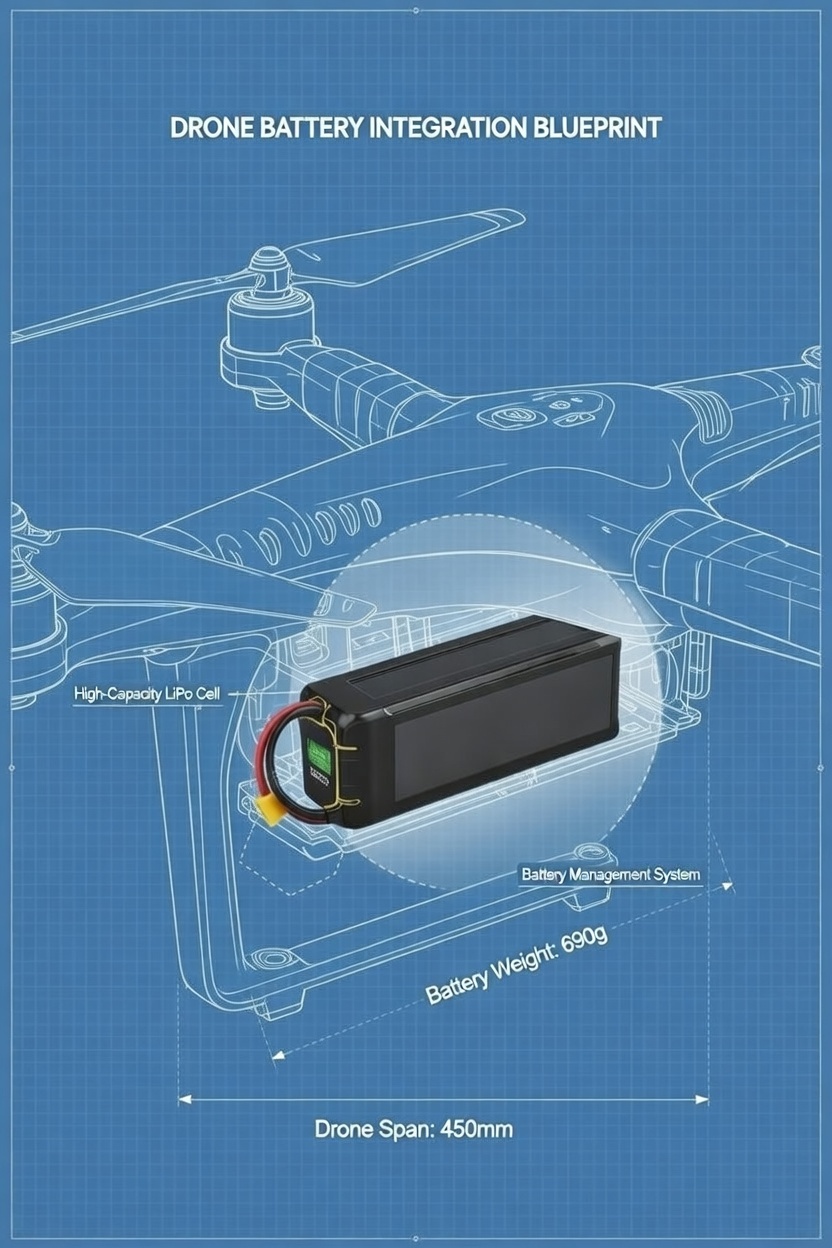
The Ultimate Balancing Act: Comparing Lightweight and Fast-Charging Drone Batteries for Storage and Performance
Is your battery strategy holding your drone operations back?
In the high-stakes world of commercial and industrial drone operations, the difference between success and failure often comes down to a single, heavy decision: Do you prioritize flight time or turnaround speed? Whether you are mapping rugged terrain, inspecting critical infrastructure, or managing a logistics fleet, the physics of energy storage remain the same. You cannot infinitely increase capacity without adding weight, and you cannot charge instantly without generating dangerous heat.
This guide cuts through the marketing jargon to help you compare the physics, the trade-offs, and the real-world applications of Lightweight High-Density batteries versus Fast-Charging solutions. We will help you optimize your storage strategy to maximize ROI.
⚖️ The Physics of the Trade-Off
Before diving into specific models, it is crucial to understand the core scientific constraints that govern drone battery design.
- The Weight Penalty: Every gram of lithium added to increase capacity is a gram subtracted from your payload or flight time. There is a point of diminishing returns where the battery becomes too heavy for the drone to lift efficiently.
- The Heat Barrier: Fast charging generates heat. To achieve high C-rates (charge speeds), manufacturers must add thicker, more robust cooling systems and specialized cell chemistry, which inherently adds weight.
The Golden Rule: You must find the “sweet spot” where the energy density (Wh/kg) is high enough to justify the weight, and the charge time is fast enough to keep your workflow moving.
🪶 The Lightweight Champions: Maximizing Energy Density
For missions where every second of airtime counts—such as long-range surveying, search and rescue, or heavy-lift cinematography—lightweight, high-density batteries are the undisputed champions.
The Technology: Semi-Solid State and High-Voltage LiPo
Standard Lithium Polymer (LiPo) batteries typically max out at around 250 Wh/kg. To go lighter, you need advanced chemistry.
- Semi-Solid State Batteries: These are the cutting edge. By using an NMC 811 chemistry (80% Nickel), manufacturers can push energy density to 380 Wh/kg. This means a battery that is 30% lighter than a standard pack can deliver the same flight time.
- High-Voltage (LiHV) Series: Standard cells charge to 4.2V per cell. High-voltage cells charge to 4.35V or even 4.45V. This small increase in voltage allows for a higher energy density without significantly increasing weight.
📊 Comparison: Standard vs. Lightweight Ultra High-Density
| Feature | Standard LiPo (250 Wh/kg) | Semi-Solid State (380 Wh/kg) |
|---|---|---|
| Weight Impact | Heavy; limits payload | Ultra-Light; frees up payload capacity |
| Flight Time | Standard | +30% Extended Endurance |
| Best For | General photography, small drones | Mapping, Long-range, Heavy payloads |
| Storage Caution | Standard care required | Requires strict temperature monitoring due to high reactivity |
Expert Insight: If you are using a heavy-lift drone for agricultural spraying or heavy sensor payloads, a lightweight high-density battery isn’t just an upgrade; it is a necessity. It allows you to carry more payload or stay in the air longer, without the battery itself becoming a burden.
⚡ The Speed Demons: Fast Charging for High Throughput
In logistics, security patrols, or emergency response, time on the ground is money lost. Fast-charging batteries sacrifice a bit of energy density to slash recharge times, allowing for rapid battery swaps and continuous operation.
The Technology: Optimized Heat Dissipation and BMS
Fast-charging batteries (capable of 3C, 4C, or even 5C charging) rely on two key innovations:
- MOS Switch Configuration: This acts like a circuit breaker, allowing high current to flow safely without overheating the connectors.
- Optimized Heat Dissipation: These batteries often feature specialized casings or internal cooling channels. While this adds a bit of weight, it prevents thermal runaway during rapid recharging.
📊 Comparison: Standard vs. Fast-Charging Smart Batteries
| Feature | Standard Charging (1C) | Fast-Charging (3C – 5C) |
|---|---|---|
| Recharge Time | 60-90 Minutes | 15-20 Minutes |
| Weight | Lighter | Slightly heavier (due to cooling/BMS) |
| Best For | Single-operator, leisure | Fleets, Logistics, Security |
| Storage Impact | Can be stored immediately | Requires cooldown period before storage |
Real-World Application: Imagine a security drone patrolling a construction site. If a standard battery takes 60 minutes to recharge, you have a 60-minute gap in coverage. A fast-charging battery that recharges in 15 minutes allows for a seamless handover, ensuring 24/7 coverage with fewer batteries in rotation.
📦 The Storage Dilemma: How to Store These Powerhouses
This is where most operators make a critical mistake. You cannot store high-performance and fast-charge batteries the same way.
1. Storing Lightweight / High-Density Batteries
These batteries, especially the semi-solid state variants, are chemically “hotter.”
- The Risk: High energy density means high reactivity. If stored fully charged, they degrade rapidly and can swell.
- The Rule: Always store them at 3.8V – 3.85V per cell (storage mode). Due to their high density, they are more sensitive to temperature fluctuations. Keep them in a cool, dry place, ideally in a fireproof LiPo bag or a temperature-controlled storage box.
2. Storing Fast-Charging Batteries
These batteries suffer from “heat soak.”
- The Risk: After a 5C charge, the core of the battery is extremely hot. Putting it directly into a confined storage box traps this heat.
- The Rule: Never store immediately after fast charging. Allow the battery to cool to ambient temperature for at least 20 minutes. The intelligent BMS in these batteries often manages this, but physical cooling is mandatory to prevent long-term damage to the cell structure.
🛠️ Making the Decision: Which is Right for You?
Choosing between lightweight and fast-charging depends entirely on your operational workflow.
✅ Choose Lightweight / High-Density If:
- You are flying long-distance mapping missions.
- You are carrying heavy payloads (e.g., LIDAR, heavy cameras, or cargo).
- You have the luxury of time between flights and can manage a slower recharge cycle.
- Your Goal: Maximize airtime per kg of battery weight.
✅ Choose Fast-Charging If:
- You are operating a drone fleet (logistics, security, inspections).
- Downtime costs money.
- You have multiple operators who can swap batteries instantly.
- Your Goal: Maximize the number of missions per day.
🔗 Connect the Dots: From Storage to Flight
Whether you are optimizing for the feather-light endurance of a semi-solid state cell or the blistering turnaround of a 5C smart battery, the key is having a solution tailored to your specific drone platform.
At CNS, we understand that off-the-shelf solutions often don’t fit the unique thermal or spatial requirements of advanced drone systems. We don’t just sell batteries; we engineer power solutions that fit your storage constraints and flight requirements.
Ready to optimize your drone’s power system?
Don’t let battery limitations ground your operations. Whether you need a custom lightweight design for extended mapping or a rugged fast-charge solution for your security fleet, our engineers are ready to help.
👉 Contact us today for a free consultation and discover the perfect balance of weight and speed for your mission.