Construction mapping companies rely heavily on drone technology to deliver accurate topographical surveys, progress monitoring, and volumetric measurements. However, one critical component often overlooked is the drone battery. Poor battery performance can lead to incomplete surveys, data gaps, costly re-flights, and project delays. This article diagnoses common battery-related challenges and presents five key factors that construction mapping companies must consider when selecting and testing drone batteries for optimal performance.
Diagnosing the Problem: Why Drone Battery Performance Matters in Construction Mapping
Construction surveying demands precision, reliability, and efficiency. When a drone battery fails mid-mission or cannot sustain the required flight time, the consequences extend beyond mere inconvenience. Based on industry reports from 2025-2026, construction mapping operations face several battery-related pain points:
Incomplete Data Collection: A typical construction site survey requires 25-40 minutes of continuous flight time. Batteries that degrade quickly or cannot maintain stable voltage under load result in interrupted missions, leaving gaps in photogrammetric data that compromise 3D model accuracy.
Unexpected Downtime: Construction projects operate on tight schedules. Battery failures force teams to halt operations, wait for replacements, or reschedule flights—each scenario inflates costs and delays deliverables.
Safety Risks: Lithium polymer (LiPo) batteries that lack proper thermal management or cycle life testing can pose safety hazards, especially in demanding construction environments with dust, vibration, and temperature fluctuations.
Regulatory Compliance Issues: With aviation authorities implementing stricter battery transportation and operational standards (such as MH/T 1052-2025 in China and UN38.3 internationally), using uncertified or poorly tested batteries can lead to compliance violations.
The root cause of these problems often traces back to inadequate battery selection criteria and insufficient performance testing protocols. Let’s explore the five key factors that separate high-performance drone batteries from mediocre ones.
5 Key Factors for High-Performance Drone Batteries
1. Energy Density and Capacity Optimization
Energy density, measured in watt-hours per kilogram (Wh/kg), determines how much power a battery can store relative to its weight. For construction mapping drones carrying heavy payloads like LiDAR scanners or high-resolution cameras, this factor is critical.
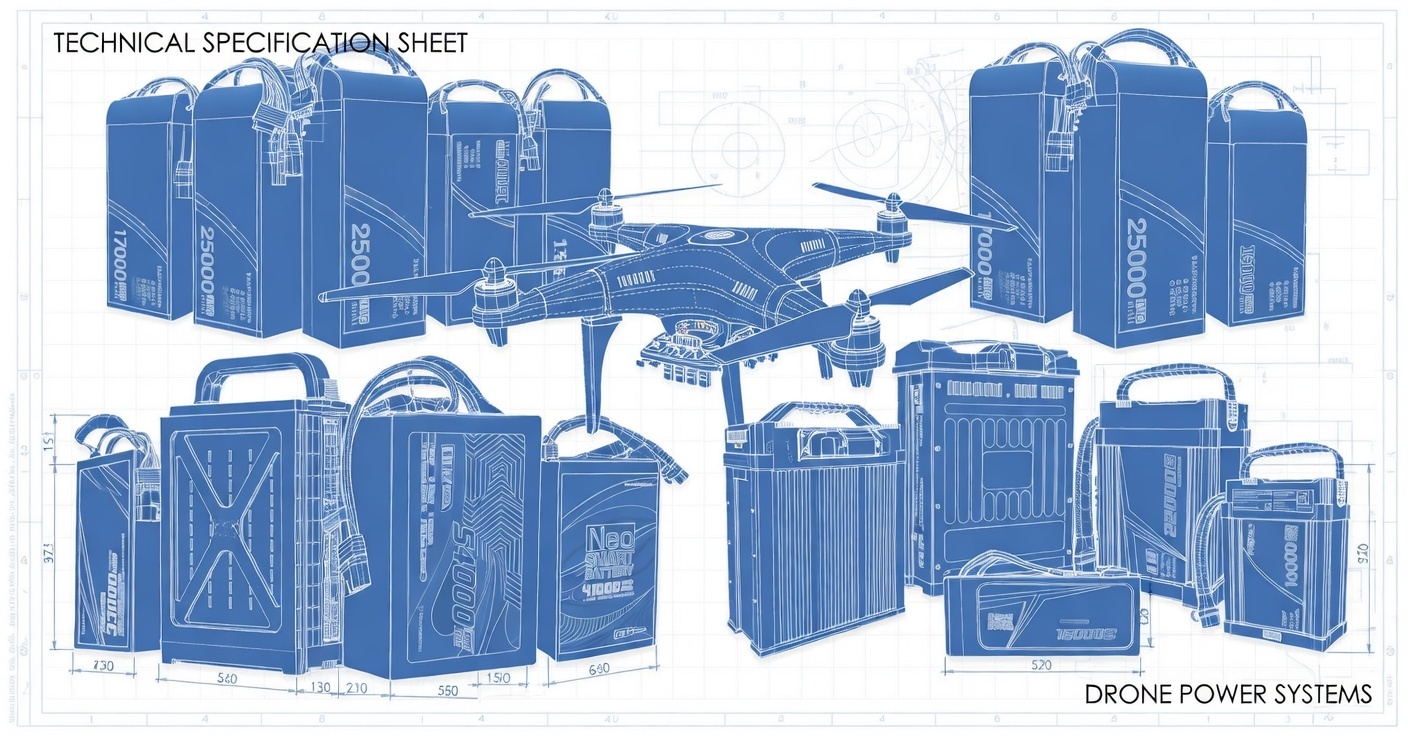
Industry Benchmark: Leading industrial drone batteries in 2026 achieve 280-310 Wh/kg, with semi-solid-state technology pushing boundaries further. A 22,000mAh 6S battery weighing approximately 1,920g represents the current standard for medium-to-large mapping drones.
What to Test:
- Verify actual capacity matches specifications under realistic load conditions
- Measure weight-to-capacity ratio to ensure optimal flight efficiency
- Assess how capacity degrades over 100+ charge cycles
User Benefit: Higher energy density translates directly to extended flight times, allowing surveyors to cover larger areas per mission and reduce the number of battery swaps needed during critical operations.
2. Discharge Rate (C-Rate) Stability Under Load
The C-rate indicates how quickly a battery can safely discharge its energy. Construction mapping drones experience variable power demands—hovering consumes less power than rapid ascents or flying against wind.
Industry Benchmark: Professional mapping drones require batteries with sustained discharge rates of 10C-15C, with peak capabilities reaching 20C-25C for emergency maneuvers. Lower C-rates cause voltage sag, triggering premature low-battery warnings.
What to Test:
- Monitor voltage stability curves during high-discharge scenarios
- Measure capacity retention at different C-rates (1C, 5C, 10C)
- Identify voltage collapse points that indicate battery weakness
User Benefit: Stable discharge performance ensures consistent power delivery throughout the mission, preventing unexpected landings and maintaining sensor accuracy during critical data capture moments.
3. Cycle Life and Long-Term Durability
Cycle life refers to the number of complete charge-discharge cycles a battery can undergo before its capacity drops below 80% of original specifications. Construction companies operating drone fleets daily cannot afford frequent battery replacements.
Industry Benchmark: Quality LiPo batteries for industrial applications should deliver 500-1,000 cycles when properly maintained. Premium cells with cobalt-based chemistry often exceed these figures.
What to Test:
- Conduct accelerated cycle testing (100+ cycles) to project long-term performance
- Track capacity degradation patterns over time
- Evaluate recovery characteristics after deep discharge events
User Benefit: Extended cycle life reduces total cost of ownership, minimizes operational interruptions for battery replacements, and ensures consistent performance throughout the battery’s service life.
4. Thermal Management and Temperature Tolerance
Construction sites expose drones to extreme conditions—scorching summer heat, cold winter mornings, and everything in between. Battery chemistry is highly temperature-sensitive, affecting both performance and safety.
Industry Benchmark: Industrial-grade drone batteries should operate reliably between -10°C to 50°C ambient temperatures. Advanced thermal management systems prevent overheating during high-discharge operations.
What to Test:
- Measure performance degradation at temperature extremes
- Monitor internal cell temperatures during sustained high-load operations
- Verify thermal protection mechanisms activate appropriately
User Benefit: Robust thermal performance enables year-round operations without seasonal limitations, reduces risk of thermal runaway incidents, and maintains consistent flight times regardless of weather conditions.
5. Safety Certifications and Compliance Standards
Battery safety isn’t optional—it’s mandatory. Construction mapping companies must ensure their drone batteries meet international transportation and operational safety standards to avoid liability issues and ensure insurance coverage.
Industry Benchmark: Look for UN38.3 (transportation safety), CE (European conformity), RoHS (hazardous substances), and MSDS (material safety) certifications. Aviation-specific standards like MH/T 1052-2025 provide additional assurance for commercial operations.
What to Test:
- Verify all certification documentation is current and authentic
- Conduct independent safety testing for overcharge, over-discharge, and short-circuit protection
- Review manufacturer’s quality control processes and traceability systems
User Benefit: Certified batteries reduce legal and insurance risks, ensure smooth transportation across borders, and demonstrate due diligence to clients and regulatory bodies.
Performance Testing Protocol: Putting Theory into Practice
Selecting the right battery is only half the battle. Construction mapping companies should implement a systematic performance testing protocol:
Pre-Deployment Testing:
- Capacity verification at rated discharge rates
- Voltage stability assessment under simulated mission profiles
- Thermal imaging during sustained high-load operations
Ongoing Monitoring:
- Track cycle counts for each battery in the fleet
- Log performance metrics after every 50 cycles
- Flag batteries showing >10% capacity degradation for replacement
Documentation Requirements:
- Maintain battery health records for compliance audits
- Document all testing procedures and results
- Establish clear replacement criteria based on objective metrics
Conclusion: Investing in Battery Performance Pays Dividends
For construction mapping companies, drone batteries are not disposable commodities—they are mission-critical components that directly impact data quality, operational efficiency, and bottom-line profitability. By prioritizing the five key factors outlined above—energy density, discharge rate stability, cycle life, thermal management, and safety certifications—companies can build reliable drone fleets that consistently deliver exceptional results.
Performance testing isn’t just about avoiding failures; it’s about optimizing every flight to maximize data collection efficiency and minimize operational costs. Companies that implement rigorous battery selection and testing protocols gain competitive advantages through reduced downtime, extended equipment life, and enhanced client confidence.
Ready to Optimize Your Drone Battery Performance?
Don’t let battery limitations hold back your construction mapping operations. Our team specializes in high-performance drone battery solutions tailored for industrial surveying and mapping applications. We offer comprehensive performance testing, custom battery configurations, and ongoing technical support to ensure your drone fleet operates at peak efficiency.
Contact us today for a customized battery solution that meets your specific operational requirements. Visit our contact page at https://cnsbattery.com/drone-battery-home/drone-battery-contact to speak with our technical experts and discover how the right battery strategy can transform your construction mapping capabilities.
Your next mission deserves reliable power. Let’s make it happen together.