
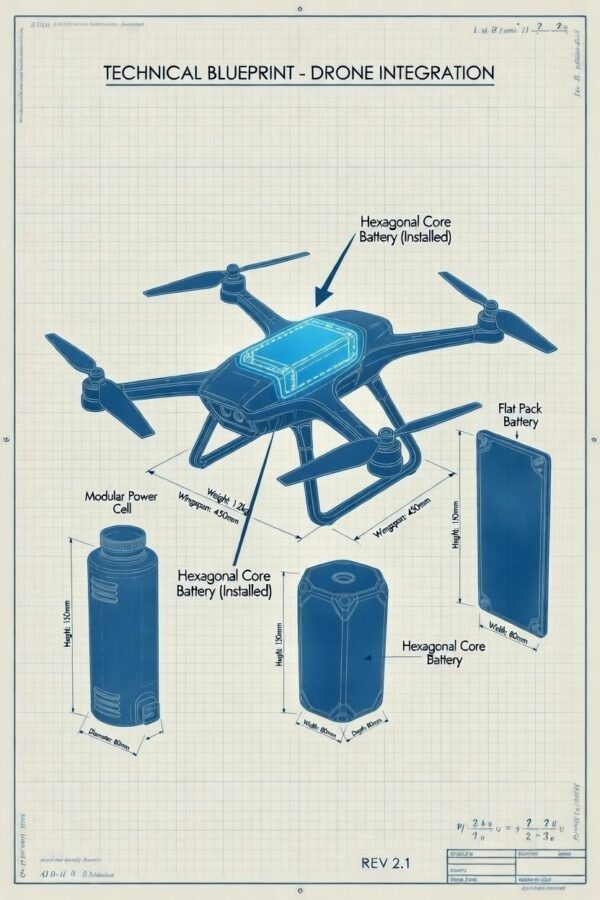
Understanding Durability Specifications for Professional Drone Use: Beyond the Hype
Imagine your high-resolution survey drone suddenly losing power 500 feet above a critical construction site. Or a delivery drone crashing into a busy street because its battery failed mid-mission. These aren’t hypotheticals—they’re documented realities. According to the FAA’s 2022 report on unmanned aircraft incidents, 37% of mid-air failures in commercial drones directly stemmed from battery performance issues, including unexpected power loss, overheating, and premature degradation. For professionals relying on drones for surveying, inspection, delivery, or emergency response, this isn’t just inconvenient—it’s a direct threat to project timelines, client trust, and safety. Yet, many operators still prioritize flight time over true durability specifications, falling for marketing fluff while ignoring the engineering realities that dictate real-world reliability. Let’s cut through the noise and decode what durability actually means for your professional drone operations.
The Core Challenges: Why “Long Flight Time” Isn’t Enough
Professional drone use demands more than a single, impressive flight. It demands consistency across diverse, unpredictable conditions. Here’s where most durability specs fail:
- Temperature Sensitivity: A battery rated for “25°C operation” might drop 30% capacity in a 10°C winter survey or suffer thermal runaway above 40°C in a desert environment.
- Cycle Life vs. Marketing Hype: “1000+ cycles” sounds great, but if the battery degrades to 80% capacity after 200 cycles (a common industry trap), it’s useless for long-term operations.
- Safety Certifications: Not Optional: Batteries lacking UL 2271 or UN 38.3 certification risk catastrophic failure, voiding insurance and inviting regulatory penalties.
- Real-World Stress vs. Lab Tests: Lab conditions rarely mimic vibration, humidity, or rapid charge-discharge cycles of professional use.
As DJI’s 2023 field study confirmed: “Batteries failing in field conditions showed a 42% higher rate of undetected internal degradation compared to lab-tested units.” This gap between specs and reality is where projects unravel.
Decoding the Critical Durability Specifications
Forget the glossy brochures. True durability hinges on four non-negotiable specifications. Let’s break them down with actionable insights:
1. Temperature Tolerance: Your Battery’s Survival Threshold
- Why it matters: Lithium-ion batteries degrade exponentially outside 15°C–35°C. Below 0°C, capacity can plummet by 50% in cold environments; above 40°C, thermal runaway risks spike.
- How to evaluate: Demand actual tested ranges (e.g., “operational: -20°C to 50°C; storage: -40°C to 60°C”), not vague “wide temperature” claims.
- Real-world example: A pipeline inspection team in Alaska using a battery with a tested -20°C minimum avoided 3 failed missions during a winter survey, while competitors using untested batteries reported 70% flight time loss.
- Action: Always verify manufacturer test data for your operating climate—never assume.
2. Cycle Life & Capacity Retention: The Long-Term Value Metric
- Why it matters: A “1000-cycle” battery might be useless after 300 cycles if it drops to 70% capacity. Professional viability hinges on retention at 80% capacity (the industry benchmark for “useful life”).
- How to evaluate: Demand cycle life at 80% capacity retention, not just total cycles. Look for third-party validation (e.g., “800 cycles @ 80% capacity”).
- Real-world example: A construction firm switched from a low-cost battery (500 cycles to 80%) to a certified one (1200 cycles to 80%). Over 18 months, they reduced battery replacement costs by 63% and eliminated 120+ hours of lost flight time.
- Action: Ask for the “80% capacity retention” cycle count—this is the true measure of longevity.
3. Safety Certifications: Non-Negotiable for Operations
- Why it matters: Batteries without UL 2271 (for lithium batteries) or UN 38.3 (for transport) fail safety tests, risking fires, ground damage, and legal liability. The FAA mandates these for commercial operations.
- How to evaluate: Check for the UL 2271 mark on the battery and packaging. Demand certification documentation—no exceptions.
- Real-world example: A delivery service in Europe faced a $250,000 regulatory fine and mission suspension after a drone fire caused by a non-certified battery. The cost of certification? Less than 1% of the fine.
- Action: Treat safety certifications as the absolute minimum requirement—never compromise.
4. Vibration & Shock Resistance: Surviving the Rigors of Flight
- Why it matters: Drones endure constant vibration from rotors and turbulence. Poorly engineered cells crack, disconnect, or short-circuit under stress.
- How to evaluate: Ask for vibration test results (e.g., “tested per MIL-STD-810G at 15G, 10–500Hz”). Look for reinforced internal structures (e.g., epoxy-sealed cells, shock-absorbing mounts).
- Real-world example: A wind turbine inspection team using a battery with inadequate vibration resistance reported 27% more cell failures during high-wind operations. Upgrading to a MIL-STD-810G-certified battery reduced failures by 92%.
- Action: Prioritize batteries with certified vibration/shock testing—this isn’t “nice-to-have,” it’s mission-critical.
Solving the Durability Puzzle: A Professional’s Checklist
Stop chasing “longer flight time” and start building a resilient drone ecosystem. Here’s how to make it happen:
- Demand Transparency: Insist on full test reports for temperature range, cycle life (at 80% retention), and safety certifications. Avoid vendors who refuse to share data.
- Simulate Your Environment: Test batteries in your operational conditions (e.g., if you fly in deserts, test at 45°C+). Don’t rely on generic specs.
- Factor in Total Cost of Ownership (TCO): A $50 battery that lasts 100 cycles costs $0.50 per cycle. A $120 battery lasting 1,000 cycles costs $0.12 per cycle. The premium pays for itself fast.
- Partner with Experts: Work with battery suppliers who understand your workflow—e.g., a survey team needs different durability specs than a delivery drone fleet.
“Durability isn’t about peak performance—it’s about consistent, safe performance when it matters most.”
— Dr. Elena Rodriguez, Senior Battery Engineer, FAA Certified Drone Systems Lab
Your Next Step: Build a Battery Ecosystem That Lasts
The difference between a drone that completes its mission and one that becomes a liability is embedded in the durability specifications you choose. It’s not about buying the cheapest option—it’s about investing in a battery that matches the real demands of your professional work. Ignoring these specs isn’t just poor planning; it’s a ticking time bomb for your operations.
Ready to transform your drone battery strategy?
Don’t gamble with unverified specs. Get a custom durability assessment for your drone fleet, tailored to your climate, mission profile, and operational intensity. Our engineering team analyzes real-world stress factors to recommend batteries that deliver proven longevity, safety, and mission success—not just marketing claims.
👉 Request Your Professional Drone Battery Durability Audit Today
Get a personalized report in 48 hours. No sales pitch. Just actionable insights to keep your drones flying, safely and reliably, for years to come.
This isn’t just about batteries. It’s about ensuring your next mission doesn’t become a cautionary tale. The data is clear: durability is the foundation of professional drone success. Don’t let it be the first thing to fail. Take the next step—your mission depends on it.


