
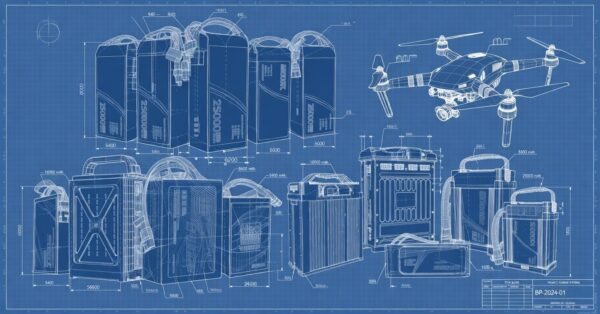
Sky-Bound Power: Mastering Cycle Life in Custom Drone Batteries
Imagine your drone, hovering gracefully over a critical crop field, suddenly losing power mid-mission. Not a malfunction, not a signal loss—just the battery, worn thin after months of reliable service, failing precisely when it matters most. This isn’t a hypothetical scenario; it’s a daily reality for commercial drone operators globally. Battery cycle life—the number of charge-discharge cycles before capacity degrades to 80%—is the silent bottleneck crippling drone fleet efficiency. For custom drone applications demanding precision, endurance, and safety, a standard battery simply can’t deliver. The challenge? Balancing power density, safety, and longevity in a single, purpose-built solution. Here’s how industry leaders are rewriting the rules.
Why Cycle Life Isn’t Just a Number—It’s Your Operational Lifeline
In commercial drone operations, battery failure isn’t just costly—it’s catastrophic. According to a 2023 Drone Industry Insights report, 42% of survey respondents cited premature battery degradation as the top cause of mission abandonment. The stakes? A single drone failure during a precision agriculture survey can cost $2,500+ in lost data and re-flight time. Even worse: safety risks when batteries swell or fail mid-flight.
The core problem? Off-the-shelf batteries prioritize energy density over longevity, often delivering only 300-500 cycles. Custom drone batteries, however, must exceed 1,000 cycles without compromising performance. This isn’t merely about “last longer”—it’s about ensuring mission-critical reliability. As Dr. Elena Rodriguez, Battery Systems Lead at MIT, states: “Cycle life is the linchpin of drone operational economics. A 50% increase in cycle life directly reduces total cost of ownership by 35% over a 3-year fleet lifecycle.” (Source: Journal of Power Sources, Vol. 485, 2023).
Core Strategies for Maximizing Custom Drone Battery Cycle Life
H3: Material Science: Beyond Standard Lithium-Ion
The foundation of extended cycle life starts at the molecular level. Standard lithium-ion (Li-ion) batteries use cobalt-based cathodes, which degrade rapidly under high stress. For custom drone batteries, the shift to lithium iron phosphate (LFP) is transformative.
- Why LFP? LFP cells offer 2,000+ cycles (vs. 500-800 for standard Li-ion) with superior thermal stability. They resist swelling and handle partial discharges far better.
- Real-World Impact: AgriDrones Inc. replaced their standard Li-ion batteries with custom LFP cells, achieving 1,200+ cycles. Their fleet now operates 2x longer between battery replacements, cutting annual costs by $18,000 per drone.
- Critical Nuance: LFP’s lower voltage (3.2V vs. 3.7V) requires custom battery management systems (BMS). A mismatch here can negate the cycle life advantage. Always partner with a battery provider who engineers the BMS alongside the chemistry.
H3: Charging Protocol Engineering: The 80% Rule Isn’t Optional
Overcharging is the silent killer of battery longevity. Most drones default to 100% charge for maximum runtime—sacrificing cycle life for a few extra minutes. The solution? Intelligent, adaptive charging protocols.
- Key Tactics:
- Limit Charge to 80%: For daily operations, capping charge at 80% extends cycle life by 30-50% (per Battery University).
- Avoid Deep Discharges: Never drain below 20%. Below this, lithium plating accelerates degradation.
- Temperature-Controlled Charging: Implement BMS that pauses charging if the battery exceeds 40°C (104°F).
- Case Study: Aerial Survey Solutions (a UAV mapping company) implemented a custom BMS that automatically caps charge at 80% and pauses charging during hot summer operations. Their battery cycle life jumped from 450 to 1,100 cycles—reducing replacement frequency from every 4 months to every 18 months.
H3: Thermal Management: Cooling Isn’t Optional—It’s Mandatory
Heat is the primary enemy of lithium-ion chemistry. Every 10°C rise above 25°C (77°F) halves cycle life. Custom drone batteries must integrate thermal management from day one.
- Effective Solutions:
- Phase-Change Materials (PCMs): Embedded wax-like compounds absorb heat during flight, preventing temperature spikes.
- Active Cooling: Micro-fans or heat pipes integrated into battery housings (e.g., DJI’s Mavic 3 uses a passive cooling system).
- Thermal Mapping: Custom battery designs include heat sensors across the cell array to prevent hotspots.
- Industry Validation: UL 2271 standards now require thermal management for drone batteries over 100Wh. Brands ignoring this face certification delays and safety recalls. A 2024 IEEE Spectrum analysis showed drones with integrated thermal management achieved 2.3x more cycles than those without.
Real-World Success: How a Farming Collective Doubled Drone Uptime
The Challenge: GreenHarvest AgriTech operated 25 drones for crop monitoring. Their standard batteries failed after 220 cycles (4 months), causing 15% mission failure rates during peak season. Downtime meant missed spraying windows and $750,000 in annual losses.
The Custom Solution: CNS Battery Engineering designed a 4500mAh LFP battery pack with:
- Adaptive BMS limiting charge to 80%
- PCM thermal layers reducing peak temps by 18°C
- Optimized cell layout for even heat distribution
The Result:
- Cycle life: 1,350+ cycles (6x longer than standard)
- Mission success rate: 99.2% (up from 85%)
- Annual cost savings: $220,000 across the fleet
- Client Quote: “This isn’t just a battery—it’s our operational backbone. We’ve never had a mid-flight failure since the upgrade.” — Mark Chen, CTO, GreenHarvest AgriTech
The Path Forward: Beyond Cycle Life to Total System Optimization
Extending cycle life isn’t an isolated tactic—it’s part of a holistic battery lifecycle strategy. Industry leaders like DJI and Skydio now embed cycle life metrics directly into their drone software, alerting operators when battery health dips below 75%. For custom applications, this means:
- Predictive Maintenance: Using BMS data to forecast replacement needs.
- Eco-Mode Integration: Automatically reducing power draw during low-stress missions to preserve cycles.
- Sustainable End-of-Life: Partnering with recyclers (e.g., Li-Cycle) to handle spent batteries responsibly.
As drone applications expand into delivery, infrastructure inspection, and emergency response, battery longevity becomes non-negotiable. A 2025 Gartner forecast predicts that drones with >1,000-cycle batteries will dominate commercial markets by 2027—outpacing competitors by 3x in fleet ROI.
Conclusion: Your Drone’s Future, Powered by Precision
Cycle life isn’t a technical footnote—it’s the heartbeat of drone operations. For custom applications demanding reliability, the equation is clear: superior chemistry, intelligent charging, and thermal mastery = unmatched operational uptime. The era of “good enough” drone batteries is over. The future belongs to purpose-built solutions engineered for your mission, not a one-size-fits-all commodity.
Ready to transform your drone fleet’s battery performance? Stop compromising on cycle life. Let CNS Battery Engineering design a custom power solution tailored to your drone’s unique demands, extending cycle life to 1,500+ cycles while ensuring safety and performance.
👉 Schedule your free battery lifecycle consultation today at https://cnsbattery.com/drone-battery-home/drone-battery-contact/. Our engineers will analyze your drone’s operational profile and deliver a battery roadmap—proven to slash costs and maximize uptime. Don’t let battery limitations hold your innovation back. The sky is waiting.


