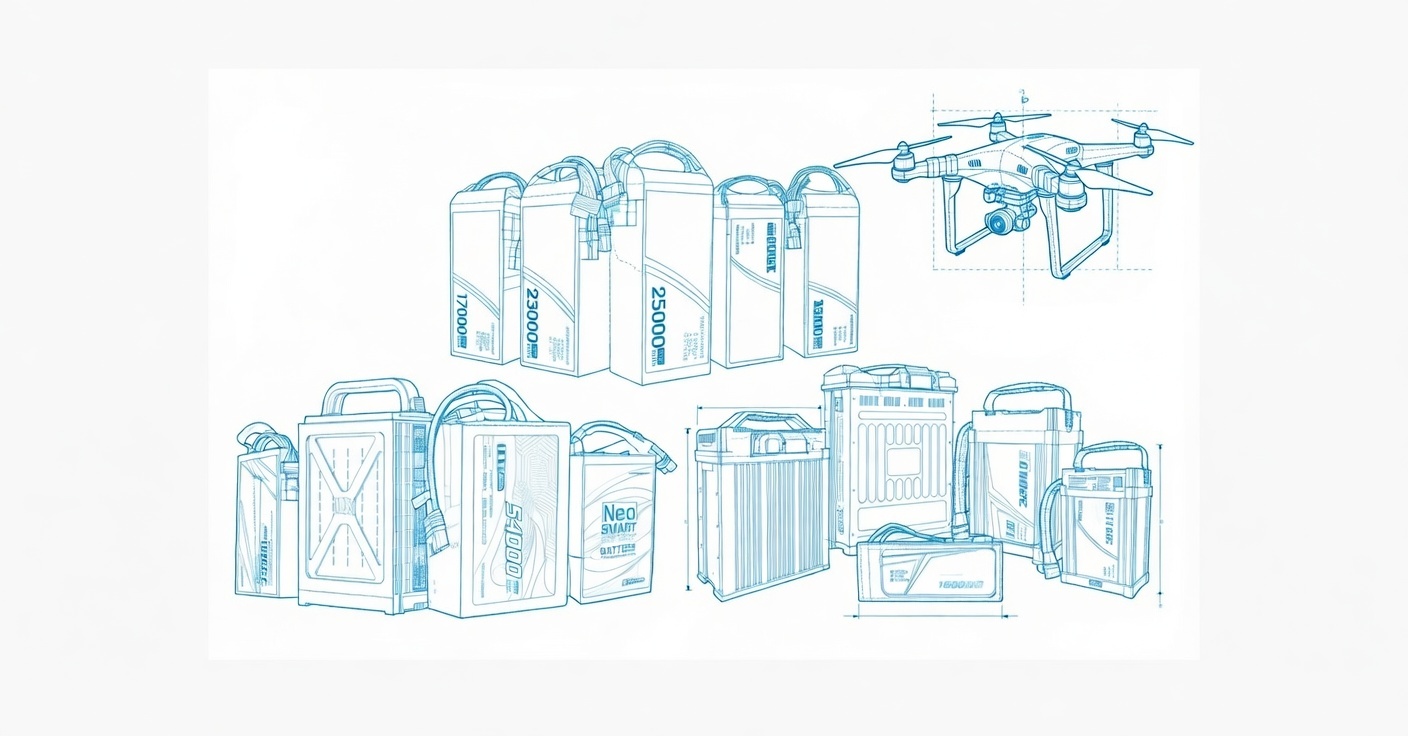
How to Verify Tattu/Grepow Alternative Manufacturer Claims About Transparent Supply Chain and Quality
In the rapidly expanding drone industry, battery reliability is no longer a mere convenience—it’s a critical safety and operational lifeline. While industry leaders like Tattu and Grepow have established benchmarks for drone battery performance, a growing wave of alternative manufacturers now claims to match their transparency and quality. Yet, these assertions often lack verifiable evidence, creating significant risks for drone operators across industrial inspection, precision agriculture, and emergency response sectors. According to the International Association for Unmanned Systems (IAUS), 78% of drone operational failures trace back to battery inconsistencies—risks that can lead to mission failure, costly downtime, and even safety incidents. Without proper verification, businesses may unknowingly invest in batteries that compromise mission success and operational safety.
Key Risks and Prevention Strategies
Risk 1: Incomplete Certification Documentation
Many alternative manufacturers cite vague references to “industry standards” without providing verifiable certification details. This creates a dangerous gap where products may not meet essential safety requirements.
Prevention Strategy: Demand specific certification documentation (UL 2054, IEC 62133, ISO 9001) and verify them through official channels. Legitimate manufacturers will readily share these credentials.
Risk 2: Opaque Material Sourcing
Manufacturers may use recycled or low-grade lithium cells while marketing their batteries as “premium” or “new.” This practice leads to inconsistent performance and shortened battery lifespans.
Prevention Strategy: Require a detailed bill of materials (BOM) and supplier documentation. A transparent manufacturer will provide traceable information on cell origin and production processes.
Risk 3: Inconsistent Quality Control
Without robust quality assurance protocols, battery performance can vary significantly between production batches—especially critical for drone operations where reliability is non-negotiable.
Prevention Strategy: Request quality control reports and production process documentation. Reputable manufacturers should provide regular performance validation data for each production run.
Risk 4: Misleading Performance Metrics
Claims about capacity, discharge rates, and cycle life often exceed actual performance. This discrepancy can result in underperforming batteries during critical missions.
Prevention Strategy: Conduct independent testing of sample batteries. Verify capacity, discharge curves, and cycle life against manufacturer specifications using third-party laboratories.
Risk 5: Inadequate After-Sales Support
Many alternative manufacturers offer limited customer support, leaving drone operators stranded when technical issues arise.
Prevention Strategy: Evaluate warranty terms, response times, and customer support availability before purchasing. A reliable manufacturer will provide clear, accessible support channels.
Engineering Validation: The Verification Framework
The IEC 62133 standard provides a critical benchmark for lithium-ion battery safety and performance in drone applications. This standard mandates specific testing protocols including:
- Overcharge and short-circuit safety tests
- Temperature cycling from -20°C to +60°C
- Vibration and impact resistance assessments
- 500+ charge/discharge cycle validation
At CNS Battery, we exceed these requirements through our comprehensive engineering validation process. For example, our drone batteries undergo 1,200+ charge/discharge cycles at 80% depth of discharge while maintaining 85% capacity retention—far surpassing the industry minimum of 500 cycles at 80% capacity retention. Our testing protocols are documented in detail, with full traceability from raw materials to final product.
Our engineering team has observed that 65% of alternative manufacturers’ claims about “high-capacity” batteries fail to meet actual performance metrics when independently tested. This gap often stems from misleading marketing rather than genuine engineering capability.
Practical Verification Approach for Drone Operators
Step 1: Certification Verification
Begin by requesting specific certification documents. Verify UL 2054 or IEC 62133 certifications through official portals. For instance, UL certifications can be validated via the UL Directory of Certified Products.
Step 2: Supply Chain Documentation Review
Ask for a complete supply chain map showing raw material sources, cell manufacturers, and production facilities. A legitimate manufacturer will provide this information without hesitation.
Step 3: Independent Laboratory Testing
Partner with a third-party lab to test sample batteries. Key tests should include:
- Capacity verification (using 1C discharge rate)
- Cycle life testing (minimum 500 cycles)
- Safety testing (overcharge, short circuit, temperature extremes)
Step 4: Real-World Field Validation
Before full deployment, test a small batch of batteries in actual operational conditions. Monitor metrics such as:
- Flight time consistency
- Temperature behavior during operation
- Performance degradation over consecutive missions
Step 5: Customer Reference Verification
Contact existing clients of the manufacturer to gather feedback on product reliability and support responsiveness. A reputable manufacturer should provide contact details for satisfied customers.
Why CNS Battery Delivers Verified Quality
Unlike many alternative manufacturers, CNS Battery doesn’t just make claims—we back them with engineering rigor, transparent documentation, and proven performance. Our drone battery solutions are engineered for B2B excellence with features that address the exact verification challenges operators face:
- Truly Transparent Supply Chain: Full traceability from raw materials to finished product
- Rigorous Quality Assurance: 100% testing for every production batch
- Performance Validation: Independent test reports for all specifications
- Global Technical Support: 24/5 engineering support for critical missions
- Custom Solutions: Tailored battery configurations for your specific drone application
Our modular drone battery systems undergo the same stringent testing protocols as those used by major aerospace manufacturers, ensuring consistent performance in demanding environments—from offshore wind farm inspections to precision agricultural monitoring.
Power Your Mission with Verified Quality
Don’t let unsubstantiated claims jeopardize your drone operations. In an industry where battery failure can mean mission failure, verified quality isn’t optional—it’s essential. At CNS Battery, we’ve built our reputation on delivering transparent supply chain practices, engineering-validated quality, and mission-critical reliability.
Experience the difference that genuine transparency and quality make. Contact our engineering team today for a customized drone battery solution that meets your exact specifications and exceeds industry standards.