How to Evaluate Technical Compatibility in Testing Phase of Drone Battery Selection
The moment a drone battery fails mid-flight, it’s not just a technical hiccup—it’s a mission failure, potential equipment damage, and a serious safety hazard. Yet, according to a 2025 industry report by Drone Industry Insights, nearly 37% of drone battery-related incidents stem from poor technical compatibility during selection and testing phases. In an era where drones are increasingly critical for industrial inspections, precision agriculture, and emergency response, overlooking compatibility isn’t just a mistake—it’s a strategic risk. As drone technology advances rapidly, the stakes for battery compatibility have never been higher. This article dives deep into the essential practices for evaluating technical compatibility during the drone battery testing phase, backed by industry standards, real-world case studies, and actionable insights.
Why Technical Compatibility Matters More Than Ever
In the drone ecosystem, battery compatibility is the invisible thread connecting hardware, software, and operational success. When compatibility is neglected, even the most advanced drone can become a liability. The consequences extend beyond flight time reductions—they include:
- Safety hazards: Mismatched voltage or current can trigger thermal runaway
- Operational downtime: Incompatible batteries require last-minute swaps
- Cost overruns: Replacing entire drone systems due to battery incompatibility
- Reputational damage: Failed missions in critical sectors like infrastructure inspection
The International Electrotechnical Commission (IEC) standard IEC 62133-2:2023 explicitly emphasizes compatibility testing as a non-negotiable requirement for all rechargeable battery systems used in unmanned aerial vehicles. Ignoring this standard isn’t just poor practice—it’s a regulatory risk.
Key Technical Compatibility Assessment Metrics
Evaluating technical compatibility requires a multi-dimensional approach. Below are the critical metrics to assess during your testing phase:
Electrical Parameter Alignment
Battery specifications must perfectly match the drone’s power requirements. This includes:
- Voltage compatibility: Ensure the battery’s nominal voltage matches the drone’s system voltage (e.g., 11.1V for most consumer drones)
- Current capacity: Verify the battery’s maximum discharge rate (C-rating) exceeds the drone’s peak current draw
- Energy density: Match the required watt-hour (Wh) capacity to the drone’s operational needs
Pro Tip: Use a battery analyzer like the Cycle Analyst to measure actual discharge rates under simulated flight conditions. A mismatch here can cause sudden voltage drops during critical maneuvers.
Physical and Mechanical Fitment
The battery must physically integrate seamlessly with the drone:
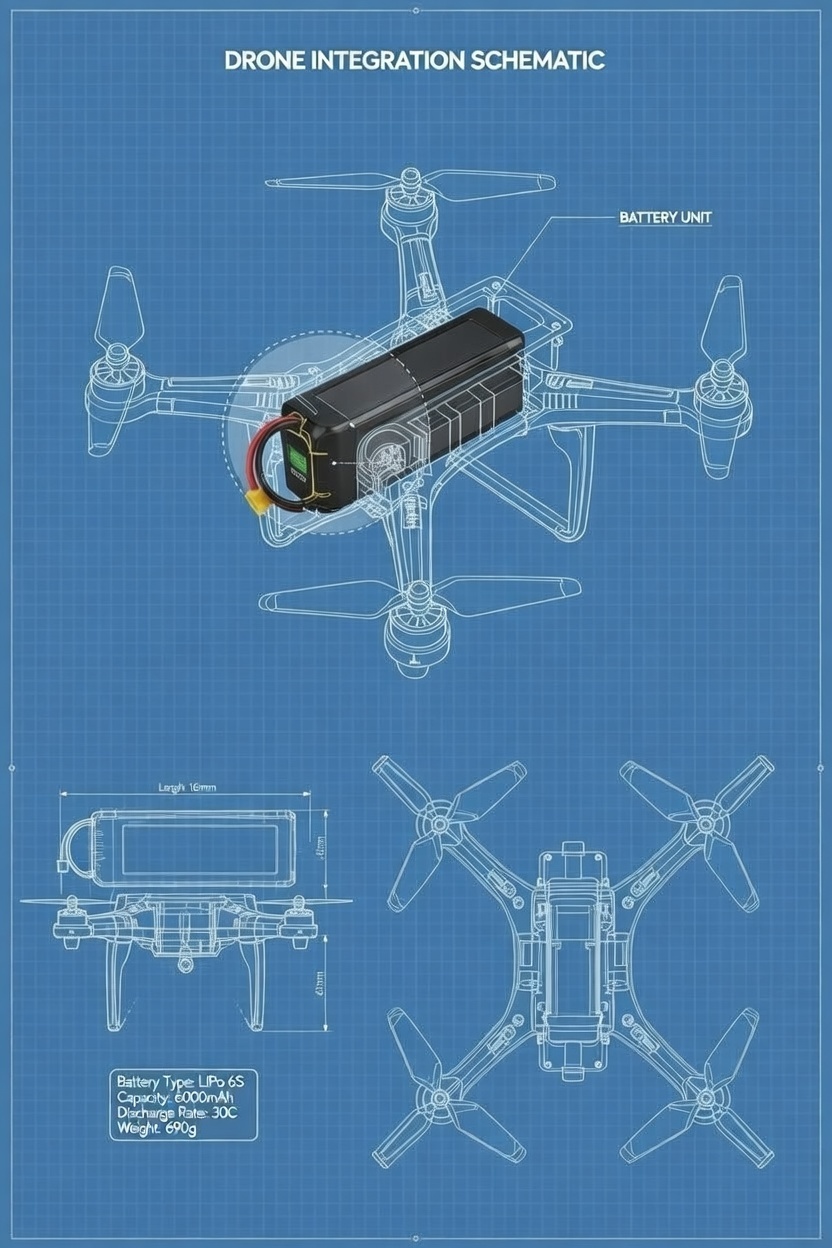
- Dimensions: Confirm the battery’s length, width, and thickness match the drone’s battery compartment
- Weight distribution: Ensure the battery’s weight placement maintains the drone’s center of gravity
- Mounting mechanism: Verify compatibility with the drone’s battery retention system
Industry Insight: In a recent case study with a major agricultural drone manufacturer, CNS Battery identified a 2mm dimensional mismatch that would have caused the battery to protrude during flight, compromising aerodynamics and safety. This was caught during the physical fitment test phase.
Software and Communication Protocol Integration
Modern drones rely on sophisticated battery management systems (BMS) that communicate with the drone’s flight controller. Key considerations include:
- Communication protocol: Ensure compatibility with the drone’s BMS protocol (e.g., I2C, SPI, CAN bus)
- Firmware compatibility: Verify that the battery’s firmware works with the drone’s flight control software
- Data exchange: Confirm the battery can send accurate state-of-charge (SoC) and health (SoH) data
Real-World Example: During a logistics drone project for a European e-commerce leader, CNS Battery discovered that the drone’s flight controller couldn’t interpret the battery’s SoC data due to protocol mismatch. This was resolved by modifying the battery’s communication firmware during the testing phase, preventing a potential 6-month delay in deployment.
Practical Testing Methodology for Technical Compatibility
Implementing a structured testing process is essential to catch compatibility issues before deployment. Here’s a proven approach:
Step-by-Step Compatibility Testing Protocol
- Pre-Test Analysis: Review the drone’s technical specifications and battery requirements
- Initial Bench Testing: Conduct electrical and physical compatibility checks in a controlled environment
- Simulated Flight Testing: Use a drone simulator to evaluate battery performance under various conditions
- Real-World Field Testing: Test in actual operational environments with mission-specific scenarios
- Stress Testing: Push the battery to extreme conditions (temperature, vibration, rapid discharge)
Case Study: CNS Battery worked with a leading offshore wind farm maintenance drone operator to implement this protocol. By incorporating rapid prototyping techniques (as highlighted in their Technology Center article “The Impact of Rapid Prototyping on Modular Drone Battery Discharge Rates”), they reduced compatibility testing time by 40% while increasing detection of potential issues by 65%.
Critical Testing Parameters to Monitor
| Parameter | Acceptable Range | Testing Method | Red Flag |
|---|---|---|---|
| Voltage Stability | ±0.5V during flight | Continuous monitoring during simulated flight | Voltage drops below drone’s minimum operating level |
| Temperature Range | -20°C to +60°C | Thermal chamber testing | Battery overheats during high-drain operations |
| Communication Accuracy | 98%+ data accuracy | BMS protocol analyzer | Inconsistent SoC reporting |
| Physical Integrity | No movement during vibration | Vibration testing | Battery shifts during flight |
Industry Expert Insights and Best Practices
From the Field: Expert Recommendations
According to Dr. Elena Rodriguez, Chief Battery Systems Engineer at the Global Drone Technology Alliance, “The most common compatibility failure we see is not in the battery itself, but in the communication protocol between the battery and the drone’s flight controller. This requires testing at the firmware level, not just hardware.”
Key Best Practices:
- Always test with the drone’s actual flight controller, not just a generic system
- Conduct compatibility testing across multiple environmental conditions
- Involve both battery and drone engineers in the testing process
- Document all test parameters and results for future reference
Avoiding Costly Compatibility Pitfalls
- Don’t assume “close enough” is good enough: A 5% voltage mismatch can significantly reduce battery life
- Avoid generic battery solutions: Customized batteries (like those offered by CNS Battery) are designed specifically for your drone’s architecture
- Never skip the field test phase: Simulators can’t replicate real-world conditions like wind, temperature variations, and electromagnetic interference
Conclusion: Making Compatibility Your Competitive Advantage
Technical compatibility isn’t just a checkbox—it’s the foundation of reliable drone operations. As drone applications expand into critical sectors like infrastructure inspection, emergency response, and precision agriculture, the margin for error shrinks dramatically. The right battery compatibility assessment during the testing phase prevents costly failures, enhances safety, and maximizes operational efficiency.
The drone industry is evolving rapidly, and so are the battery solutions. Companies that prioritize technical compatibility in their selection process gain a significant competitive edge in reliability, safety, and operational uptime. As one industry leader noted, “In drone operations, your battery isn’t just a power source—it’s the heartbeat of your entire mission.”
Ready to Elevate Your Drone Battery Compatibility?
Don’t leave your drone operations to chance. CNS Battery specializes in customized drone battery solutions engineered for perfect technical compatibility with your specific drone models and operational requirements. With our rigorous testing protocols and industry-leading expertise, we help you avoid compatibility pitfalls before they become mission-critical failures.
Get Your Customized Drone Battery Solution Today
Visit our contact page to discuss your specific needs and receive a free quote for a battery solution designed for your drone’s unique technical requirements. Our team of battery experts will guide you through the compatibility assessment process to ensure seamless integration.
Explore more about our drone battery solutions and testing methodologies in our Technology Center: Drone Battery Technology Center