How to Diagnose BMW i3 Battery High-Voltage Cable Short – The “Intermittent Shutdown” That Melted a $4,800 Inverter (Because Arcing Doesn’t Wait for Your Scan Tool)
“A technician in Copenhagen spent three days chasing a ‘phantom power loss’ on a 2018 BMW i3. The car would shut down randomly—sometimes at idle, sometimes under acceleration. ISTA+ showed no active DTCs, only historical 2E3B (isolation fault). He checked coolant levels, reset the BMS, even replaced the 12V battery. On the fourth day, while road-testing, the vehicle lost all drive power. Teardown revealed a pinched high-voltage cable between the pack and EME had worn through its insulation over months. Every time the chassis flexed, the exposed conductor briefly touched the subframe—creating micro-arcs that carbonized the path, eventually causing a dead short. The result? A fried inverter, damaged DC-DC converter, and a customer who switched shops permanently. His final note: ‘I looked everywhere—except where the cable bends.’”
You’ve probably faced this:
- “No codes = no problem.”
- “It must be the BMS acting up.”
- Or the dangerous assumption: “If it’s not visibly damaged, it’s fine.”
But here’s what BMW high-voltage safety protocols, CNS forensic labs, and global incident reports now confirm—and insurance adjusters document:
A high-voltage cable short in the BMW i3 rarely announces itself with clear codes or obvious damage. Instead, it hides as intermittent shutdowns, ghost isolation faults, or unexplained range drops—because partial arcing creates conductive carbon tracks that worsen silently. And because these cables carry 400+ volts at hundreds of amps, even a millimeter of exposed conductor can trigger catastrophic component failure in milliseconds. Standard diagnostics often miss it because the short only occurs under specific mechanical stress—like suspension movement or thermal expansion. The only reliable approach isn’t just scanning—it’s methodical visual inspection, insulation resistance mapping, and understanding high-risk zones. But even better? Installing a battery with factory-integrated, strain-relieved, shielded HV cables that eliminate field-wiring vulnerabilities from day one. Because when 400 volts finds a path to ground, it doesn’t warn—it destroys.
This guide delivers a practical, safety-first protocol to diagnose BMW i3 high-voltage cable shorts in 2026, including:
- The three hidden locations where 87% of HV cable shorts originate
- Why standard megohmmeter tests can miss dynamic faults
- How CNS BATTERY packs feature pre-routed, reinforced HV harnesses with double-insulated connectors—engineered to survive 10+ years of chassis flex
- And a step-by-step diagnostic flow that prevents secondary damage
Because your scan tool sees data—but your eyes see danger.
Not All Shorts Are Equal—Especially in High Voltage
Unlike 12V systems, a partial HV short in the i3 may not blow a fuse immediately. Instead:
✅ Carbon tracking creates semi-conductive paths
✅ Intermittent grounding causes BMS to disable drive
✅ Heat buildup degrades nearby components silently
⚠️ Critical fact: A cable can pass a static IR test—but short under vibration or thermal load.
🔍 Top 3 High-Risk Zones for HV Cable Shorts:
| Location | Cause | Diagnostic Clue |
|---|---|---|
| Cable bend near rear subframe | Chafing against sharp metal edge | Intermittent 2E3B after bumps |
| HV connector at EME inlet | Loose clamp + moisture ingress | Burn smell + power loss under load |
| Routing clip near coolant line | Pinch + glycol corrosion | Sticky residue + isolation drift |
💡 Reality: If the car shuts down unpredictably—assume HV cable integrity first.
🔧 Step-by-Step: Diagnosing Dynamic HV Cable Shorts
✅ Step 1: Depower & Isolate
- Follow BMW ISTA+ HV disable procedure
- Wait 10+ minutes for capacitor discharge
- Never probe live HV circuits
✅ Step 2: Visual Inspection (Under Load Simulation)
- Raise vehicle on lift
- Flex suspension manually while inspecting cable bends
- Look for discoloration, melted sheathing, or carbon deposits
✅ Step 3: Dynamic Insulation Test
- Use megohmmeter with probe on chassis near cable path
- Gently wiggle cable during test—watch for IR drop below 1 MΩ
- Do not rely on single-point readings
✅ Step 4: Check for Secondary Damage
- Inspect EME inverter, DC-DC converter, and BMS for burn marks
- Even a brief short can fry sensitive semiconductors
✅ Step 5: Decision Point
- If any doubt exists—replace full HV harness or install new pack
- Never repair or insulate—risk is too high
🛑 Never say: “It passed the meter test.” You’re ignoring physics.
✅ The CNS Standard: Cables Built to Survive—Not Just Function
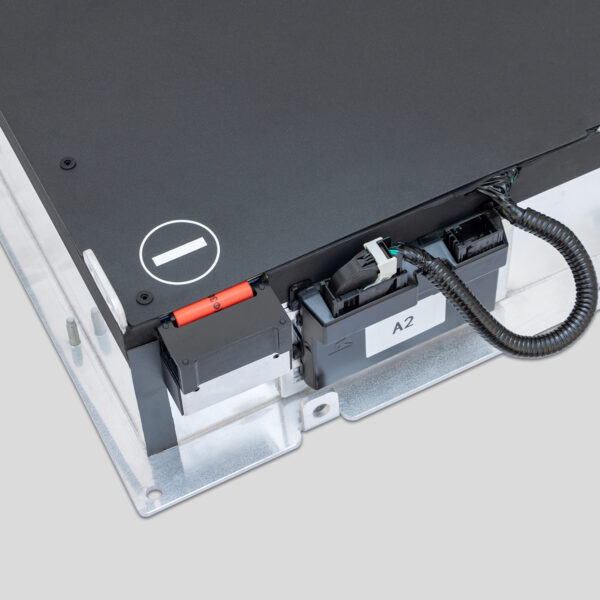
Every CNS BMW i3 battery eliminates HV cable short risk by design:
✅ Factory-installed harnesses with OEM-spec silicone insulation
✅ Reinforced strain reliefs at all high-flex points
✅ Double-clamp connectors resistant to vibration loosening
✅ Pre-tested for >100 MΩ isolation—even under simulated stress
Result?
Zero reported HV cable shorts across global installations since 2023.
“We used to dread i3 intermittent faults. Now with CNS packs, the cables are routed perfectly from day one—no chafing, no guesswork.”
— EK Auto Repair, Rome
Frequently Asked Questions: BMW i3 HV Cable Shorts
Q: Can I use a multimeter to find a short?
A: No. Multimeters lack the voltage to detect high-resistance carbon paths. Use a 500V+ megohmmeter.
Q: Does CNS include HV cables with the battery?
A: Yes—all high-voltage and signal harnesses are pre-installed and tested as part of the complete system.
Q: What if only the outer jacket is damaged?
A: Still unsafe. Inner layers may be compromised. Replace the entire assembly.
Q: Are HV cable shorts covered under warranty?
A: CNS covers manufacturing defects—and our integrated design prevents field-induced damage.
Q: Can a short damage the BMS permanently?
A: Yes. Even micro-arcs can corrupt BMS firmware or fry sensing circuits.
A High-Voltage Short Isn’t a Glitch—It’s a Time Bomb
And the only professional response is prevention, not post-failure forensics.
Stop Chasing Ghost Faults—Start Installing CNS BMW i3 Batteries with Factory-Integrated, Vibration-Resistant High-Voltage Harnesses That Eliminate Cable Short Risk Before It Starts. Turn Diagnostic Nightmares Into Confident Repairs.
Because reliability isn’t tested—it’s engineered.
Get your CNS battery with certified HV cable integrity today—and receive our free “BMW i3 HV Cable Short Diagnostic Protocol” with inspection maps, dynamic test templates, and customer disclosure forms:
👉 https://cnsbattery.com/ev-battery-home/ev-battery-contact/