
Expert Advice: Overcoming Fast Charging in Drone Battery Purchasing for Pipeline Monitoring Firms
In the high-stakes world of infrastructure management, pipeline monitoring firms operate on a razor-thin margin between efficiency and operational downtime. Unmanned Aerial Vehicles (UAVs) have become the backbone of modern inspection protocols, offering thermal imaging, leak detection, and structural analysis over vast, often inaccessible terrains. However, as drone fleets expand and mission criticality increases, a singular bottleneck threatens to undermine these technological advantages: battery recharge time. For procurement officers and operations managers, the challenge is no longer just about buying batteries; it is about engineering a workflow that minimizes ground time while maximizing air time. This guide provides expert advice on navigating the complexities of fast-charging drone battery purchasing, specifically tailored for the rigorous demands of pipeline monitoring.
The Hidden Costs of Downtime in Pipeline Surveillance
Pipeline networks often stretch across hundreds of miles, traversing remote deserts, dense forests, and mountainous regions. In such environments, the logistics of power management become a critical operational variable. Traditional charging cycles, which can take 60 to 90 minutes for a standard LiPo (Lithium Polymer) battery, create significant gaps in data collection.
Consider a scenario where a monitoring team is tasked with inspecting a 50-mile segment of gas pipeline. With a standard flight time of 25 minutes per battery set, the crew might complete four sorties in a day. If each battery requires an hour to recharge safely, the crew is effectively grounded for half the working day. This downtime translates directly into lost revenue, delayed maintenance decisions, and increased labor costs. Furthermore, in emergency response situations, such as a suspected leak or environmental hazard, the inability to redeploy drones immediately can have severe safety and regulatory consequences.
The pain point extends beyond mere time loss. Frequent charging cycles in field conditions often lead to inconsistent power delivery. As batteries age or are charged in suboptimal temperatures, their voltage sag increases, reducing the drone’s payload capacity and stability. For pipeline firms carrying heavy LiDAR sensors or high-resolution thermal cameras, this inconsistency can compromise data quality. Therefore, the shift toward fast-charging solutions is not merely a convenience; it is a strategic necessity for maintaining continuous operational tempo.
Technical Barriers in Fast Charging Technology
While the demand for speed is clear, the physics of energy storage presents significant hurdles. Fast charging is not simply about pushing more current into a cell; it is about managing the electrochemical reactions that occur during the process. When a battery is charged at high C-rates (Charge rates), internal resistance generates heat. If this heat is not dissipated effectively, it can lead to thermal runaway, a catastrophic failure mode where the battery overheats and potentially catches fire.
For industrial drone applications, the degradation of cycle life is another primary concern. Standard lithium-ion chemistry can suffer from accelerated capacity loss when subjected to frequent high-current charging. A battery rated for 500 cycles at 1C charging might only sustain 300 cycles if consistently charged at 3C or higher. For procurement managers, this means calculating the Total Cost of Ownership (TCO). A cheaper battery that requires replacement every six months due to fast-charge degradation is far more expensive than a premium unit designed to withstand high-rate inputs over thousands of cycles.
Moreover, the infrastructure required to support fast charging is often overlooked. High-wattage chargers demand stable power sources, which may not be available in remote pipeline locations. Generators add weight and noise, while solar solutions may lack the intensity required for rapid turnover. Thus, the purchasing decision must encompass not just the battery cells, but the entire ecosystem of power management.
Strategic Purchasing Criteria for Enterprise Fleets
To overcome these barriers, pipeline monitoring firms must adopt a rigorous set of purchasing criteria. The focus should shift from nominal capacity to discharge and charge efficiency. Here are the critical technical specifications that should define your Request for Proposal (RFP):
- High C-Rate Tolerance: Look for cells specifically engineered for high discharge and charge rates. A minimum of 5C continuous discharge and 3C charge capability is recommended for industrial workloads.
- Advanced Battery Management System (BMS): The BMS is the brain of the battery pack. It must feature active cell balancing to ensure all cells charge uniformly, preventing overcharging in individual cells which is a common cause of failure during fast charging.
- Thermal Management Integration: Prefer batteries with built-in temperature sensors that communicate with the charger. Some advanced packs include self-heating elements for cold weather operations and passive cooling structures to dissipate heat during rapid charging.
- Cycle Life Guarantees: Demand verified data on cycle life under fast-charging conditions. A reputable manufacturer should provide test reports showing capacity retention after 500+ cycles at high C-rates.
- Modular Design: In the field, flexibility is key. Modular battery systems allow for the replacement of individual modules rather than the entire pack, reducing long-term waste and cost.
Industry Standards and Compliance Safety
Safety cannot be compromised for speed. When procuring batteries in bulk, compliance with international transport and safety standards is non-negotiable. The most critical certification is UN38.3. This United Nations standard ensures that lithium batteries have passed a series of rigorous tests simulating conditions during transport, such as altitude simulation, thermal tests, vibration, and shock. Without UN38.3 certification, shipping batteries to remote pipeline sites via air freight may be prohibited, causing logistical nightmares.
Additionally, firms should look for compliance with IEC 62133, which specifies safety requirements for portable sealed secondary cells. In the context of 2026 technology standards, newer regulations regarding battery passports and digital identification are emerging. Ensuring your battery supplier is ahead of these curves protects your firm from future regulatory obsolescence. A battery that meets these standards not only ensures safety but also signals a level of manufacturing quality that correlates with performance reliability.
Case Scenario: Optimizing a Northern Pipeline Inspection
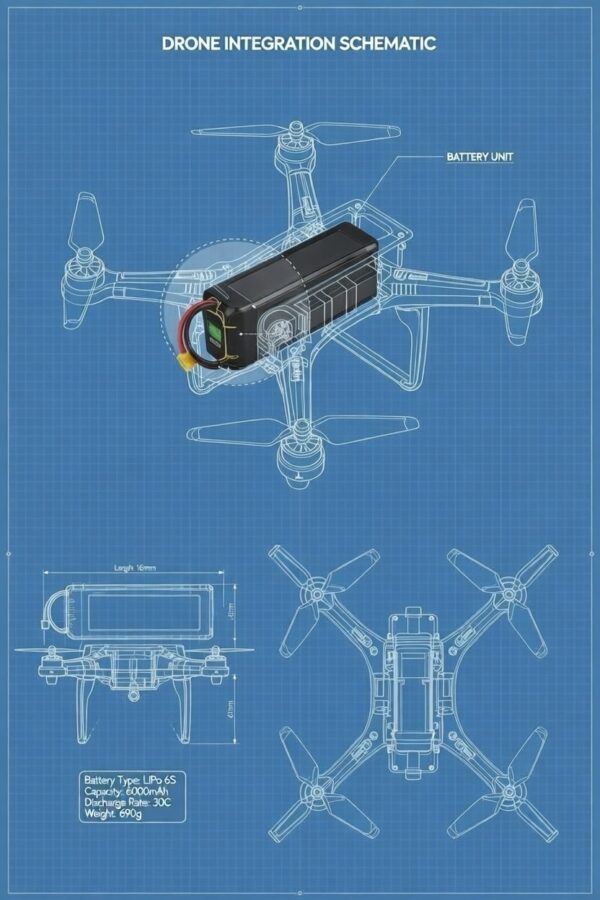
To illustrate the impact of proper battery procurement, consider a hypothetical case involving a firm monitoring oil pipelines in Northern Canada. Previously, the team relied on standard 6S LiPo batteries. In sub-zero temperatures, flight times dropped by 40%, and charging times doubled due to the need for pre-heating. The team could only manage two inspection loops per day.
After switching to a specialized industrial battery line featuring high-rate chemistry and an integrated smart BMS with low-temperature charging protection, the operational metrics shifted dramatically. The new batteries supported 4C charging even in cold conditions, reducing ground time from 90 minutes to 25 minutes. The integrated heating elements allowed for safe charging without external warm-up boxes. Consequently, the team increased daily sorties from two to five, covering 150% more pipeline mileage without increasing headcount. The initial investment in premium batteries was recouped within three months through increased contract billability and reduced generator fuel costs.
Procurement Feature Checklist
For purchasing departments ready to upgrade their fleet, use this checklist to evaluate potential suppliers:
- Chemistry Type: Is it High-Voltage LiPo or Li-Ion optimized for power density?
- Connector Durability: Are the discharge connectors (e.g., AS150, XT90) rated for the expected amperage without overheating?
- Communication Protocol: Does the battery support smart communication (CAN bus, UART) with the drone and charger for real-time health monitoring?
- Warranty Terms: Does the warranty cover cycle life degradation or only manufacturing defects?
- Supply Chain Stability: Can the vendor guarantee bulk delivery timelines to match your fleet expansion?
- Recycling Program: Does the manufacturer offer a take-back program for end-of-life batteries to ensure environmental compliance?
Frequently Asked Questions
Q: Does fast charging always reduce battery lifespan?
A: Not necessarily. While high heat accelerates degradation, modern batteries with advanced thermal management and high-quality electrolytes can withstand fast charging with minimal impact. The key is using a charger and battery pair that are matched and monitored by a smart BMS.
Q: Can I use automotive fast-charging standards for drones?
A: Generally, no. Drone batteries operate at different voltage ranges and discharge profiles compared to EVs. While the underlying chemistry might be similar, the pack configuration and BMS logic are specific to aerial applications. Using EV chargers can damage drone batteries.
Q: How do I verify UN38.3 certification?
A: Request the test summary report from the manufacturer. This document details the results of the eight required tests. Be wary of suppliers who only provide a certificate without the underlying test data.
Q: What is the ideal storage charge for fleet batteries?
A: For long-term storage, batteries should be kept at approximately 50-60% state of charge (3.8V per cell). Storing them fully charged or fully depleted for extended periods can lead to swelling or capacity loss.
Conclusion: Powering the Future of Infrastructure Monitoring
The transition to fast-charging drone batteries represents a pivotal upgrade for pipeline monitoring firms. It is a move that transcends simple hardware replacement, touching upon operational workflow, safety compliance, and financial efficiency. By understanding the technical nuances of C-rates, thermal management, and regulatory standards, procurement leaders can make informed decisions that propel their operations forward. The right battery partner does not just supply power; they supply reliability, ensuring that every mile of pipeline is monitored with precision and continuity.
As the industry moves into the mid-2020s, the expectation for rapid deployment will only grow. Firms that invest in robust, fast-charging energy solutions today will define the operational standards of tomorrow. Do not let power limitations ground your potential.
Ready to optimize your drone fleet’s performance? Contact our expert team to discuss custom battery solutions tailored for industrial pipeline monitoring.

