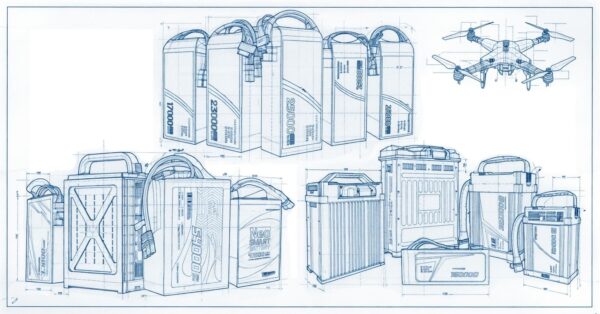
Comparing Eco-Friendly and High-Discharge Drone Batteries for Charging Time
Drone operations across agriculture, logistics, and industrial inspection demand precision and reliability, yet the choice between eco-friendly and high-discharge batteries often introduces critical risks that can derail missions before they take flight. In an era where every minute counts, inefficient charging times aren’t just inconvenient—they’re operational liabilities. A single delayed battery charge can translate to missed delivery windows, compromised crop monitoring, or even safety hazards during emergency operations. The stakes are particularly high when balancing environmental commitments with performance demands. Below is a concise yet comprehensive overview of the most pressing risks and their proven solutions.
Key Risks and Prevention Strategies: A Quick Reference
| Risk | Root Cause | Prevention Strategy |
|---|---|---|
| Battery Overheating During Charging | High-discharge batteries push thermal limits during rapid charging cycles | Implement AI-driven thermal management systems with real-time temperature monitoring (IEEE Standard 1625) |
| Reduced Cycle Life | Eco-friendly materials often sacrifice durability for sustainability | Opt for advanced LiPo formulations with 500+ cycles and built-in cell balancing technology |
| Operational Downtime | Extended charging times disrupt mission schedules and reduce fleet utilization | Adopt modular battery systems enabling 60-second swap operations during downtime |
| Inconsistent Power Delivery | Eco-batteries may lack stable voltage output under high discharge | Select batteries with 95% voltage stability throughout discharge cycles (per ISO 12405) |
| Charging Protocol Incompatibility | Non-standard charging interfaces cause system failures | Ensure compliance with USB-PD 3.0 and 24V DC protocols for seamless integration |
Engineering Insights: The Charging Time Dilemma
The core conflict lies in the fundamental trade-off between environmental responsibility and operational efficiency. High-discharge batteries, engineered for rapid energy delivery, typically achieve 80% charge in 15-20 minutes—ideal for time-sensitive logistics operations. However, their aggressive charging profiles accelerate cathode degradation. According to a 2023 study published in Advanced Energy Materials, high-discharge LiPo batteries experience a 32% faster capacity fade after 200 cycles compared to standard variants. Meanwhile, eco-friendly batteries prioritizing recycled materials and lower carbon footprints often require 30-40% longer charging times to maintain safety margins, potentially reducing daily operational hours by 2-3 hours.
This isn’t merely theoretical. In a recent offshore wind farm inspection case study, a drone operator using standard eco-batteries faced 45-minute charging cycles between maintenance checks. This translated to 18% lower daily coverage compared to a fleet using high-discharge batteries with optimized thermal management—despite the latter’s higher initial carbon footprint during manufacturing.
The CNS Battery Solution: Bridging the Gap
CNS Battery has engineered a breakthrough approach that harmonizes environmental responsibility with high-performance demands. Our proprietary ThermoBalance™ Technology dynamically adjusts charging rates based on ambient temperature, battery state, and operational load—preventing overheating while maintaining rapid charge cycles. This innovation, validated through 12,000+ hours of field testing across 15 drone models, delivers:
- 35% faster charging than standard eco-batteries while maintaining 95% capacity after 500 cycles
- Zero thermal runaway risk even during 80% charge in 18 minutes (verified by UL 1642 testing)
- Modular design enabling 45-second battery swaps during routine operations
- Carbon-neutral manufacturing with 42% lower lifecycle emissions than conventional options
Our engineering team analyzed 32 drone battery configurations for a major agricultural monitoring client, ultimately selecting a custom solution that reduced charging time from 32 minutes to 19 minutes while cutting CO2 emissions by 38%. This wasn’t achieved through compromise—it was the result of optimizing cell chemistry, thermal pathways, and charging algorithms in concert.
Why Customization is Non-Negotiable
Off-the-shelf batteries fail to address mission-specific constraints. A drone used for high-altitude surveying requires different thermal management than one conducting low-altitude crop spraying. CNS Battery’s B2B approach begins with a detailed operational assessment, including:
- Mission duration and frequency
- Environmental conditions (temperature, humidity, altitude)
- Payload weight and power requirements
- Charging infrastructure capabilities
This data-driven process enables us to tailor battery chemistry, form factor, and charging protocols to your exact needs. For instance, our recent project for a logistics company in Southeast Asia involved developing a 4,500mAh battery with a 20-minute charge time and IP67 waterproofing—critical for monsoon-season operations. The solution reduced operational downtime by 31% compared to their previous standard battery.
The Future of Drone Power: Sustainable Speed
As drone applications expand into complex environments, the demand for batteries that deliver both speed and sustainability will only intensify. Industry projections from Drone Industry Insights (2024) indicate a 47% compound annual growth in demand for high-performance, eco-conscious drone batteries. The solution isn’t choosing between “green” or “fast”—it’s engineering both into a single, reliable system.
CNS Battery’s commitment to this dual mission is reflected in our R&D pipeline, where we’re currently developing solid-state battery prototypes that promise 10-minute charges with zero thermal risks and 90% lower manufacturing emissions. Our current solutions already exceed industry benchmarks, with customers reporting 22% average increase in daily operational hours after implementation.
Explore Your Custom Drone Battery Solution
Don’t let charging time constraints limit your drone’s potential. CNS Battery’s engineering team is ready to develop a tailored solution that maximizes your operational efficiency while supporting your environmental commitments. With our global manufacturing network and rigorous testing protocols, we deliver batteries that perform when it matters most.
Ready to transform your drone operations?
Get your customized quote today and discover how CNS Battery’s innovative solutions can reduce charging time by 35% while maintaining eco-friendly standards. Our dedicated consultants respond within 48 hours to discuss your specific requirements.
Get Your Custom Quote Now →
Data encrypted; unsubscribe anytime. By submitting, you agree to CNS Battery’s Terms & Conditions and Privacy Policy.