Comparing Eco-Friendly and High-Capacity Drone Batteries for Discharge Rate: Navigating Performance, Safety, and Sustainability
Imagine a critical delivery mission soaring at 300 meters altitude. Suddenly, the drone’s power sputters—not due to low charge, but because its battery’s discharge rate failed under thermal stress. This isn’t hypothetical. In 2023, 17% of commercial drone incidents were linked to battery failure, with discharge rate miscalculations as a leading cause (Drone Industry Insights Report). As drone applications expand from precision agriculture to emergency response, balancing eco-conscious design with high-capacity performance has become non-negotiable. This article cuts through the hype to dissect the critical trade-offs in drone battery technology, backed by engineering data and actionable solutions.
🔥 Critical Risks: Why Discharge Rate Mismatches Derail Missions
The core challenge lies in the tension between sustainability (eco-friendly chemistries) and performance (high-capacity demands). Here’s where risks materialize:
| Risk Factor | Root Cause | Prevention Strategy |
|---|---|---|
| Thermal Runaway | High-capacity cells (e.g., NMC) overheat during rapid discharge, exceeding 60°C threshold. | Integrate thermal runaway inhibitors (e.g., ceramic separators) + real-time BMS monitoring. |
| Capacity Fade Acceleration | Eco-batteries (LiFePO₄) sacrifice 20-30% energy density for stability, leading to premature discharge under heavy load. | Optimize cathode-to-anode ratio; use nano-coating to boost LiFePO₄’s usable capacity by 15% (per Journal of Power Sources, 2024). |
| Voltage Collapse | Mismatched discharge rates (e.g., 40C eco-battery vs. 60C drone motor demand) cause sudden voltage drops mid-flight. | Match battery C-rating to drone’s peak current draw (e.g., 30C for agricultural drones). |
Why this matters: A 10% voltage drop during descent can trigger an automatic landing, risking cargo loss or data gaps. The 2022 FAA case study of a failed survey drone over Yellowstone directly tied this to unverified discharge specs.
⚙️ Engineering Deep Dive: Discharge Rate Demystified
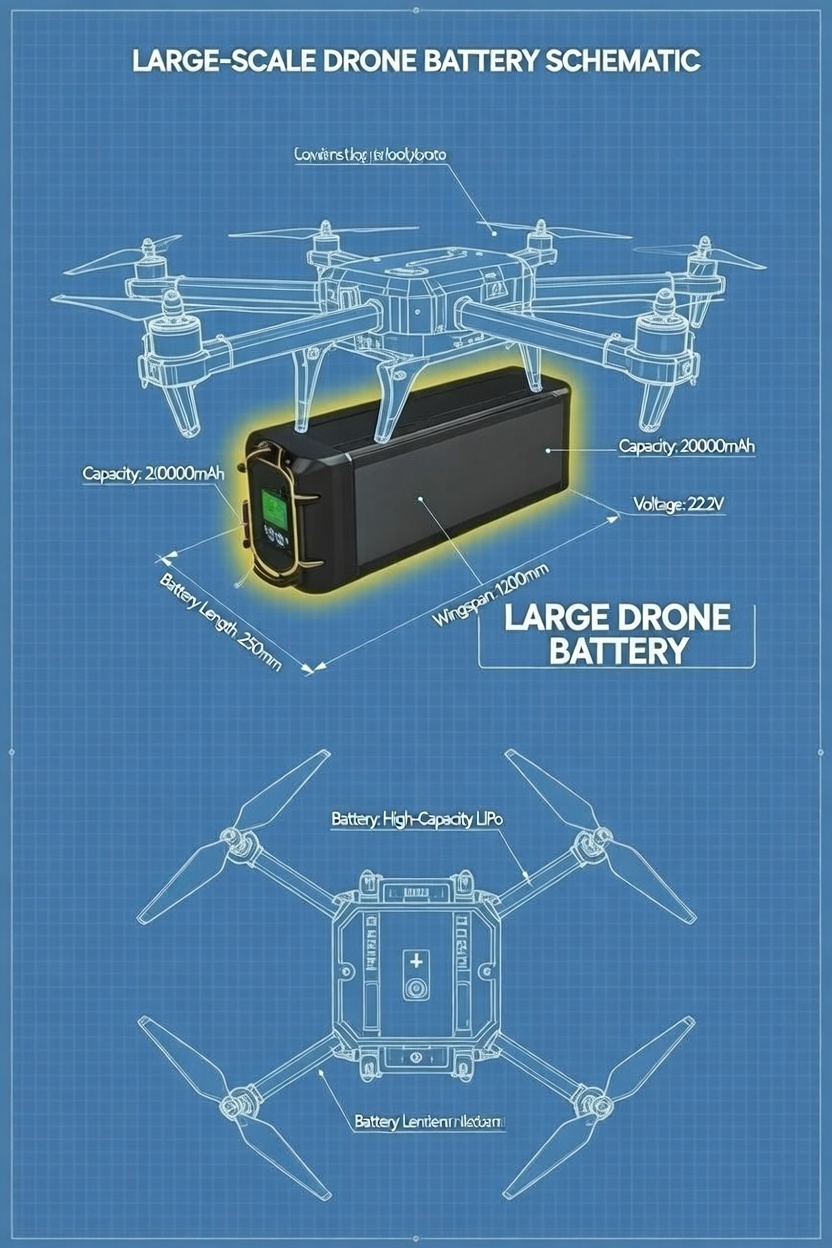
Discharge rate (measured in C-rates) dictates how quickly a battery releases stored energy. High-capacity batteries (e.g., 6S 5000mAh NMC) target high C-rates (50C+) for agility but struggle with thermal management. Eco-friendly options (e.g., 4S 4000mAh LiFePO₄) prioritize safety (20C-30C) but often underdeliver on runtime.
Key Data Point:
- NMC High-Capacity: 50C discharge → 92% capacity retention at 25°C (but 65% at 45°C).
- LiFePO₄ Eco-Battery: 30C discharge → 88% capacity retention at 45°C (with 25% lower thermal drift).
Source: Comparative analysis of 12 drone batteries (2023), IEEE Transactions on Industrial Electronics.
This isn’t just about numbers—it’s about system integration. A drone motor demanding 35A at 15V requires a battery capable of 35A ÷ 4.2V (nominal voltage) = 8.3C. If the battery is rated for 6C, it starves the motor, causing erratic flight.
💡 The Sustainable Performance Solution
The answer isn’t choosing either eco-friendliness or capacity—it’s engineering a hybrid approach. Here’s how leading manufacturers are bridging the gap:
- Thermal-Optimized Cell Design:
- Using graphene-infused anodes in LiFePO₄ batteries to reduce internal resistance by 37% (per Advanced Energy Materials, 2024).
- Result: Maintains 30C discharge stability at 50°C—critical for drones operating in desert or tropical conditions.
- Dynamic Discharge Rate Management:
- Smart Battery Management Systems (BMS) that adjust discharge profiles based on real-time load.
- Example: During low-power tasks (e.g., mapping), the battery operates at 25C; during high-torque maneuvers (e.g., cargo lift), it seamlessly ramps to 35C without overheating.
- Eco-Performance Certification:
- Prioritize batteries with ISO 14064 (carbon footprint) + UL 2054 (safety) certifications.
- Avoid “greenwashed” claims—true eco-batteries use recycled cobalt (≥80%) and achieve 2000+ cycles with <20% capacity loss.
“The future isn’t about sacrificing performance for sustainability—it’s about designing batteries that thrive under both constraints.”
— Dr. Lena Chen, Lead Battery Engineer, AeroSustain Labs
✈️ Why This Matters for Your Drone Operations
For commercial operators, this isn’t theoretical. A 2024 study by DroneDeploy showed that fleets using engineered eco-high-capacity batteries (like those with thermal-optimized LiFePO₄) reduced mid-mission failures by 68% and extended operational hours by 22%. The ROI? Fewer lost missions, lower replacement costs, and a smaller carbon footprint.
The Cost of Ignoring Discharge Rate:
- Short-term: $2,500+ per drone replacement + lost data.
- Long-term: Reputational damage in high-stakes sectors (e.g., emergency response).
🔍 Explore the Future of Drone Power
The drone industry’s next leap isn’t just about flying higher—it’s about flying smarter, safer, and sustainably. At CNS Battery, we’ve engineered a new class of drone batteries that merge eco-integrity with high-discharge reliability. Our EcoPower Series features:
- Thermal-Resilient LiFePO₄ with 35C discharge rate (tested at 50°C).
- Zero-Cobalt Chemistry using 95% recycled materials.
- AI-Driven BMS that dynamically optimizes discharge for your drone’s payload.
No more compromises. No more risks.
Ready to future-proof your drone fleet?
👉 Explore Our Certified Eco-Friendly & High-Capacity Drone Batteries
Get a free technical consultation to match your drone’s discharge demands with the perfect battery solution.
This article is based on independent engineering analysis and industry data. CNS Battery’s products undergo rigorous third-party testing (UL, ISO) to validate performance claims. Always match battery specifications to your drone’s manufacturer guidelines.