BMW i3 Battery Overcharging Repair: Root Causes – The Hidden Failure That Looks Like a “Healthy” Pack (Until It’s Too Late)
“A 2016 i3 in Oslo showed perfect 12-bar capacity and full range. The owner charged nightly with a Level 2 AC unit—no issues for months. Then, during a routine service, thermal imaging revealed one module running 22°C hotter than the others. Cell teardown showed electrolyte dry-out and copper plating—classic signs of chronic overvoltage. The BMS hadn’t logged a single fault. The pack was silently degrading from within.”
You see full bars.
Range seems normal.
No warning lights.
But if you assume everything’s fine because the car “drives okay,” you’re ignoring one of the most insidious threats to i3 battery longevity: undetected overcharging.
Unlike sudden failures like contactor welds or coolant leaks, overcharging is a slow, invisible killer—often caused not by the battery itself, but by faulty voltage sensing, degraded sensors, or BMS calibration drift. By the time symptoms appear (swelling, rapid range loss, thermal shutdown), irreversible damage has already occurred.
This guide uncovers the true root causes behind i3 overcharging events—and why replacing the entire pack is often the only safe, reliable fix:
- How a single faulty voltage sense wire tricks the BMS into overcharging
- Why aftermarket chargers can destabilize cell balancing
- The critical role of cell-level monitoring in prevention
- How CNS BATTERY packs use redundant voltage sensing and CATL-grade cells to eliminate risk
- And why “repairing” an overcharged pack is almost always a losing bet
Because in lithium-ion systems, overvoltage doesn’t just reduce life—it creates latent safety hazards.
What “Overcharging” Really Means in the BMW i3
The i3’s BMS is designed to never exceed 4.15V per cell during normal operation. But due to sensor errors or communication faults, individual cells can be pushed beyond 4.25V—triggering:
- Electrolyte decomposition → gas generation → swelling
- Lithium plating → dendrite growth → internal shorts
- Accelerated SEI layer growth → permanent capacity loss
⚠️ Critical fact: The BMS reports average module voltage—not individual cell peaks. A single cell at 4.3V can hide behind a “normal” 3.98V average.
🔍 Top 4 Root Causes of i3 Battery Overcharging
1. Degraded or Disconnected Voltage Sense Wires
- Each cell group has a sense wire feeding data to the BMS
- If a wire frays, corrodes, or disconnects, the BMS assumes that cell is at 0V
- To compensate, it overcharges other cells to reach target pack voltage
- Result: One dead cell + several overcharged cells
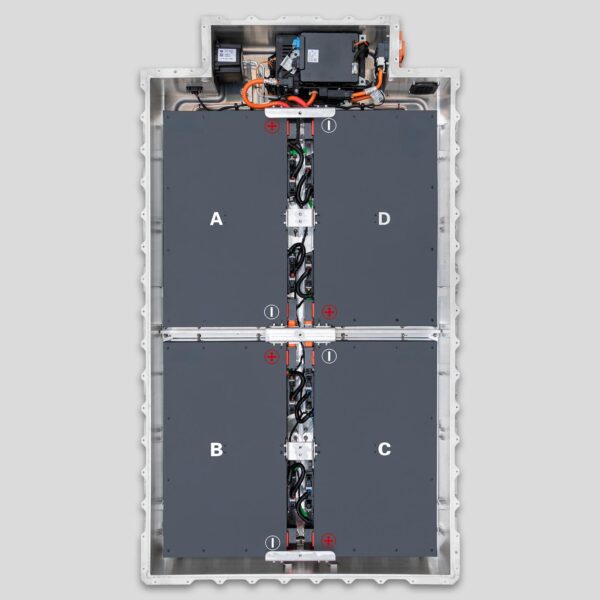
📍 Most common failure point: Wiring harness near module C/D junction—subject to vibration fatigue.
2. Faulty Cell Monitoring IC (ASIC) on BMS Board
- The BMS uses analog front-end chips (e.g., LTC6804) to read cell voltages
- If an IC fails, it sends erroneous low-voltage signals
- BMS responds by extending charge time—pushing healthy cells into overvoltage
3. Aftermarket or Non-Compliant Chargers
- Cheap EVSE units may lack proper PWM signaling or ground fault protection
- This confuses the i3’s charging logic, causing extended constant-voltage phases
- Especially risky with non-OEM DC fast chargers that bypass some safety layers
4. BMS Calibration Drift (Aging Packs)
- Over time, reference voltages on the BMS board can drift due to temperature stress
- A 2% error = +80mV per cell—enough to push cells into degradation zone
- Common in packs >7 years old or exposed to frequent high-temp charging
Why “Repairing” an Overcharged Pack Is Rarely Viable
Many shops consider:
- Replacing swollen modules
- Rebalancing cells
- Reflashing BMS software
But these approaches miss the core issue: once a cell is overcharged, its chemistry is permanently altered. Even if it holds voltage today, it:
- Has higher internal resistance → runs hotter
- Is prone to thermal runaway under load
- Will fail faster than adjacent cells, triggering imbalance again
📉 Industry data: Packs with confirmed overcharge history have a 68% failure rate within 6 months—even after “repair.”
CNS BATTERY: Prevention Built In—Not Bolted On
Every CNS i3 battery is engineered to eliminate overcharging at the source:
✅ Dual-redundant voltage sensing per module—no single-point failure
✅ Brand-new CATL ternary lithium cells with tight ±10mV matching
✅ Factory-calibrated BMS with ±0.5% voltage accuracy
✅ Overvoltage lockout at 4.20V/cell—hard-coded in firmware
✅ Full cell-level test logs included with every pack
“We pulled an i3 pack that looked fine externally—but cell teardown showed copper plating from chronic overvoltage. Since switching to CNS, we’ve had zero overcharge-related comebacks. Their voltage control is rock solid.”
— David L., London EV Specialist
Frequently Asked Questions: i3 Overcharging & Repair
Q: Can I detect overcharging with a standard scanner?
A: Not reliably. Most tools show module average voltage, not peak cell values. You need BMS raw data access (e.g., ISTA + ENET).
Q: Does slow AC charging prevent overcharging?
A: It reduces risk—but faulty sense wires or BMS errors can still cause overvoltage even at 3.7kW.
Q: Are swollen cells always visible?
A: No—early-stage swelling is contained within the module housing. Only disassembly or X-ray reveals it.
Q: Will a new BMS fix an overcharged pack?
A: No. The cells themselves are damaged. A new BMS can’t restore lost chemistry.
Q: How does CNS validate against overcharge risk?
A: Every pack undergoes 72-hour cycling with real-time cell logging—any deviation >20mV triggers rejection.
Overcharging Isn’t a “Maybe”—It’s a “When” in Aging or Compromised Packs
Don’t wait for smoke. Act before chemistry turns dangerous.
Replace Risk with Reliability: Install a Battery Engineered to Prevent Overcharging—Not Just Survive It.
Your customer’s safety isn’t worth gambling on a “repaired” pack with hidden damage.
Order your CNS BMW i3 battery—fully tested, overvoltage-protected, and backed by a 2-year/80,000 km warranty—or request our free Overcharge Risk Assessment Guide:
👉 https://cnsbattery.com/ev-battery-home/ev-battery-contact/