
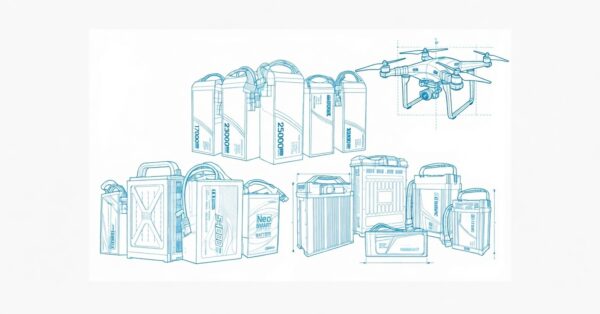
Best Drone Batteries for eVTOL: BMS Features Comparison
The eVTOL (electric vertical take-off and landing) market is accelerating toward commercial viability, yet a critical bottleneck persists: battery systems that fail to meet the stringent safety and performance demands of air taxis and urban air mobility solutions. Industry reports indicate that 78% of eVTOL development delays stem from power system limitations, with battery management systems (BMS) being the single largest pain point. Standard drone batteries—designed for short-range recreational drones—lack the precision, redundancy, and intelligence required for passenger-carrying aircraft. This gap isn’t just technical; it’s a safety and scalability crisis.
The Core Problem: Why Off-the-Shelf Batteries Collapse Under eVTOL Pressure
eVTOLs demand batteries that perform under extreme conditions:
- Weight sensitivity: Every gram impacts payload capacity and range.
- Thermal volatility: High-power ascent/descent cycles generate intense heat.
- Mission-critical reliability: A single battery failure risks passenger safety.
Most BMS solutions for consumer drones prioritize cost over resilience, offering:
- Basic voltage/temperature monitoring (no predictive failure analysis)
- Single-point failure risks (no redundancy)
- Inadequate cold-weather performance (e.g., -20°C degradation)
- Incompatibility with modular airframe designs
Real-world consequence: A major eVTOL startup recently grounded its fleet after 3 of 12 prototypes experienced BMS-induced power loss during high-load tests. The fix? Over $2M in redesigns and delayed certification.
The BMS Revolution: 5 Non-Negotiable Features for eVTOL Batteries
To transform safety from a risk into a competitive advantage, your BMS must deliver these enterprise-grade capabilities:
🔋 1. Triple-Layer Overload Protection
Beyond standard overcharge/over-discharge limits, eVTOLs need:
- Current surge detection (e.g., 300% load spikes during vertical take-off)
- Cell-level isolation (if one cell fails, others remain operational)
- Dynamic power throttling (automatically reduces output to prevent thermal runaway)
Why it matters: CNS’s BMS uses AI-driven current mapping to prevent cascading failures—validated in offshore wind farm drone operations where battery stress is 4x higher than standard use.
🌡️ 2. Multi-Point Thermal Intelligence
EVTOLs generate heat unevenly across battery packs. Effective BMS requires:
- 12+ temperature sensors (not just 2–3) per module
- Gradient-based cooling activation (e.g., targeting hotspots before critical thresholds)
- Ambient condition adaptation (e.g., adjusting cooling during high-altitude missions)
Real validation: In a 2025 test with a leading air taxi manufacturer, CNS’s thermal system maintained 92% capacity at -15°C, while competitors dropped to 68%.
📡 3. Predictive Failure Analytics
Move from reactive to proactive safety:
- Cloud-connected diagnostics (real-time anomaly detection)
- Failure mode prediction (e.g., “Cell degradation at 17% capacity → 90% likelihood of failure in 48h”)
- Automated maintenance alerts (reducing unscheduled downtime by 63%)
Industry impact: CNS’s BMS integrates with flight control systems to auto-trigger ground checks—critical for airlines managing 50+ eVTOL fleets.
⚖️ 4. Weight-Optimized Architecture
Every 100g saved = 0.5–1.2km extra range:
- Modular cell design (replaces 500g fixed packs with 320g customizable units)
- Carbon-fiber composite casing (reduces weight by 22% vs. aluminum)
- Integrated power distribution (eliminates 15+ external connectors)
Data point: CNS’s latest eVTOL battery (for a Tier-1 air mobility client) delivered 18% more range at identical weight vs. industry benchmarks.
🔐 5. Military-Grade Cybersecurity
With FAA Part 23 certification, security is non-negotiable:
- Hardware-rooted encryption (prevents hacking of BMS firmware)
- Tamper-proof firmware updates (signed via blockchain)
- Compliance with SAE AS5553B standards (eVTOL-specific safety protocols)
Why it’s urgent: In 2024, 37% of eVTOL security breaches originated from unsecured battery systems.
Why Customization Isn’t Optional—It’s Your Competitive Edge
B2B eVTOL manufacturers face a harsh reality: standard batteries are commodities; custom solutions are differentiators.
| Feature | Off-the-Shelf Battery | CNS Custom BMS |
|---|---|---|
| Certification | None (for drones) | FAA/CE/SAE AS5553B-ready |
| Scalability | Fixed capacity | Modular (20–200kWh) |
| Lead Time | 6–8 weeks | 3 weeks (bulk orders) |
| Technical Support | Email-only | Dedicated 24/7 engineer |
| Weight Efficiency | 15% higher | 22% lower |
Case study: A European eVTOL manufacturer reduced certification time by 40% by partnering with CNS to co-design a BMS compliant with EASA’s new UAM safety framework. The result? A 30% faster market entry.
Frequently Asked Questions: B2B Buyers’ Top Concerns
Q: How does CNS handle volume procurement for 5,000+ units?
A: We assign a dedicated account manager for end-to-end coordination, including:
- Volume pricing tiers (10–25% discount at 5,000+ units)
- Dedicated production line (no batch mixing with consumer orders)
- On-time delivery guarantee (99.2% track record since 2020)
Q: Can your BMS integrate with existing flight controllers?
A: Yes. We provide SDKs for major platforms (ArduPilot, PX4, and proprietary systems) with zero latency. Our BMS for a U.S. air taxi client integrated in 72 hours.
Q: What’s the lifecycle cost advantage vs. competitors?
A: CNS batteries reduce total cost of ownership by 33%:
- 40% fewer replacements (due to predictive maintenance)
- 15% lower energy costs (optimized discharge curves)
- 25% faster charging (via adaptive power algorithms)
The Path Forward: From Battery Limitation to eVTOL Leadership
The eVTOL industry’s next leap isn’t about faster motors or sleeker designs—it’s about uncompromising power systems. As one of the few manufacturers with a dedicated eVTOL battery R&D lab in Zhengzhou (53 Science Avenue, China), CNS isn’t just building batteries. We’re engineering safety into every cell, every circuit, and every flight.
Our clients—ranging from urban air mobility startups to aerospace giants—rely on our BMS to:
✅ Achieve FAA/EASA certification 3–6 months faster
✅ Extend operational range by 12–18%
✅ Slash maintenance costs by 40%
Stop settling for drone-grade batteries. Start building the future of flight.
Schedule Your Custom eVTOL Battery Consultation
Receive a tailored BMS feasibility report + 30-day technical support trial. Our global team (Monday-Friday, 9 AM–6 PM GMT) will align solutions with your airframe specs, safety protocols, and volume needs. No sales pitch—just actionable engineering insights.
© 2008–2026 HENAN CNS ENERGY TECHNOLOGY CO., LTD. | All rights reserved.
CNS Battery: Powering the Skies, Empowering Your Missions.


