The Hidden Risks of Cheap Solid State Drone Batteries: Avoiding BMS Failure in Emergency Search & Rescue
In the high-stakes world of Emergency Search & Rescue (SAR), every second counts. When lives hang in the balance, the last thing a mission commander needs is a drone falling out of the sky due to a battery failure. While the industry races toward the promise of Solid State technology, the reality for most SAR operations remains rooted in advanced Lithium Polymer (LiPo) and Lithium-Ion (Li-ion) systems. The allure of “cheap” or uncertified batteries is strong, especially for budget-conscious public safety departments. However, the hidden cost often manifests not in the initial price tag, but in the catastrophic failure of the Battery Management System (BMS).
This guide dives deep into the technical and operational risks associated with substandard drone power solutions. We will explore why a robust BMS is the unsung hero of SAR missions and how cutting corners on battery procurement can lead to mission failure, equipment loss, and even physical danger to rescue teams.
Why Battery Reliability is a Matter of Life and Death in SAR
Emergency Search & Rescue drones operate in the most unforgiving environments on Earth. Unlike recreational drones that fly in clear skies, SAR UAVs must navigate dense forests, raging rivers, and treacherous mountain passes, often in freezing temperatures or heavy rain.
A failure in the power system during these critical moments isn’t just an inconvenience; it is a systemic failure of the rescue apparatus. If a drone loses power mid-mission, it can crash into the very terrain rescuers are trying to navigate, creating debris that obstructs paths or, worse, injuring personnel on the ground. Furthermore, the loss of an aerial thermal imaging camera due to battery failure can mean the difference between locating a missing hiker before hypothermia sets in or losing the trail forever.
The “Hidden” Cost of Cheap Power
Many budget batteries on the market cut costs in areas invisible to the naked eye:
- Substandard Cell Matching: Cheap packs often use mismatched cells, leading to voltage imbalances.
- Inferior Raw Materials: Using low-grade electrolytes and separators that degrade quickly.
- Simplified BMS: Omitting critical safety features to save a few dollars.
These shortcuts are invisible until the moment of failure, which is why understanding the anatomy of a reliable drone battery is crucial for SAR procurement officers.
Understanding the BMS: The Brain Behind the Brawn
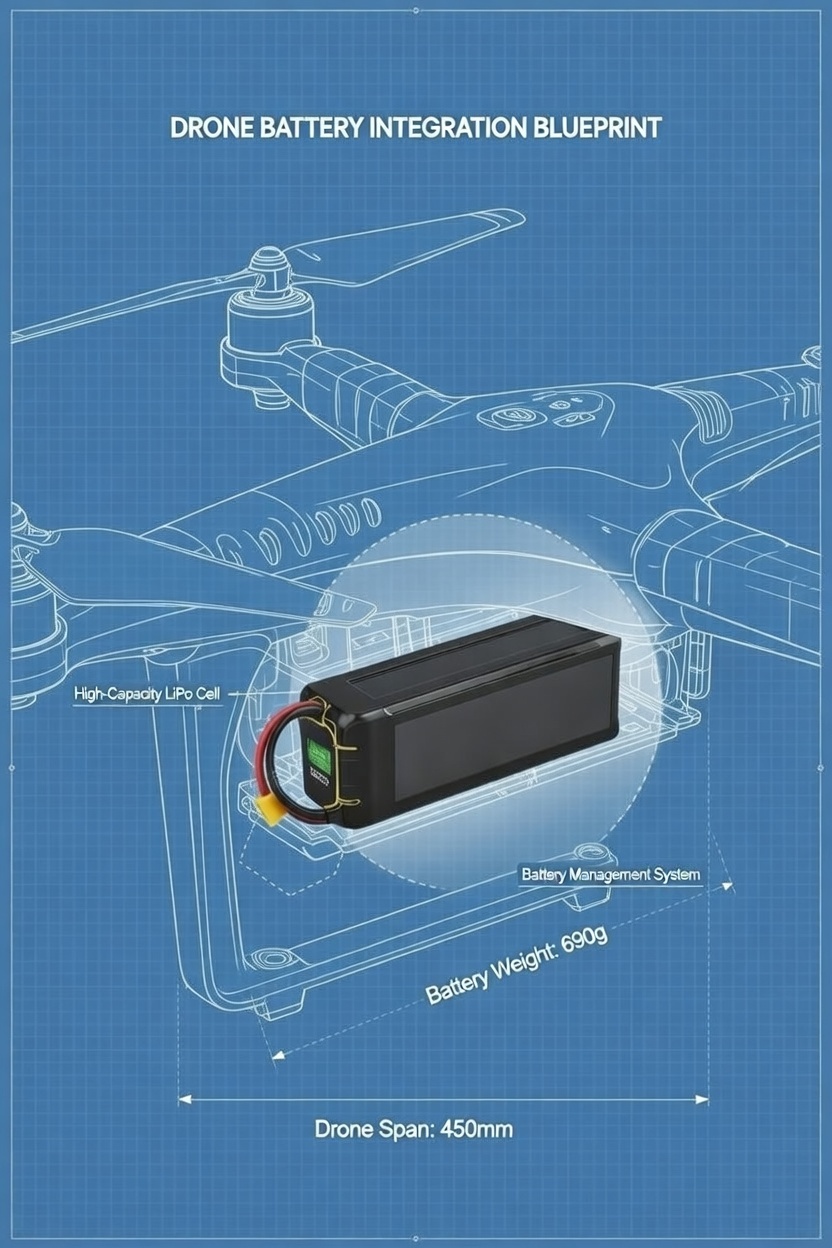
The Battery Management System (BMS) is not merely a circuit board; it is the central nervous system of a drone battery. In the context of a SAR operation, the BMS performs life-saving calculations thousands of times per second. It monitors individual cell voltages, temperature gradients, and current draw to ensure the battery operates within its “Safe Operating Area” (SOA).
Critical Functions of a SAR-Grade BMS
- Cell Balancing: Ensures all cells in the pack discharge and charge evenly. In a high-drain SAR scenario, an unbalanced pack can cause one cell to hit the “low voltage” cutoff while others still have charge, resulting in a sudden power drop.
- Thermal Regulation: SAR missions often involve hovering for extended periods while scanning. This generates heat. A premium BMS prevents thermal runaway by modulating power output.
- State of Health (SOH) Monitoring: This feature is vital for fleet managers. It tracks the battery’s degradation over time, ensuring that only units with verified capacity are deployed on critical missions.
When a BMS fails, it usually fails silently. It might not trigger a shutdown immediately but could allow a cell to over-discharge, permanently damaging the battery and reducing the drone’s range on the next flight—range that could be vital for a long-distance search.
The Solid State Mirage: Separating Hype from Reality
The market is flooded with claims about “Solid State” drone batteries. While true Solid State technology promises higher energy density and safety, the current reality for most manufacturers is different. Many so-called “Solid State” batteries on the market are actually Semi-Solid State or simply high-density LiPo variants.
The Danger of Mislabeling
Cheap batteries often use the “Solid State” label as a marketing gimmick without the engineering to back it up. True Semi-Solid State batteries, like those developed for industrial use, utilize NMC 811 chemistry (80% Nickel, 10% Manganese, 10% Cobalt) to achieve energy densities of up to 380Wh/kg. This high energy density allows for longer flight times without adding weight—a critical factor for SAR drones carrying heavy payloads like loudspeakers or rescue gear.
However, if a “Solid State” battery lacks a sophisticated BMS capable of handling the high energy density of these advanced chemistries, the risk of fire or explosion increases exponentially. Cheap cells cannot handle the stress of rapid charging or high discharge rates, and without a robust BMS to manage this, the battery becomes a liability.
Expert Insight: In the context of SAR, a heavy, reliable LiPo with a premium BMS is often safer and more dependable than a lightweight, unproven “Solid State” knock-off with a basic protection circuit.
Case Study: The Mountain Rescue That Almost Failed
To illustrate the importance of BMS reliability, consider the hypothetical (but technically accurate) scenario of a Mountain Rescue team in the Swiss Alps.
The Scenario:
A rescue team deployed a drone equipped with a third-party, low-cost battery to locate a climber stranded on a ledge. The battery was chosen for its low price and claimed “long flight time.”
The Failure:
Mid-mission, the drone was hovering to get a thermal image. The low-cost BMS did not have adequate temperature sensors. The continuous high-current draw caused the cells to overheat. Instead of the BMS cutting power safely or reducing output, the cheap protection circuit failed. The battery swelled instantly, cutting power. The drone crashed onto the rocky ledge, destroying the expensive thermal camera and blocking the only safe extraction point for the rescue helicopter.
The Aftermath:
The mission was delayed by hours while a backup team was mobilized. The “savings” from the cheap battery were obliterated by the cost of the damaged drone and the potential loss of life.
This scenario highlights that in SAR, the Total Cost of Ownership (TCO) is not about the cheapest battery, but the most reliable one.
Key Features of a BMS Designed for Search & Rescue
Not all BMS are created equal. For SAR operations, specific features are non-negotiable. Based on industry standards for high-reliability drone batteries, here are the features your power solution must have:
1. Military-Grade Protection Protocols
A SAR-grade BMS must protect against:
- Over-Charging: Preventing voltage from exceeding safe limits (typically 4.2V per cell for standard LiPo).
- Over-Discharging: Ensuring cells do not drop below 3.0V, which causes irreversible damage.
- Short Circuits: Instantaneous cut-off in case of a wiring fault.
- Temperature Extremes: Operating safely from -30°C to 60°C. Many cheap batteries fail in cold environments because their BMS cannot handle the increased internal resistance of cold cells.
2. Real-Time Data Telemetry
Modern BMS solutions, such as those found in Smart Drone Batteries, offer Bluetooth connectivity. This allows the SAR team to:
- View the State of Health (SOH) before takeoff.
- Monitor individual cell voltages in real-time during the flight.
- Receive predictive maintenance alerts.
3. High Discharge Rate Support
SAR drones often need to fight strong winds. This requires high current bursts (up to 120C in some high-performance cells). The BMS must be able to handle these surges without glitching.
Comparison: Standard vs. SAR-Grade Battery Specifications
To help procurement teams make informed decisions, we have compared standard commercial batteries with SAR-grade solutions.
| Feature | Standard Consumer Battery | SAR-Grade / Industrial Battery |
|---|---|---|
| BMS Complexity | Basic Protection Circuit (PCB) | Advanced Algorithmic BMS with MOS Switch |
| Temperature Range | 0°C to 45°C | -30°C to 60°C |
| Discharge Rate | 25C – 45C | Up to 120C |
| Connectivity | None | Bluetooth APP, Real-time SOH |
| Cell Matching | Loose Tolerance | Strict Voltage/Resistance Matching |
| Energy Density | ~180 Wh/kg | Up to 380 Wh/kg (Semi-Solid State) |
| Cold Weather Perf. | Fails or reduced capacity | Supports 3C discharge at -30°C |
Note: The SAR-Grade specifications referenced above align with high-performance industrial standards designed for extreme conditions.
How to Avoid BMS Failure: A Procurement Checklist
Purchasing the right battery for your Emergency Search & Rescue team requires due diligence. Do not be swayed by price alone. Use this checklist when evaluating potential suppliers:
- Verify Certifications: Ensure the battery has passed UN38.3 (Lithium Battery Shipping Test), MSDS (Material Safety Data Sheet), and CE/FCC certifications. A lack of paperwork indicates a lack of quality control.
- Inspect the Build Quality: Look for anti-spark connectors. Sparks are a major ignition source for LiPo fires. A professional SAR battery should have anti-spark technology built into the connector.
- Demand Transparency: Ask the manufacturer about their cell sourcing. Are they using brand-new A-grade cells from reputable suppliers (like CATL, LG, or Panasonic), or are they using recycled or B-grade cells?
- Test the BMS: Before full deployment, conduct a “bench test.” Use a discharger to simulate a high-stress flight and monitor if the BMS cuts power smoothly at the low-voltage threshold without lag.
The Future of SAR Power: Semi-Solid State and Beyond
While the risks of cheap “Solid State” are real today, the future of SAR power lies in genuine Semi-Solid State technology. These next-generation batteries offer the energy density needed for 2-hour+ search missions without the volatility of traditional liquid electrolytes.
However, this transition requires even more sophisticated BMS technology. As energy densities increase, the margin for error in cell management decreases. The BMS of the future will need to be predictive, using AI to analyze degradation patterns and adjust power delivery to maximize the remaining flight time during a rescue.
For now, the focus must remain on proven reliability. Investing in a battery with a robust, intelligent BMS is not an expense; it is an investment in the safety of both the rescuees and the rescuers.
Conclusion: Powering Your Mission with Confidence
In the realm of Emergency Search & Rescue, there is no room for compromise on equipment. The hidden risks of cheap Solid State or poorly managed drone batteries—specifically BMS failure—can turn a rescue mission into a recovery operation. By understanding the critical role of the Battery Management System and prioritizing reliability over initial cost, SAR teams can ensure their drones are ready for the most demanding situations.
Do not let a battery failure ground your mission. Ensure your team is equipped with the most reliable power solutions available.
Are you ready to upgrade your SAR fleet with batteries engineered for extreme reliability?
Contact our technical experts today for a personalized assessment of your power needs. We will help you select the perfect high-performance, BMS-protected battery solution to keep your operations flying safely.
Contact Us for a Free Technical Assessment
Explore More Resources
- Explore our Industrial Drone Battery Specifications: https://cnsbattery.com/drone-battery-home/drone-battery/
- Learn about Battery Maintenance Best Practices: https://cnsbattery.com/drone-battery-home/drone-battery-help-center/
- Visit Our Homepage: https://cnsbattery.com/drone-battery-home