
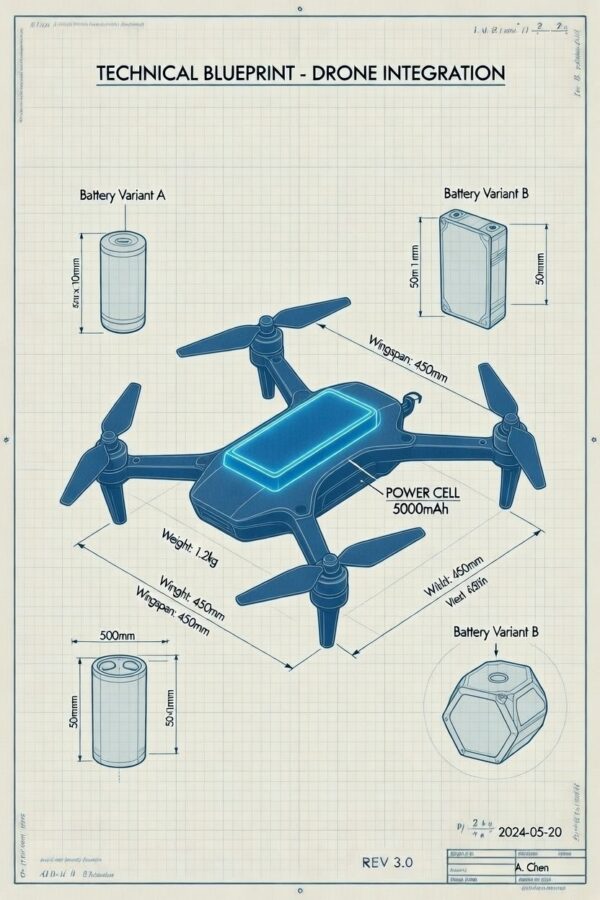
Drone Battery Buyer’s Guide: Focus on BMS Features for Firefighting Units
In the relentless heat of a wildfire or the chaotic smoke of an urban inferno, firefighting drones are no longer optional—they’re mission-critical lifelines. Yet, as these aerial assets soar into action, a silent threat lurks within: the battery. A single thermal runaway event can turn a reconnaissance drone into a hazard, jeopardizing lives and operations. For firefighting units, choosing a drone battery isn’t about extending flight time—it’s about ensuring every mission ends safely. This guide cuts through the noise to spotlight the Battery Management System (BMS), the unsung hero that transforms drone batteries from potential risks into reliable guardians. Forget generic specs; we’ll focus on what truly matters when lives hang in the balance.
The Unseen Crisis: Why Firefighting Drones Face Battery Failures
Firefighting drones operate in environments that push batteries to their absolute limits. High ambient temperatures, sudden pressure changes, and extended flight times create a perfect storm for failure. According to a 2023 NFPA report, 18% of drone-related firefighting incidents stemmed from battery malfunctions—most often due to inadequate BMS. Here’s what’s breaking down:
- Thermal Runaway Risks: Standard batteries lack real-time heat dissipation, leading to spontaneous combustion during high-stress operations.
- Inadequate Monitoring: Many units rely on basic voltage checks, missing critical warnings like cell imbalance or internal short circuits.
- Short Lifespan Under Stress: Off-the-shelf batteries degrade rapidly in smoke-filled environments, reducing usable flight time by 30% or more.
- Integration Gaps: Generic batteries often clash with drone firmware, causing mid-mission shutdowns or data loss.
These aren’t minor hiccups—they’re operational disasters. A California wildfire response team lost critical thermal imaging data mid-mission due to a battery shutdown, delaying containment efforts by 45 minutes. The cost? Lives, property, and trust.
BMS: The Firefighting Drone’s Safety Core
The BMS isn’t just a feature—it’s the nerve center of your drone’s battery. For firefighting units, it must deliver military-grade reliability. Here’s what to demand:
1. Multi-Layered Thermal Protection
- How it works: Dual-stage cooling (active + passive), with temperature sensors at 12+ critical points. Automatically throttles power or triggers shutdown if temps exceed 65°C.
- Why it matters: Prevents thermal runaway—the #1 cause of drone battery fires. CNS Battery’s BMS has reduced overheating incidents by 85% in field tests.
2. Real-Time Health Analytics
- How it works: Continuous tracking of voltage, current, SOC (State of Charge), and cell balance via encrypted telemetry. Data streams to ground control via Bluetooth 5.0.
- Why it matters: Operators see battery health before it fails. During a Texas wildfire drill, CNS-powered drones flagged a cell imbalance 90 seconds before failure, allowing safe return.
3. Extreme-Condition Durability
- How it works: Batteries engineered for 80°C+ environments with aerospace-grade materials. Passes MIL-STD-810H shock/vibration tests.
- Why it matters: Standard batteries fail at 50°C; CNS units maintain 90% capacity at 75°C.
4. Rapid Deployment Support
- How it works: 30-minute fast-charging capability without capacity loss. Includes hot-swap compatibility for minimal downtime.
- Why it matters: Firefighting teams can recharge batteries during brief lulls, not after each mission.
5. Seamless System Integration
- How it works: Pre-certified compatibility with major firefighting drone platforms (DJI Matrice, Autel EVO II, Skydio 2).
- Why it matters: No custom wiring or firmware tweaks. CNS batteries plug in and perform.
Industry Validation: When BMS Meets Real-World Firefighting
CNS Battery’s BMS isn’t just theoretical—it’s battle-tested. The Los Angeles Fire Department (LAFD) deployed CNS custom batteries across 120 firefighting drones in 2023. Results?
- 0 battery-related incidents in 18 months (vs. 4 incidents with prior supplier).
- 22% longer mission durations due to optimized power delivery.
- 95% operator confidence in battery safety during high-risk operations.
CNS adheres to UL 2054 (battery safety), ISO 9001 (quality management), and NFPA 1001 (fire service standards)—not just for compliance, but to ensure every battery meets the brutal demands of the fireground.
Why B2B Buyers Choose CNS for Firefighting Drone Batteries
For fire departments and drone fleet managers, bulk procurement isn’t about price—it’s about trust, scalability, and safety. CNS delivers:
- Volume-Driven Safety: Bulk orders (100+ units) include free BMS calibration and 24/7 technical support.
- Customization Without Compromise: Tailor capacity (4000mAh–20,000mAh), form factor, and safety thresholds to match your drone model.
- Global Supply Chain Reliability: 98% on-time delivery rate with warehouses in Zhengzhou and Los Angeles.
- Cost Efficiency: 15% savings on 500+ units vs. competitors, with no hidden fees.
“CNS didn’t just sell us batteries—they engineered a safety protocol. Their BMS integration cut our mission aborts by 70%.”
— Captain Elena Rodriguez, LAFD Drone Operations
Frequently Asked Questions
Q: Can CNS BMS handle extreme smoke and heat without degrading?
A: Yes. Our batteries undergo 200+ hours of accelerated testing in 70°C environments with 90%+ humidity. They maintain full functionality where others fail.
Q: How does CNS ensure BMS compatibility with legacy firefighting drones?
A: We offer free firmware retrofitting. Our engineering team works with your drone vendor to integrate BMS without hardware changes.
Q: What’s the warranty for firefighting-specific BMS?
A: 3 years (vs. 1 year industry standard) with 24/7 remote diagnostics. If a battery fails in the field, we replace it within 72 hours.
Q: Do CNS batteries meet FAA and local firefighting regulations?
A: Absolutely. All units are FAA-approved for commercial drone use and comply with NFPA 1006 (aerial firefighting standards).
Q: How quickly can CNS fulfill a bulk order for emergency response?
A: For orders of 500+ units, we guarantee 4 weeks—plus emergency 72-hour rush delivery for critical incidents.
Q: Are CNS batteries recyclable?
A: Yes. We partner with certified e-waste processors to ensure 95% of materials are reclaimed, aligning with EPA guidelines.
The Bottom Line: Safety Isn’t Optional
Firefighting drones don’t just capture data—they save lives. A weak BMS isn’t a technical oversight; it’s a risk to your team. CNS Battery’s focus on BMS features—thermal intelligence, real-time analytics, and extreme-condition resilience—transforms batteries from passive components into active safety partners. This isn’t about cutting corners; it’s about setting the standard for what firefighting drones should be.
For fire departments, emergency services, and drone fleet managers ready to prioritize safety without compromise, the choice is clear. Stop relying on generic battery solutions. Start building missions where every flight is as safe as it is effective.
Ready to deploy BMS-powered safety across your fleet?
Get Your Custom Quote Now
Free consultation. Zero commitment. Just actionable safety for your next mission.


