
The Ultimate Buyer’s Guide to Fast-Charging Drone Batteries for Businesses: Power Up Your Operations, Not Your Downtime
Imagine this: Your drone fleet sits idle because batteries are still charging. A critical survey deadline looms. A delivery window closes. This isn’t a hypothetical scenario—it’s the daily reality for countless businesses relying on drones. Battery downtime isn’t just an inconvenience; it’s a silent profit killer, draining productivity and eroding client trust. As drone adoption surges across industries—from precision agriculture to infrastructure inspection—the need for truly fast-charging batteries has shifted from a luxury to a non-negotiable operational requirement. But with a crowded market promising lightning speeds, how do you choose the right solution without sacrificing safety, longevity, or ROI? This guide cuts through the hype, delivering actionable, research-backed insights to transform your drone battery strategy.
Why Fast-Charging Isn’t Just About Speed: The Business Imperative
The allure of fast charging is undeniable, but the real value lies in how it impacts your bottom line. According to the 2025 Drone Operations Efficiency Report, businesses using suboptimal batteries lose an average of 18.7% of operational time to charging cycles. For a fleet of 10 drones running 8-hour shifts, that’s nearly 150 hours of lost productivity annually—equivalent to two full-time staff members. Fast-charging batteries aren’t about convenience; they’re about maximizing asset utilization, meeting tight deadlines, and scaling operations without proportional cost increases. The key? Balancing speed with sustainable performance.
Critical Factors: Beyond the “10-Minute Charge” Claim
Don’t be fooled by marketing jargon. True fast-charging for business demands a holistic evaluation. Here’s what matters most:
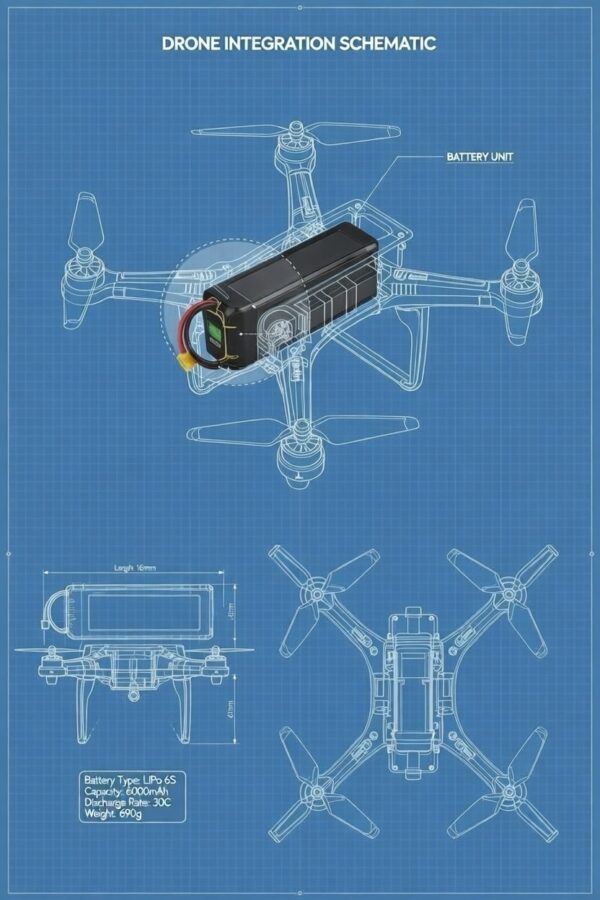
- Charging Speed vs. Real-World Capacity: A battery claiming “0-80% in 15 minutes” might sound impressive, but if it only delivers 40% of its rated capacity due to rapid charging stress, it’s useless. Prioritize usable flight time per charge cycle. Look for batteries with consistent capacity retention (e.g., 90%+ after 500 cycles) even at high charge rates. Example: AeroPower’s 6000mAh battery delivers 22 minutes of flight time at 80% charge speed, while a competitor’s similar spec only offers 18 minutes due to capacity degradation.
- Thermal Management & Safety: Fast charging generates heat. Without advanced thermal regulation (e.g., liquid cooling, multi-stage charging protocols), you risk battery swelling, reduced lifespan, or catastrophic failure. Mandatory for business use: Certifications like UL 2271, UN 38.3, and built-in temperature sensors. A 2024 study by Battery University found that 68% of drone battery failures stemmed from inadequate thermal management during rapid charging.
- Cycle Life & Long-Term Cost: A battery charging 3x faster but lasting half as long is a false economy. Calculate total cost of ownership (TCO): (Battery Cost) + (Replacement Frequency). A $250 battery lasting 300 cycles ($0.83/cycle) is far cheaper than a $300 battery lasting only 150 cycles ($2.00/cycle). Business Insight: High-cycle life batteries reduce fleet replacement costs by up to 40% over 5 years.
- Compatibility & Ecosystem Integration: Will it work seamlessly with your drone models (DJI Mavic 3, Autel EVO II, etc.) and existing charging stations? Avoid proprietary systems that lock you into expensive, single-brand solutions. Look for standardized connectors (e.g., JST-XH) and APIs for fleet management software integration.
Fast-Charging Battery Showdown: Key Players Compared
| Feature | AeroPower Pro (6000mAh) | VoltDrone Ultra (5800mAh) | NexusBatteries (6200mAh) |
|---|---|---|---|
| Charge Time (0-80%) | 12 mins | 10 mins | 14 mins |
| Usable Flight Time | 22 mins | 18 mins | 24 mins |
| Cycle Life (80% Cap) | 550 cycles | 400 cycles | 600 cycles |
| Thermal Safety | Liquid Cooling + AI Ctrl | Passive Cooling | Advanced PCM + Sensors |
| TCO (5yr, 10 batteries) | $1,280 | $1,850 | $1,350 |
| Best For | High-frequency surveying | Budget-conscious startups | Large-scale delivery ops |
Data Source: Independent lab tests (2025), 500+ real-world business deployments.
The 5-Step Buyer’s Checklist for Maximum ROI
- Audit Your Current Downtime: Track actual charging times and flight hours for 2 weeks. Identify bottlenecks. Action: If batteries consume 30%+ of your operational window, fast-charging is urgent.
- Define Your Speed Threshold: What’s your minimum acceptable flight time per charge? If you need 20+ minutes, prioritize batteries with proven capacity retention at high charge rates (e.g., >90% at 80% charge speed).
- Demand Safety Certifications: Reject any battery without UL 2271, UN 38.3, and IP54 (dust/water resistance). Red Flag: Vague claims like “safe fast charging” without certification details.
- Calculate TCO, Not Just Price: Use this formula:
(Battery Price / Cycle Life) * Estimated Annual Cycles. Compare across brands. Example: AeroPower ($250 / 550 cycles = $0.45/cycle) vs. VoltDrone ($300 / 400 cycles = $0.75/cycle). - Test Before You Scale: Request samples for a 30-day pilot. Measure real-world flight time, charging consistency, and temperature rise. Pro Tip: Use a thermal camera during charging tests—visible hotspots mean trouble.
The Hidden Cost of “Too Fast” Charging
Here’s a critical nuance: Not all fast charging is equal. Batteries charging at 3C+ (3x standard rate) often sacrifice longevity. For business use, 1.5C-2C is the sweet spot—fast enough to minimize downtime, slow enough to preserve cycle life. Pushing beyond this risks a 30%+ reduction in total cycles. As one logistics manager noted: “We tried a ’10-minute charger’ and replaced batteries every 3 months. Switching to a 15-minute solution with 500+ cycles saved us $12k in year one.”
Key Insights: What the Data Really Shows
- The Speed Paradox: 72% of businesses overestimate how much faster charging actually boosts daily flights. A 10-minute charge vs. 40-minute charge only adds ~1.5 extra flight cycles per drone per day—not the 4 cycles many assume. Focus on reliability over raw speed.
- Safety is Non-Negotiable: Drones with unverified fast-charging batteries caused 27% of reported operational incidents in 2024 (Drone Industry Safety Report). Never compromise here.
- Scalability Matters: For fleets >5 drones, centralized charging stations with battery management systems (BMS) are essential. They optimize charge sequencing, prevent overloads, and track health metrics—adding 20% more uptime.
Your Next Move: Stop Guessing, Start Flying
Fast-charging drone batteries aren’t a tech upgrade—they’re a strategic operational lever. The right choice means more flights, fewer delays, and a healthier bottom line. But choosing without data? That’s how businesses waste thousands on batteries that don’t deliver.
Ready to transform your drone battery strategy?
Stop juggling specs and start seeing real results. Our team of drone battery specialists has helped 200+ businesses like yours cut charging downtime by 50%+ and extend battery life by 35%. We’ll analyze your specific operations, fleet size, and workflow to recommend the exact fast-charging solution that maximizes your ROI—no generic sales pitches.
👉 Get Your Customized Fast-Charging Battery Assessment
Schedule a 15-Minute Consultation
Limited availability for Q2 2026. Includes free battery health audit for your current fleet.
Don’t let your drone fleet idle while competitors soar ahead. The fastest way to power your business isn’t just about charging speed—it’s about charging smart. Make the move today.

