
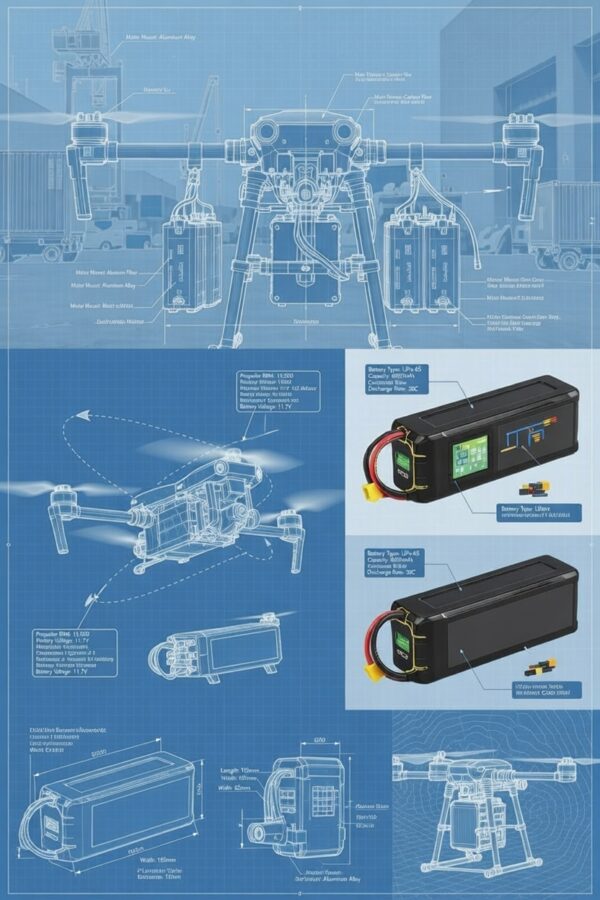
Comparing Li-Ion and Modular Drone Batteries for Durability: Cutting Through the Charge
Picture this: your drone is mid-mission, capturing critical aerial footage for a construction site survey, when suddenly, power sputters. The drone descends, risking not just the equipment but the entire project timeline. This isn’t just a nightmare; it’s a reality for many operators relying on batteries that fail when they’re needed most. Durability – the relentless ability to deliver consistent power flight after flight – isn’t just a feature; it’s the bedrock of operational reliability. In the high-stakes world of commercial drones, choosing between traditional Li-Ion and the emerging modular approach isn’t merely a technical decision; it’s a strategic investment in your mission’s success. Let’s dissect the true durability battle.
Why Durability Isn’t Just a Buzzword – It’s Your Bottom Line
Forget the glossy specs on a box. For drone operators, battery durability translates directly to:
- Reduced Downtime: Fewer replacements mean more flight hours.
- Lower Cost Per Flight: Avoiding constant battery swaps saves significant capital.
- Mission Confidence: Knowing your power source won’t betray you mid-task.
- Data Integrity: Preventing mid-flight data loss during critical surveys or inspections.
Li-Ion batteries dominate the market, but their inherent limitations in long-term durability for heavy-use scenarios are becoming increasingly apparent. Enter the modular battery system – a paradigm shift designed explicitly to tackle the core durability challenge.
Li-Ion Batteries: The Familiar Workhorse (With Hidden Weaknesses)
Li-Ion (Lithium-Ion) technology powers the vast majority of consumer and many commercial drones. Its strengths are undeniable: high energy density (more power in a smaller package), relatively fast charging, and a mature supply chain. However, when it comes to sustained, high-demand durability, Li-Ion reveals its Achilles’ heel:
- The Cycle Life Conundrum: Most standard Li-Ion drone batteries offer 300-500 charge cycles before capacity drops significantly (e.g., 80% of original). For a drone fleet flying 5-10 missions daily, this means a battery might need replacement every 6-12 months. Each replacement is a direct cost and operational interruption.
- Degradation is Inevitable, Not Optional: Every charge/discharge cycle, exposure to extreme temperatures (hot or cold), and even prolonged storage accelerates capacity loss. A battery that seems fine today might struggle to deliver 80% of its rated flight time in six months. This isn’t just wear; it’s a predictable decline.
- The Whole Pack, Whole Story: If one cell in a multi-cell Li-Ion pack degrades significantly, the entire pack’s performance suffers. You can’t just replace the weak cell; the whole pack must be swapped out, often when the rest of the cells are still functional. This is a massive waste of resources and a key durability flaw.
- Sensitivity to Abuse: Li-Ion is sensitive to overcharging, deep discharging, and physical stress. A single mishandling incident can permanently damage the pack, shortening its effective lifespan.
Real-World Impact: A survey by Drone Industry Insights found that 37% of commercial drone operators cited battery failure as the top cause of unexpected mission interruption, directly linked to capacity degradation and unexpected shutdowns.
Modular Drone Batteries: The Durability Revolution
Modular drone batteries aren’t just an incremental upgrade; they’re engineered around the core principle of maximizing usable lifespan through replaceability. Think of it like having a car with interchangeable engine blocks instead of a single, monolithic engine.
- The Power of Replaceable Modules: A modular system consists of multiple smaller, independent battery modules (e.g., 2-4 modules per “battery pack”). Each module is a self-contained unit with its own BMS (Battery Management System).
- Targeted Replacement, Not Whole Swaps: This is the game-changer. When one module shows significant degradation (e.g., after 600 cycles), you simply replace just that module, not the entire battery. The other modules, still at 80-90% capacity, continue to function optimally. This extends the overall system’s usable lifespan dramatically – potentially doubling or tripling the time before a complete battery replacement is needed.
- Optimized Performance & Consistency: Since modules are replaced individually, the battery pack always operates with a balanced set of cells. There’s no “weak link” dragging down the whole system’s performance, ensuring consistent flight times mission after mission.
- Reduced Waste & Cost: Replacing only the worn module drastically reduces the cost per flight hour. You’re not throwing away perfectly good cells. For a fleet manager, this is a massive operational savings over the battery’s lifetime.
- Enhanced Resilience: If one module fails catastrophically (rare, but possible), the system can often continue operating at a reduced capacity (e.g., 2 modules instead of 4), allowing for a safe landing or mission completion, rather than an immediate catastrophic failure.
Real-World Impact: A major agricultural drone service provider switching to a modular system reported a 65% reduction in battery-related downtime and a 40% decrease in annual battery replacement costs within the first year, directly attributed to extended module-level lifespan.
The Durability Showdown: Li-Ion vs. Modular – A Clearer Picture
| Feature | Traditional Li-Ion Battery | Modular Drone Battery System | Durability Advantage |
|---|---|---|---|
| Core Durability Concept | Single-unit lifespan (300-500 cycles) | Replaceable modules extend system life (1000+ cycles) | Modular |
| Degradation Handling | Entire pack degrades; full replacement needed | Only degraded modules replaced; others continue | Modular |
| Cost Per Flight Hour | Higher (frequent full replacements) | Significantly Lower (targeted replacements) | Modular |
| Operational Downtime | High (waiting for new pack) | Minimal (quick module swap) | Modular |
| Environmental Stress Impact | Sensitive; affects whole pack | Isolated; other modules unaffected | Modular |
| Long-Term Value | Lower (wasteful full replacements) | Higher (maximizes cell utilization) | Modular |
Your Step-by-Step Guide to Choosing the Durability Champion
Don’t just guess. Follow this practical guide to determine which battery solution truly delivers the durability your drone operations demand:
- Assess Your Usage Intensity: How many flights per day? How long are typical missions? High-intensity use (5+ flights/day, 30+ mins each) makes modular a strong contender. For light recreational use, Li-Ion might suffice.
- Calculate Your True Cost Per Flight: Factor in all costs: initial battery price, replacement frequency, downtime cost, and potential data loss. Modular often wins on lifetime cost, even with a higher upfront price. Example: A $400 Li-Ion pack replaced every 6 months ($800/year) vs. a $600 modular system with $150 module replacements every 18 months ($300/year) – modular wins by $500/year.
- Evaluate Your Operating Environment: Do you fly in extreme cold, heat, or dusty conditions? Modular systems often have better thermal management per module and are less vulnerable to single-point failures from environmental stress.
- Analyze Your Maintenance Workflow: Can your team perform quick module swaps in the field? Modular requires minimal training for module replacement, fitting seamlessly into a busy drone operator’s routine. Li-Ion replacements require full pack swaps, taking more time.
- Prioritize Mission Criticality: Is your drone used for surveying, inspections, or deliveries where downtime costs thousands? For mission-critical applications, the reduced downtime and enhanced reliability of modular is non-negotiable for true durability.
The Verdict: Durability Demands a Modular Mindset
Li-Ion batteries are a proven technology, but they were never designed for the relentless, high-utilization demands of professional drone fleets. Their inherent design – a single, unreplaceable unit – makes them fundamentally less durable for long-term commercial use. The modular approach isn’t just a “battery type”; it’s a durability philosophy built on the simple, powerful idea of maximizing the life of every individual cell.
The data is clear: modular systems deliver significantly longer operational lifespans, lower costs per flight, and vastly reduced downtime. They transform battery management from a constant cost center into a strategic asset. For operators serious about maximizing uptime, minimizing costs, and ensuring their drones deliver every time, the choice is no longer about “if” to switch, but “when.”
Ready to Transform Your Drone Battery Durability?
Stop settling for batteries that wear out too fast. Embrace a future where your drone fleet runs longer, costs less, and delivers reliably. CNS Battery is pioneering modular drone battery solutions engineered for maximum durability and operational efficiency. Our systems are designed with your mission success in mind, offering seamless integration and expert support.
Stop the battery headaches. Start flying with confidence. Contact CNS Battery today for a tailored solution that maximizes your drone fleet’s durability and ROI: https://cnsbattery.com/drone-battery-home/drone-battery-contact/

