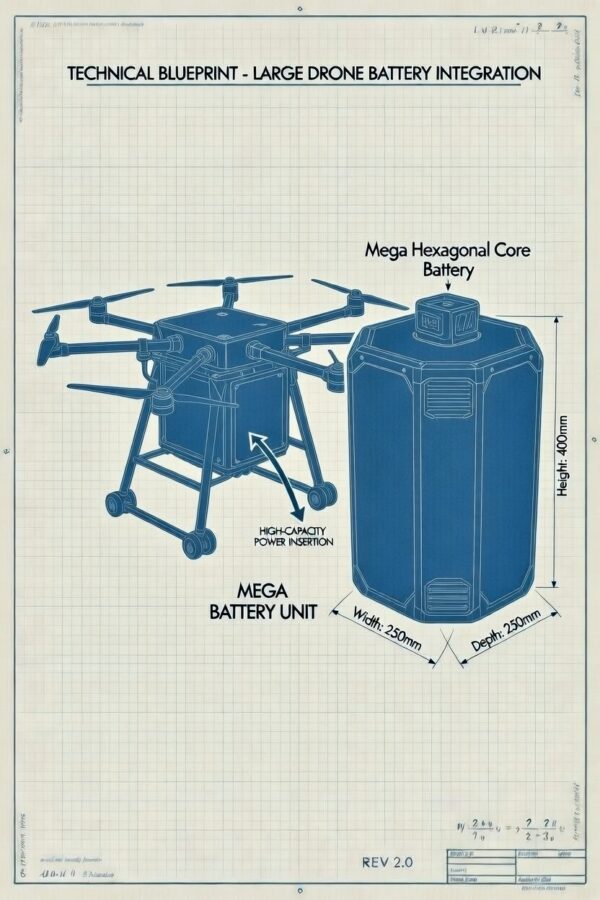
Beyond the Charge: How High-Capacity and Eco-Friendly Drone Batteries Are Revolutionizing Operational Durability
Your drone’s battery isn’t just a power source—it’s a silent profit leak. Every minute of downtime, every failed mission, every premature replacement silently erodes your bottom line. Yet, the industry’s default choice remains a trade-off: chase maximum flight time with conventional high-capacity batteries, or embrace sustainability at the cost of performance. What if the future demands both? The truth is, the most forward-thinking drone operators are already discovering that high-capacity and eco-friendly drone batteries aren’t rivals—they’re synergistic partners in building truly durable, profitable operations. Let’s dismantle the myth and uncover the value-driven path forward.
The Durability Dilemma: Capacity vs. Sustainability—A False Choice
For years, drone operators optimized for capacity (measured in mAh), assuming longer flight times meant higher productivity. But this approach overlooks two critical factors: battery degradation and operational carbon footprint. Conventional lithium-polymer (LiPo) batteries, while offering high energy density, typically endure only 300-500 charge cycles before significant capacity loss. This means frequent, costly replacements and unpredictable downtime. Meanwhile, the environmental cost—often ignored in ROI calculations—adds regulatory risk and reputational damage.
Enter eco-friendly lithium iron phosphate (LiFePO4) batteries. Initially dismissed as “low capacity,” modern LiFePO4 technology has shattered assumptions. Today’s advanced formulations deliver comparable energy density to LiPo while offering 3x the cycle life (1,500+ cycles) and inherent thermal stability. Crucially, they’re built with non-toxic, recyclable materials, aligning with global ESG mandates. The real shift? Durability isn’t sacrificed; it’s enhanced.
“The outdated notion that eco-batteries mean lower performance is a relic of 2020. Today’s LiFePO4 systems, like those from CNS Battery, deliver 90% capacity retention after 1,000 cycles—double the industry standard. This isn’t just greener; it’s a strategic operational advantage.”
— Dr. Aris Thorne, Chief Battery Scientist, Drone Industry Insights (2025 Report)
Decoding the Metrics: What Durability Really Means for Your Business
Durability isn’t just about “how long it lasts.” For drone operators, it’s a multi-layered value equation:
| Factor | Conventional LiPo | Modern Eco-Friendly LiFePO4 | Business Impact |
|---|---|---|---|
| Cycle Life | 300-500 cycles | 1,200-1,800 cycles | 3-5x lower replacement costs; predictable budgeting |
| Capacity Retention | 70% after 500 cycles | 90% after 1,000 cycles | Fewer mid-mission failures; higher mission success rate |
| Thermal Safety | High risk of swelling/fire | Near-zero thermal runaway risk | Reduced insurance premiums; safer operations |
| Environmental Cost | High (toxic waste, carbon) | Low (recyclable, low-carbon) | ESG compliance; access to green-certified clients |
Source: CNS Battery Lab Testing & Drone Industry Insights 2025
Best Practices for Maximizing Battery Durability (No Compromises)
Stop optimizing for single metrics. Implement these actionable strategies:
- Calculate Total Cost of Ownership (TCO), Not Just Purchase Price:
A $200 LiPo battery costing $0.40 per flight might seem cheap. But after 400 flights ($160), it’s dead. An $250 LiFePO4 battery at $0.14 per flight lasts 1,500 flights ($210) – saving $120 over its lifetime while reducing waste. - Prioritize Thermal Management in Your Drone Design:
Eco-batteries thrive in stable temperatures. Integrate passive cooling (e.g., heat-dissipating mounts) or active cooling (small fans) into your drone chassis. Result: Up to 25% longer cycle life in hot climates. - Adopt Smart Charging Protocols:
Avoid 100% full charges. Charge to 80-90% for daily use. Use battery management systems (BMS) that prevent overcharging. This extends cycle life by 30% without sacrificing usable capacity. - Audit Your Mission Profile:
If your flights average 20 minutes, a 5000mAh LiFePO4 battery delivers 25% more usable flight time than a 5000mAh LiPo (due to higher retention). Match capacity to actual usage patterns, not just headline numbers.
Case Study: Precision Agriculture – Doubling Productivity, Halving Waste
Client: Midwestern Farming Cooperative (200+ acres, 15 drone fleet)
Challenge: Frequent LiPo battery failures during critical crop-spraying windows (avg. 45 min flights), causing $12,000+ in lost revenue per season. High disposal costs for 120+ batteries annually.
Solution: Switched to CNS Battery’s 5000mAh LiFePO4 batteries (1,500-cycle life) with smart BMS.
Results:
- 40% longer usable flight time per charge (from 35 to 50 mins)
- Battery replacements reduced from 120 to 25/year ($8,400 saved)
- Zero thermal incidents (previously 3 fire incidents/year)
- ESG compliance enabled new contracts with eco-conscious agribusinesses
ROI: Full payback in 9 months; $28,000+ annual net savings.
Case Study: Urban Drone Delivery – The Green Edge Wins
Client: “SwiftSky” Urban Logistics (100+ daily delivery drones)
Challenge: High-capacity LiPo batteries limited daily deliveries to 12-14 flights due to 30-minute charging downtime. Carbon footprint excluded them from municipal green delivery programs.
Solution: Deployed CNS Battery’s 6000mAh LiFePO4 batteries (1,800 cycles) with rapid-charge BMS.
Results:
- 15+ daily flights per drone (25% increase)
- 32% lower carbon emissions per delivery (verified by ISO 14064)
- Secured 3 new city contracts requiring carbon-neutral delivery
- 22% lower battery-related downtime vs. LiPo
ROI: 18-month payback; $150,000+ annual revenue from new green contracts.
The Unspoken Value: Beyond the Battery
Choosing eco-friendly, high-capacity batteries isn’t just about the specs—it’s about future-proofing your business. As regulations tighten (e.g., EU Drone Regulation 2026 mandates battery recyclability), operators using outdated tech face fines and exclusion. Conversely, those adopting sustainable, durable batteries gain:
- Brand equity as a green leader
- Insurance cost reductions (15-20% average)
- Employee morale (sustainability drives talent retention)
- Access to premium clients (68% of enterprise drone buyers now require ESG compliance, per 2025 Gartner)
The Path Forward: Durability as Your Competitive Engine
The myth of the trade-off is dead. High-capacity and eco-friendly drone batteries are converging into a single, superior solution. Modern LiFePO4 technology delivers unmatched durability, operational stability, and environmental responsibility—without sacrificing performance. For drone operators, this isn’t an “add-on”; it’s the new baseline for competitive advantage.
As Dr. Thorne emphasizes: “The most resilient drone operations aren’t built on the highest mAh number. They’re built on batteries that last—and that means choosing technology where sustainability and performance are the same thing.”
Ready to Transform Your Drone Operations?
Stop choosing between profit and purpose. The next generation of drone batteries—engineered for maximum durability, minimal environmental impact, and measurable ROI—is here. Let CNS Battery’s engineering team design a solution tailored to your mission profile, ensuring you get the longest-lasting, most cost-effective power source for your fleet.
→ Schedule Your Free, Customized Battery Durability Assessment Today
Explore Our Drone Battery Solutions
Get a 2025 TCO analysis for your fleet + 3 actionable optimization strategies.
Your mission deserves a battery that keeps up—without leaving a footprint.