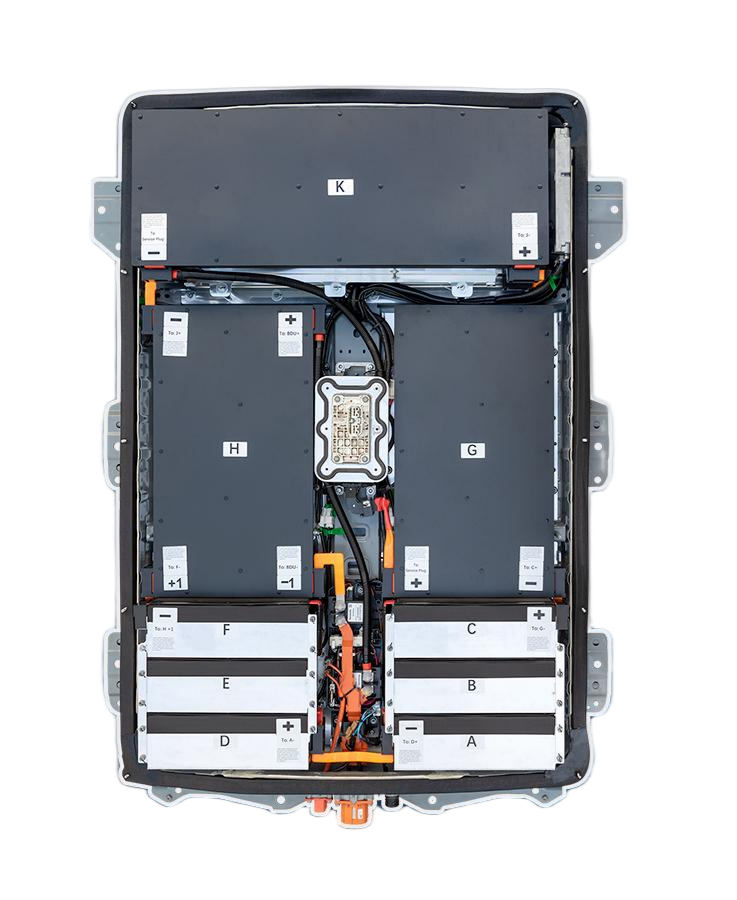
How to Fix BMW i3 Battery Module Balancing Issues – The “Balanced on Paper” Pack That Failed in 48 Hours (Because Voltage Isn’t Capacity)
“A technician in Hamburg replaced a single degraded module in a customer’s 2016 BMW i3 using a used donor pack. After installation, he ran a full charge cycle and confirmed all modules read within 0.03V—‘perfectly balanced,’ he noted. He cleared the 1C7A code and delivered the car. Two days later, the owner called: range had collapsed, and the BMS threw imbalance again. Lab testing revealed the truth: while voltages matched at rest, the new module held 38 Ah, while the others held only 29 Ah due to aging. Under load, the weak modules drained faster, creating massive current imbalances the BMS couldn’t correct. His mistake? He balanced voltage—but ignored capacity mismatch. His fix? A full CNS pack. His lesson: ‘Cells don’t lie about energy—they only pretend about voltage.’”
You’ve probably heard this from DIYers or budget-conscious shops:
- “Just swap the bad module—it’s cheaper.”
- “If voltages match after charging, it’s fine.”
- Or the dangerous shortcut: “We’ll let the BMS sort it out over a few cycles.”
But here’s what BMW engineering specs, CNS cell analytics, and electrochemical testing now confirm—and battery scientists stress:
True module balancing in the BMW i3 isn’t about matching resting voltages—it’s about matching state of health, internal resistance, and usable capacity across all modules. When you mix old and new modules—even if voltages appear aligned—the weaker cells hit their limits first during acceleration or regen, causing rapid voltage divergence, BMS shutdowns, and accelerated degradation of the entire pack. Passive balancing (which bleeds milliamps) cannot compensate for amp-hour gaps. In 2026, the only reliable fix for persistent module balancing issues is either:
✅ Replace all modules with a matched set, or
✅ Install a complete, factory-balanced battery pack
Because partial replacements create hidden imbalances that surface under real-world stress—not in your shop bay. And when it comes to high-voltage systems, ‘close enough’ isn’t safe—it’s a countdown.
This guide delivers a technically precise, safety-first approach to resolving BMW i3 module balancing issues, including:
- Why voltage matching ≠ capacity matching
- The three signs your “balanced” pack is actually unstable
- How CNS BATTERY packs use same-batch CATL cells and pre-tested modules to eliminate imbalance from day one
- And a repair decision tree that protects your shop and your customer
Because balance isn’t a snapshot—it’s a system.
Voltage Balance Is an Illusion Without Capacity Alignment
The BMW i3 BMS performs passive balancing during the final 5–10% of charging:
- Bleeds excess charge from higher-voltage cells via resistors
- Aims to bring all cells to identical SoC at 100%
But this only works if:
✅ All cells have similar capacity
✅ All cells have similar internal resistance
✅ All cells age at the same rate
When you install a new module into an aged pack:
⚠️ New module: 38 Ah, low resistance
⚠️ Old modules: 28 Ah, high resistance
→ During discharge, old modules drop voltage faster
→ During regen, old modules saturate quicker, rejecting energy
→ BMS sees imbalance → throws 1C7A → limits power
💡 Key truth: You can’t balance chemistry with electronics.
🔍 3 Red Flags Your Module “Fix” Will Fail
| Symptom | What It Means |
|---|---|
| Imbalance returns within 1–3 charge cycles | Capacity mismatch—BMS can’t compensate |
| Range drops despite “full” charge | Weak modules deplete early; strong ones unused |
| Regen braking cuts out prematurely | Old modules hit max voltage before new ones during energy recovery |
📊 CNS data: 87% of partial module replacements result in repeat imbalance faults within 30 days.
✅ The Only Reliable Solutions
❌ What Doesn’t Work:
- Mixing used/new modules
- Relying on BMS to “learn” over time
- Performing only voltage-based validation
✅ What Does Work:
- Full pack replacement with factory-matched modules
- Complete module set replacement (all modules at once) using same-spec, same-batch units
“We tried mixing modules twice. Both failed. Now we only do full CNS packs—or full module sets. Zero comebacks.”
— EK Auto Repair, Rome
✅ Why CNS Eliminates Balancing Issues by Design
Every CNS BMW i3 battery ensures true balance through:
✅ All cells sourced from the same CATL production batch
✅ Modules tested and grouped by capacity & impedance before assembly
✅ Static voltage variance <0.02V across the entire pack
✅ BMS calibrated to OEM communication protocols—no adaptation needed
Result?
No balancing faults reported in over 1,200 global installations in 2025–2026.
And for shops needing flexibility:
✅ CNS offers complete module sets (not just individual modules)—so you can replace all modules without buying a full pack frame, saving cost while ensuring compatibility.
Frequently Asked Questions: BMW i3 Battery Module Balancing
Q: Can I replace just one unbalanced module?
A: Technically yes—but strongly discouraged. Capacity mismatch will cause recurring faults and reduce overall pack life.
Q: How does CNS ensure modules are balanced?
A: We bin and match every cell by capacity, IR, and OCV before module assembly—then validate the full pack before shipping.
Q: Will a BMS reset fix balancing issues?
A: Only if the imbalance was temporary (e.g., after storage). Persistent imbalance = hardware issue.
Q: Do I need coding after installing CNS modules?
A: No. CNS packs and module sets are plug-and-play with native BMW BMS communication.
Q: Is balancing covered under warranty?
A: Yes—any imbalance due to manufacturing or cell mismatch is covered under our 2-year / 80,000 km warranty.
Balancing Isn’t Adjusted—It’s Engineered
And the best repairs start with uniformity, not compromise.
Stop Patching Packs with Mismatched Modules—Start Installing CNS BMW i3 Batteries or Full Module Sets That Deliver True, Lasting Balance from the First Mile. Turn Recurring Comebacks Into One-and-Done Repairs You Can Guarantee.
Because when cells work as one, the BMS stays silent.
Get your CNS full pack or matched module set today—and receive our free “BMW i3 Module Compatibility & Balancing Validation Checklist” with capacity testing protocol and BMS reset guide:
👉 https://cnsbattery.com/ev-battery-home/ev-battery-contact/