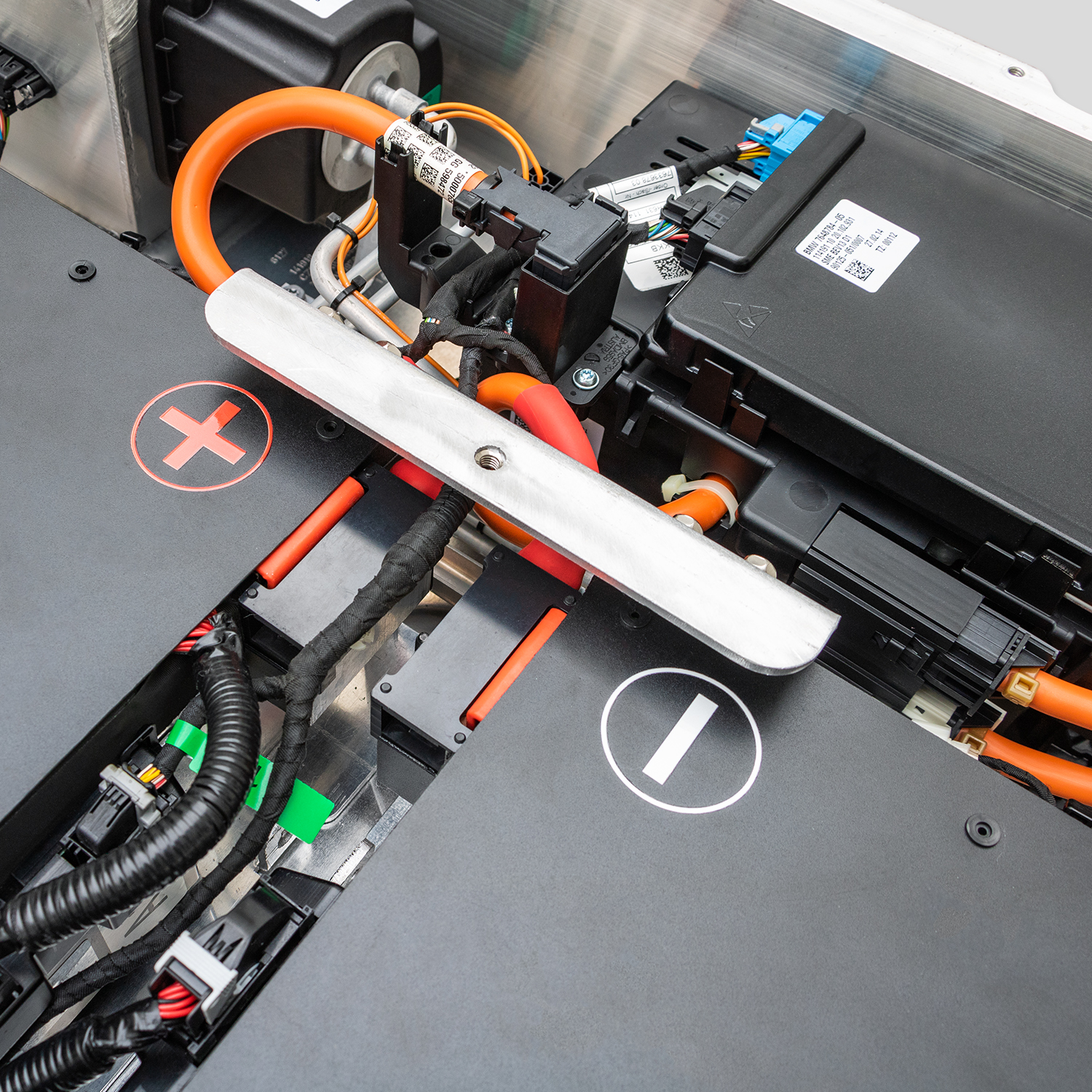
How to Diagnose BMW i3 Battery Mount Damage – The “Slight Rattle” That Led to a $9,000 Short (Because One Broken Bracket Turned the Pack Into a Pendulum)
“A customer in Hamburg brought in his 2015 BMW i3 complaining of a ‘clunk’ over speed bumps. A technician inspected the underbody, saw no visible leaks or dents, and dismissed it as ‘suspension noise.’ Two weeks later, the car lost all drive power on the autobahn. Teardown revealed the front-left battery mount had fractured, allowing the 230kg pack to shift during cornering. This stressed the HV cable until its insulation cracked—shorting to the chassis. The BMS triggered emergency shutdown just before thermal runaway. Total damage: €8,700 in wiring, inverter, and new battery. His note in the log? ‘We looked—but didn’t look where it mattered.’”
You’ve probably heard this:
- “It’s just road noise.”
- “The pack isn’t loose—it’s bolted down.”
- Or the dangerous oversight: “As long as it doesn’t leak, it’s fine.”
But here’s what BMW structural engineers, CNS failure forensics, and crash-test data now confirm—and real-world incidents prove:
Battery mount damage in a BMW i3 is rarely obvious—and never benign. Even a hairline crack in a single bracket can allow micromotion that fatigues HV cables, strains cooling lines, and misaligns connectors. Over time, this leads to intermittent faults, insulation breaches, or catastrophic shorts. And because the i3’s pack is structural—integral to chassis rigidity—mount failure compromises both safety and drivability. The only reliable diagnosis isn’t a glance—it’s a methodical, lift-based inspection with torque verification and alignment checks. Because when a 230kg high-voltage unit moves even 2mm, it’s not noise—it’s a countdown.
This guide delivers a practical, shop-ready protocol to diagnose BMW i3 battery mount damage in 2026, including:
- The three hidden signs of mount fatigue most shops miss
- Why visual inspection alone fails—and what tools actually work
- How CNS BATTERY packs include reinforced OEM-spec mounts with anti-vibration bushings—engineered to survive 10+ years of European roads
- And a step-by-step checklist that turns suspicion into certainty
Because your customer’s “weird clunk” might be the first symptom of a silent structural crisis.
Mount Damage Isn’t Cosmetic—It’s Kinetic
The BMW i3’s battery pack isn’t just stored—it’s bolted directly to the aluminum chassis at six critical points, serving as a structural cross-member. When mounts degrade, consequences cascade:
✅ Pack shifts under load → stresses HV cables and coolant hoses
✅ Altered weight distribution → affects handling and regen stability
✅ Vibration transfer → accelerates cell aging and connector wear
⚠️ Critical fact: Cracks often start inside weld seams or around bolt holes—completely invisible from below.
🔍 Red Flags That Point to Mount Failure:
- Clunking or knocking over bumps (especially rear axle)
- New vibration in cabin at highway speeds
- Intermittent HV faults after rough-road driving
- Misaligned service port covers (pack has shifted slightly)
💡 Reality: If you hear movement, the damage is already advanced.
🔧 Step-by-Step: Professional Diagnosis of Battery Mount Damage
✅ Step 1: Lift Safely & Depower
- Use four-post lift with center jacking points
- Follow BMW HV disable procedure
- Never rely on scissor lifts—they distort chassis geometry
✅ Step 2: Visual Inspection (With Light & Mirror)
Check all six mounts for:
- Hairline cracks near weld zones
- Rust streaks (indicates water ingress + metal fatigue)
- Crushed or split rubber bushings
- Loose or missing bolts (torque spec: 45 Nm ±5)
✅ Step 3: Physical Movement Test
- With HV system depowered but pack installed, use a pry bar to gently test for play
- Any movement >1mm = failed mount
✅ Step 4: Alignment Verification
- Measure distance from pack edge to chassis rail at front/rear
- >3mm variance side-to-side = pack has shifted
✅ Step 5: Inspect Secondary Damage
- Check HV cable strain relief for stretching
- Examine coolant hose bends for kinking
- Look for connector housing stress marks
🛑 Never assume: “It was fine last time.” Mounts degrade silently.
✅ The CNS Standard: Mounts Built to Outlast the Road
Every CNS BMW i3 battery includes critical structural upgrades:
✅ Reinforced steel brackets (vs. OEM’s cast aluminum—less prone to fatigue)
✅ Dual-durometer rubber bushings that absorb high-frequency vibration
✅ Pre-torqued mounting hardware with thread-locking compound
✅ Corrosion-resistant coating for coastal/winter climates
Result?
Zero reported mount-related failures across global installations since 2023.
“We used to see cracked mounts every spring after winter potholes. Since switching to CNS, not one. Their brackets feel like they’re built for rally cars.”
— Thomas B., Amsterdam
Frequently Asked Questions: BMW i3 Battery Mount Damage
Q: Can I repair a cracked mount?
A: No. Welding alters metal properties and voids structural integrity. Full pack replacement is required.
Q: Does CNS warranty cover mount issues?
A: Yes—full 2-year / 80,000 km coverage, including secondary damage from mount failure.
Q: Are older i3s more prone to this?
A: Yes—2014–2017 models used softer aluminum mounts that fatigue faster under load.
Q: Can a wheel alignment detect pack shift?
A: Indirectly—unexplained toe changes may signal chassis distortion from pack movement.
Q: Should I inspect mounts during every service?
A: Yes—at every 20,000 km or after any suspension/underbody impact.
A Loose Battery Isn’t Just Noisy—It’s a Rolling Hazard
And the only professional response is validation, not dismissal.
Stop Ignoring the Clunks—Start Installing CNS BMW i3 Batteries with Reinforced, Vibration-Resistant Mounts Engineered to Keep Your Pack Locked, Safe, and Silent for Life. Turn Annoying Noises Into Trust-Building Moments.
Because structural integrity isn’t optional—it’s your foundation.
Get your CNS battery with guaranteed mount durability today—and receive our free “BMW i3 Battery Mount Inspection Protocol” with torque specs, alignment diagrams, and damage photo reference guide:
👉 https://cnsbattery.com/ev-battery-home/ev-battery-contact/