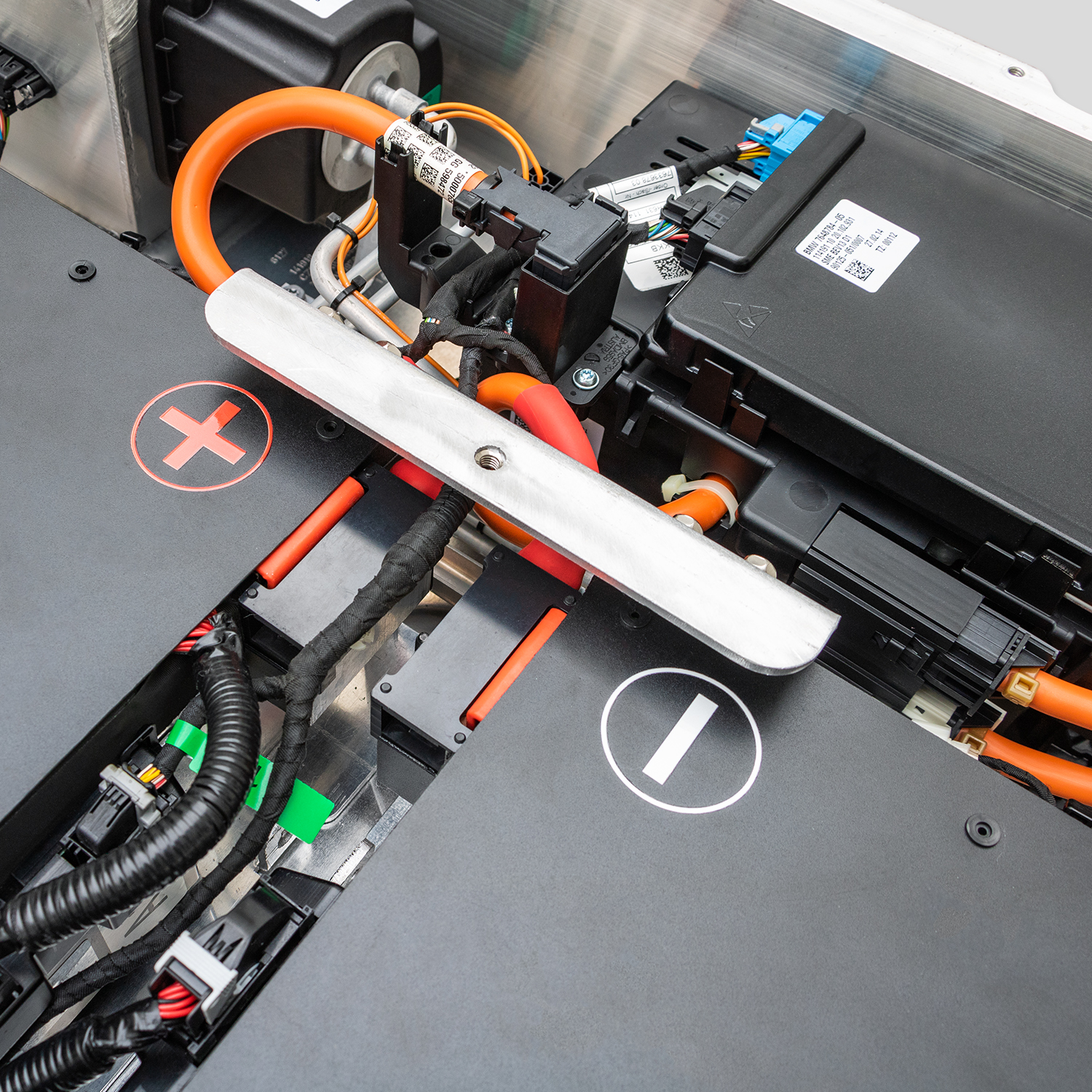
How to Fix BMW i3 Battery Module Failure – The “DIY Cell Swap” That Killed a Pack (Because Replacing One Module Can Unbalance the Whole System)
“A technician in Barcelona diagnosed a failed module in a 2017 BMW i3 showing only 8 of 12 capacity bars. To save the customer money, he sourced a used module from an online auction, installed it alongside three original—but degraded—modules, and rebalanced the pack with a third-party BMS tool. The car drove fine for 11 days. On day 12, during highway regen braking, the mismatched modules overheated. The BMS triggered emergency shutdown—and permanent isolation. Total cost to the customer: €8,400 for a full new pack. The shop’s lesson? ‘I fixed one cell and broke the whole orchestra.’”
You’ve probably considered this path:
- “Just replace the bad module—it’s cheaper than a full pack.”
- “Used OEM modules are identical, right?”
- Or the dangerous belief: “As long as voltage matches, it’ll work.”
But here’s what battery engineers, BMW service data, and CNS failure analysis now confirm—and real-world teardowns prove:
BMW i3 battery packs are tightly coupled electrochemical systems, not Lego sets. Mixing modules—even from the same model year—creates capacity, impedance, and aging mismatches that accelerate degradation, trigger false BMS faults, and risk thermal runaway. A single “repaired” module can destabilize the entire pack within weeks. And because the i3’s BMS monitors cell-level behavior across all modules, imbalance isn’t just inefficient—it’s unsafe.
This guide delivers a science-backed, safety-first approach to handling BMW i3 battery module failure in 2026, including:
- Why module-level repair is rarely viable in production environments
- The three hidden risks of mixing old and new modules
- How CNS BATTERY offers both full packs and matched-module kits—factory-balanced and tested as a complete system
- And a shop protocol that protects your customers and your reputation
Because when one module fails, the real question isn’t “Can I replace it?”—it’s “Should I?”
Module Failure Isn’t Isolated—It’s a Symptom of Systemic Aging
The BMW i3 uses 96 pouch cells arranged in 8–12 modules (depending on kWh). These modules degrade together due to:
✅ Shared thermal environment
✅ Identical charge/discharge cycles
✅ Common current paths
When one module fails early, it usually signals:
- Manufacturing defect (rare after 2+ years)
- Localized cooling failure
- Or most commonly—the entire pack is nearing end-of-life, and one module crossed the failure threshold first
⚠️ Critical insight: Replacing only the failed module creates a “young-old” hybrid pack. The new module charges faster, discharges slower, and forces the BMS into constant correction—increasing stress on all cells.
🔍 Hidden Dangers of Partial Replacement:
- Increased internal resistance mismatch → heat buildup during regen
- State-of-charge drift → inaccurate range prediction
- Premature failure of adjacent modules → cascading damage
💡 Reality: BMW does not support or warranty partial module replacement. Neither do insurers.
🔧 Step-by-Step: Professional Response to Module Failure
✅ Step 1: Confirm True Module Failure
- Use ISTA+ or capable scanner to read individual module voltages at rest
- >0.5V difference between any two modules = imbalance
- Perform load test: monitor voltage sag under controlled discharge
✅ Step 2: Assess Pack-Wide Health
- Check total State of Health (SoH)
- If <75%, the entire pack is degraded—module replacement is futile
- Review cooling system integrity (leaks accelerate localized failure)
✅ Step 3: Choose the Right Solution—Not the Cheapest
| Scenario | Recommended Action |
|---|---|
| Single module failure + SoH >85% | Replace with factory-matched module set (not one-off) |
| Any module failure + SoH <80% | Full pack replacement |
| Multiple weak modules | Full pack replacement |
🛑 Never install a single used or unmatched module.
✅ The CNS Solution: Precision-Matched Modules or Complete Packs—Engineered as One System
CNS understands shops need flexibility—but never at the cost of safety. That’s why we offer two certified paths:
🔹 Option 1: Full Battery Pack (45/50/62kWh)
- All modules built in the same batch, same CATL cells
- Pre-balanced to <0.05V variance
- Plug-and-play with zero BMS adaptation
- 2-year / 80,000 km warranty
🔹 Option 2: Complete Module Kit (All Modules Together)
- For shops that prefer in-house assembly
- Includes 4 pre-matched modules (for 45kWh i3)
- Each kit tested as a full system before shipping
- Comes with wiring harnesses, mounting hardware, and torque specs
📌 Key advantage: No mixing. No guessing. Just balanced performance from day one.
“We tried partial swaps once. Never again. Now we either do a full CNS module kit or a full pack. Our comeback rate? Zero.”
— Lisa K., Berlin
Frequently Asked Questions: BMW i3 Module Failure
Q: Can I test individual cells inside a module?
A: Technically yes—but pouch cell probing risks puncture and fire. Not recommended outside lab settings.
Q: Are CNS modules compatible with older i3 models (2014–2016)?
A: Yes—we match physical dimensions, connector types, and communication protocols for all i3 generations.
Q: What’s the weight of a CNS module kit?
A: For 45kWh: Modules A–C: 65kg each; Module D: 72kg—identical to OEM for safe handling.
Q: Do I need special tools to install modules?
A: Basic EV-safe tools (insulated wrenches, torque driver) suffice. We provide full installation videos and wiring diagrams.
Q: Can I reuse the old BMS board?
A: No. CNS packs include an integrated, calibrated BMS. Reusing old hardware voids safety and warranty.
Fixing One Module Might Save €1,000 Today—But Cost €8,000 Tomorrow
And your customers trust you to see the whole picture—not just the broken piece.
Stop Playing Russian Roulette with Mixed Modules—Start Installing CNS BMW i3 Battery Solutions Engineered as Complete, Balanced Systems. Whether You Choose a Full Pack or a Full Module Kit, Every Component Works in Harmony from the First Charge.
Because reliability isn’t built one module at a time—it’s designed as one unit.
Get your factory-matched CNS battery solution today—and receive our free “BMW i3 Module Failure Decision Guide” with voltage thresholds, SoH benchmarks, and safe handling checklist:
👉 https://cnsbattery.com/ev-battery-home/ev-battery-contact/