
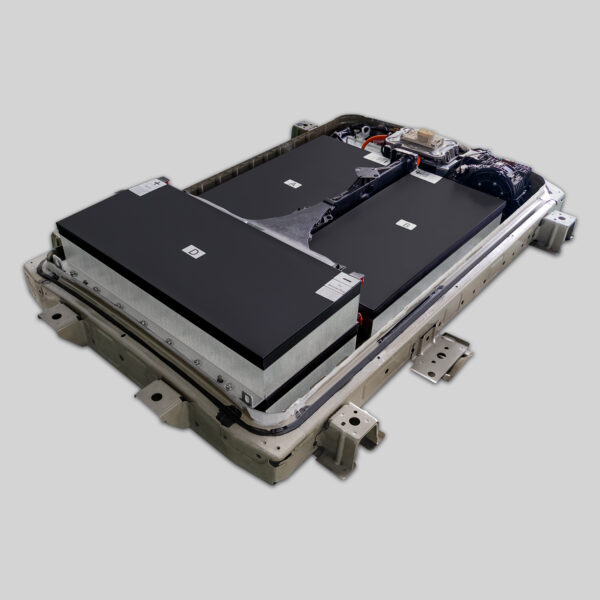
Why the BMS Data Stream is Critical for Leaf Battery Longevity
For Nissan Leaf owners, the Battery Management System (BMS) is often misunderstood. Many view it simply as a “fuel gauge” for the battery. However, in the complex world of lithium-ion chemistry, the BMS is the true guardian of longevity. At CNS BATTERY, we often see customers who focus solely on capacity (kWh) or brand-new cells while overlooking the critical role of the BMS data stream. This oversight can lead to premature degradation, even with a brand-new pack.
This article will explain why the BMS data stream is the most critical factor in ensuring your Nissan Leaf battery lasts for years, not months.
Understanding the BMS: The Brain of the Battery
Before diving into the data stream, let’s define what the BMS actually is. The BMS is a sophisticated electronic system that monitors and manages the state of the lithium-ion battery pack. It is responsible for:
- Cell Balancing: Ensuring all individual cells charge and discharge at the same rate.
- Thermal Management: Monitoring temperature to prevent overheating or overcooling.
- State of Charge (SoC): Calculating how much energy is left.
- State of Health (SoH): Calculating the overall health and degradation of the pack.
The “data stream” refers to the continuous flow of information from the sensors within the battery pack to the BMS computer, and then to the vehicle’s dashboard and diagnostic systems. If this data stream is inaccurate, delayed, or corrupted, the BMS cannot perform its protective functions effectively.
The Hidden Danger of Inaccurate Data
Imagine driving a car with a broken speedometer and temperature gauge. You would likely over-rev the engine or overheat the vehicle simply because you lacked the information to drive safely. The same principle applies to your Leaf’s battery.
If the BMS data stream does not accurately reflect the real-time voltage of each cell, the BMS might allow some cells to overcharge while others remain undercharged. This imbalance is the primary cause of lithium plating and thermal runaway, which drastically shortens the life of a lithium-ion battery.
How the BMS Data Stream Prevents Degradation
The BMS data stream acts as a protective shield through several key mechanisms:
1. Precision Cell Balancing
Lithium-ion batteries are made up of hundreds of individual cells connected in series and parallel. No two cells are exactly identical. The BMS data stream constantly monitors the voltage of each cell. If one cell reaches 4.2V (fully charged) while others are at 4.1V, the BMS must know this instantly. A high-quality BMS, like those used in CNS BATTERY packs, uses this data to shunt current away from the higher-charged cells, ensuring they all finish charging simultaneously. Without this precise data stream, cells go out of balance, leading to “weak links” that degrade the entire pack.
2. Preventing Deep Discharge
The BMS data stream monitors the State of Charge with extreme precision. When the data indicates the SoC is reaching a critical low (usually around 3%), the BMS must send a signal to the car to cut power. If the data stream lags or is inaccurate, the battery might be allowed to discharge below 2.5V per cell. This is catastrophic; it causes irreversible chemical damage and can render the cell useless.
3. Thermal Runaway Prevention
The data stream includes temperature readings from sensors placed throughout the battery pack. If the BMS detects a “hot spot” via this data, it can reduce the charging current or cut power entirely. Inaccurate temperature data is a leading cause of fires in poorly manufactured EV batteries.
The CNS BATTERY Advantage: Data Integrity
At CNS BATTERY, we understand that brand-new cells are only half the battle. If the BMS firmware does not interpret the data correctly, the battery will fail prematurely. This is why we utilize BMS technology that is fully compatible with Nissan Leaf protocols.
Our engineering team has spent thousands of hours reverse-engineering and validating the communication protocols between the battery cells and the Leaf’s Vehicle Control Unit (VCU). We do not use generic BMS units. Instead, we use proprietary algorithms that ensure the data stream flowing from our battery to your dashboard is 100% accurate. This means your Leaf will never “see” a difference between our pack and an OEM Nissan pack.
Real-World Impact: Warranty and Longevity
The proof of a reliable BMS data stream is in the warranty. Many competitors offer short warranties (6-12 months) because they know their BMS cannot maintain cell balance over time. CNS BATTERY offers an industry-leading 2-year / 80,000 km warranty. We can do this because our BMS data stream ensures the cells remain balanced and protected throughout the warranty period.
Conclusion
When shopping for a Nissan Leaf battery replacement, do not be fooled by high capacity numbers alone. The true measure of a battery’s longevity lies in the silent, invisible flow of data within the BMS. Choosing a battery with a robust, accurate BMS data stream is the only way to ensure you get the maximum lifespan from your investment.
If you are looking for a Nissan Leaf battery that prioritizes data integrity and long-term reliability, contact CNS BATTERY today.
Contact Us for a Free Quote
Click here to get your customized Nissan Leaf battery solution
Frequently Asked Questions (FAQ)
Q1: What happens if the BMS data stream is interrupted?
A: If the BMS data stream is interrupted, the system defaults to a “safe mode,” usually cutting power to the vehicle to prevent damage. This results in the car shutting down unexpectedly. In less severe cases, an interrupted data stream means the BMS cannot balance the cells, leading to rapid degradation and a significantly shorter battery life.
Q2: Can I install an aftermarket battery without reprogramming the BMS?
A: Generally, no. For safety and performance reasons, the BMS must be programmed to match the specific chemistry and configuration of the new cells. Generic or unprogrammed BMS units often fail because they use incorrect parameters (like the wrong voltage cutoff points) for your specific battery chemistry.
Q3: How does CNS BATTERY ensure the BMS data is compatible with my Nissan Leaf model?
A: We perform a VIN compatibility check before manufacturing. Our technical experts match the BMS firmware to your specific Leaf model (ZE0, ZE1, or AZE0) to ensure the data stream communicated to your car’s dashboard is perfect. This is part of our pre-sale service to guarantee a plug-and-play experience.

